Readings
A Performer’s Call and Calling Numbers
Justene Williams
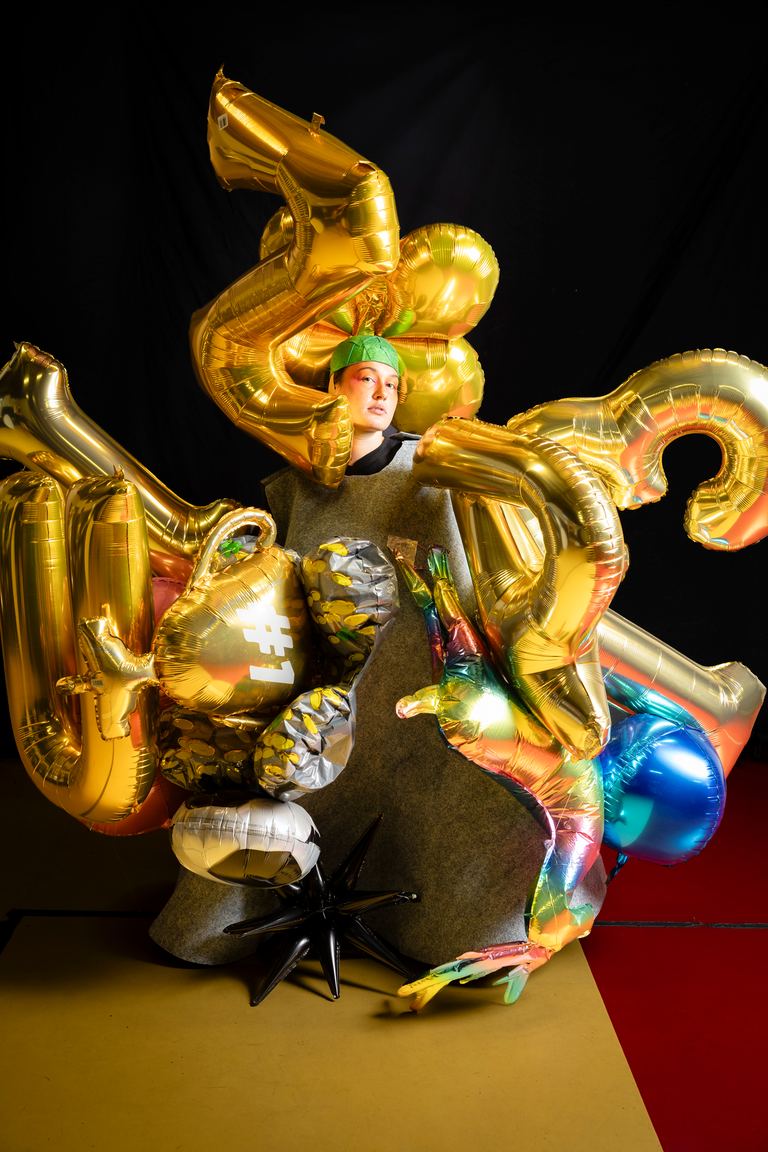
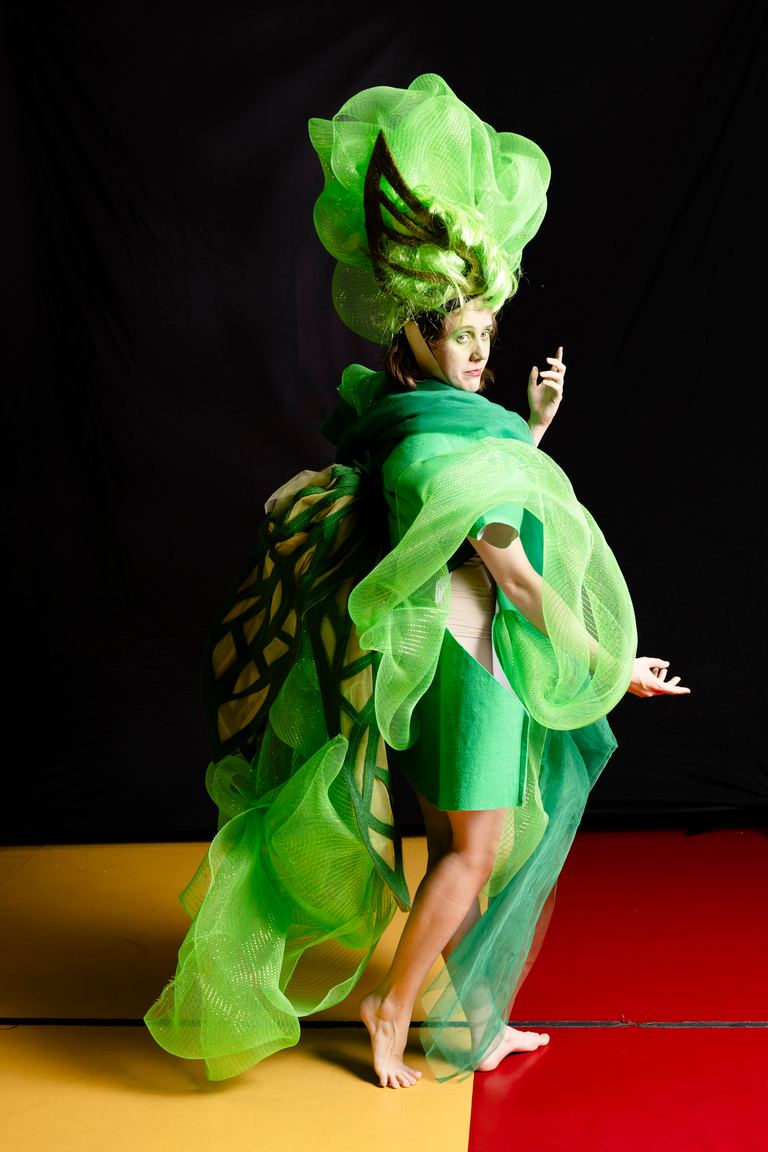
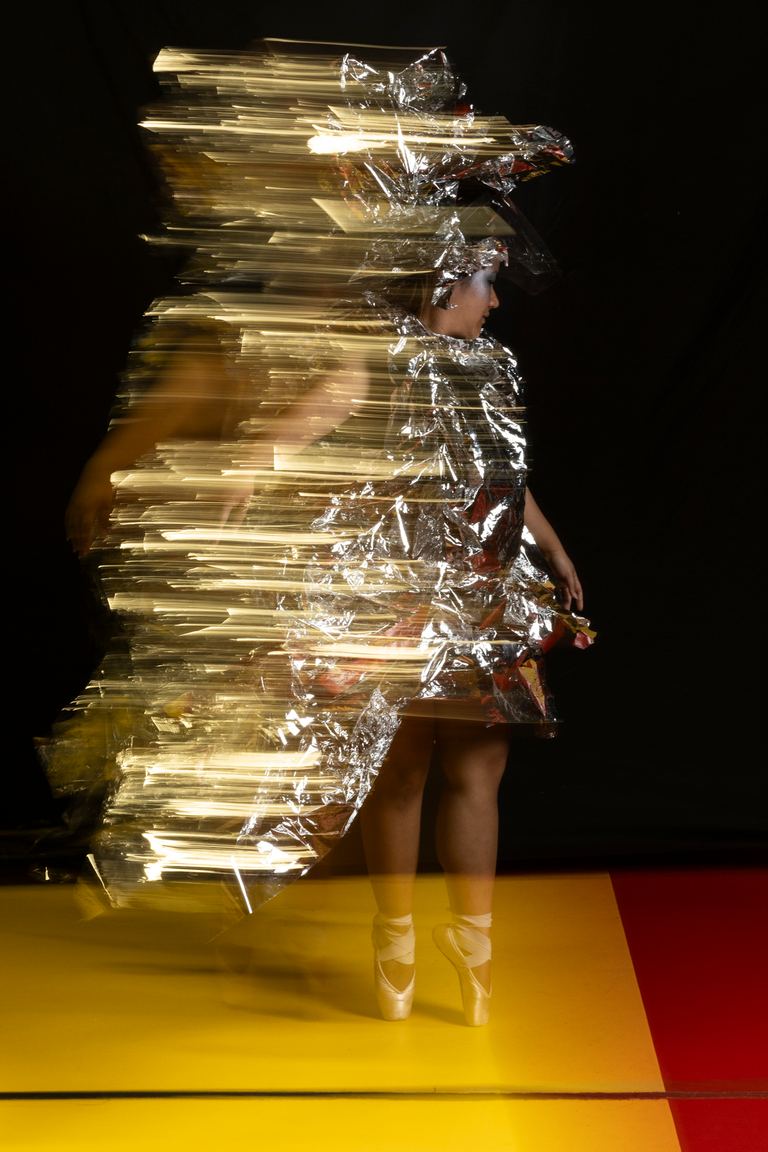
The brief was to respond to objects in the vast Powerhouse Museum collection. I think tangentially and love finding new objects and histories, so for me it was both a treasure trove and a rabbit hole where I found myself lost in everythingness.
Even so, a few objects drew me in straight away.
I was most drawn to the ‘Multiwave Oscillator’. That homemade device with its blue-green geometric seventies wallpaper, painted door, and homemade look of chalkboards and power cords. It had a connection for me to an actual event that happened after a funeral, where my mother tried to hotstart her old ute. This desperate act spoke to me in terms of restarting the world, a relationship, a museum and things.
Then there is a utilitarian black and red plate by El Lissitzky (1923), made while the artist was recovering from illness. He reluctantly began applying his abstractions, informed by PROUN (Project for the Affirmation of the New), to everyday objects. In the performance, the plate becomes the catalyst for a moment of concrete poetry (after Kurt Schwitters Ur Sonata). The stuttering speech expresses the conservator’s inability to say New, which then becomes No, and opposing ideas. Then the plate transitions to a car wheel for Jonathan Yung’s song Cars on the Street.
The collection objects all have numbers. There are over 500,000 of them. The El Lissitzky plate is 2003/137/1. The Russian cosmonaut Gennady Manakov’s spacesuit – which is also a character in the performance – actually went to space and back, and is 94/65/1. Read out aloud, the collection becomes an inventory. But numbers also make things feel infinitesimal, one speck among half a million, almost meaningless. Something someone made by hand, wore into orbit, or wired together in a shed becomes a code. Our device of speaking the numbers aloud comes from Philip Glass’ 1976 opera Einstein on the Beach, in which the chorus sings numbers. I wanted to do something similar with the collection: count it, chant it and call it out, until the inventory starts to sound like a song, or a spell.
The museum collection resonates with the ensemble, mainly young, emerging actors and dancers from Western Sydney. Working with them has been rewarding and engaging. One classically trained ballet dancer was balancing a day job with rehearsals. The sound of Tiana’s nails tapping on her phone inspired a dance scene in which she is absorbed in her own image and phone conversations. Taylor’s speciality, burlesque, is explored in Jessie Walsh’s Can’t Get Enough Radio, where decommissioned umbrella sculptures from an earlier show of mine return as set pieces.
Alongside Tiana, Tammy, Taylor Marie, Michael and Nathan are people I have worked with several times before - Nico and Billee. I value the shorthand we share, the way they understand my practice and how the work should look and move. When I work with people in performance, I try to find their speciality, their strength, and present it within the work, so each person can show their best self. Everybody is different and that should be explored in the performance.
This is the first time I have put my own body into one of my long-format, multi-performer works. I need to be in the work. The belly. The heal. The feel. The metal of the shed, the metal in the tap dance.
I see my body as breaking the fourth wall. It stops the work from being entirely theatrical. I think of performance art in the broadest terms possible ranging from dance, song, improvisational movement, being bored and unsure of what to do next, as in my recent Making Do Rhymes with Poo seven day working week performances. In live art, I want to show myself plainly, well, kind of. I am both inside and outside my performances, going about my business in the gallery, or here in the performance space. I pick up after others and pull props out into the performing area for the other performers. In that way I’m doing what I would do in rehearsal: negotiating and prompting through movement, action and speech. Bodies in space.
I tend a slowly melting block of ice. I cut it backstage before the show opens so it looks like something I would make in the studio. Once the audience arrives, I am meant to be The Ice Sculptor, but really, it’s a version of me who chamfers and massages material in the studio suggesting ordinary labour versus character.
Then there is the Goat character. I put on the mask, and the Goat drags and carries The Collection on its body behind it. What does it mean to pull something from behind? What does it mean to drag your body, to drag your feet in movement? Dragging a bundle of freshly cut bay leaves like an enormous sage stick? The bay branches sweep the floor of the Tarkett and cleanse it. I always was fascinated by staff on international flights who would go through and spray the cabin with some kind of bug killer; I imagined it was Evian refreshing us all and have used this ritual in other performances to get rid of the bugs and cleanse us.
I am tired, my body is tired. This physical logic is carried through in the work in the idea of a machine that won’t quite start. The modernist dream of continually moving forward is shifted back a gear. A goat dragging its feet and The Collection. An artist that picks up the performers’ costumes when they strip them off in a heap.
Different characters carry different physical logics. I imagined the ensemble moving with repetition, not glamorous but domestic. Held breaths, like a stalled ignition, trying and trying again, failing again better. Like a stubborn lawnmower. Cranking, priming, choking, flooding, stop, stall, pause, pull again. Like small engine actions, abstracted and slowed until they become a gesture.
The daughter character is the only one who doesn’t move repetitively; her walk is pedestrian, unhurried, domestic. She steps over leads and bodies with the mild practicality of someone crossing their studio floor. No grief, no reverence. Just doing.
The weight of things. The cardboard objects, flat. The crash, the wreck. The Ice sculpture, the Crystal Whisperer, the melt. Nothing lasts, not performance, not objects, not people, not art, not ideas.