Readings
An isle full of noises
Anthony Gardner
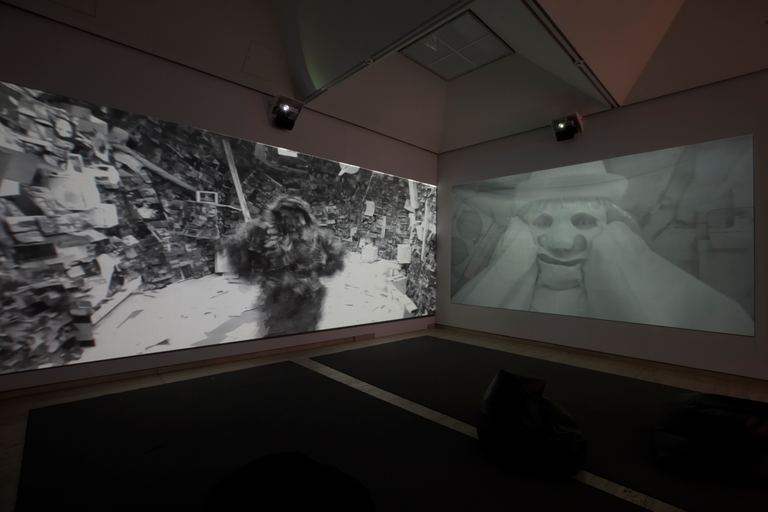
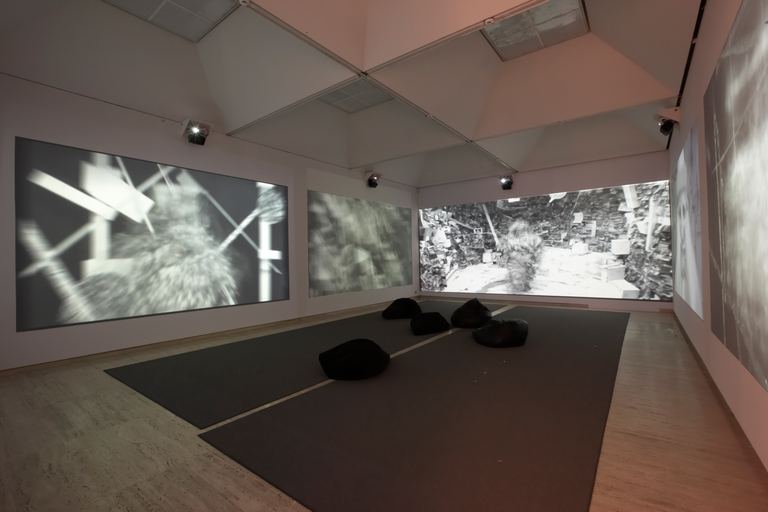
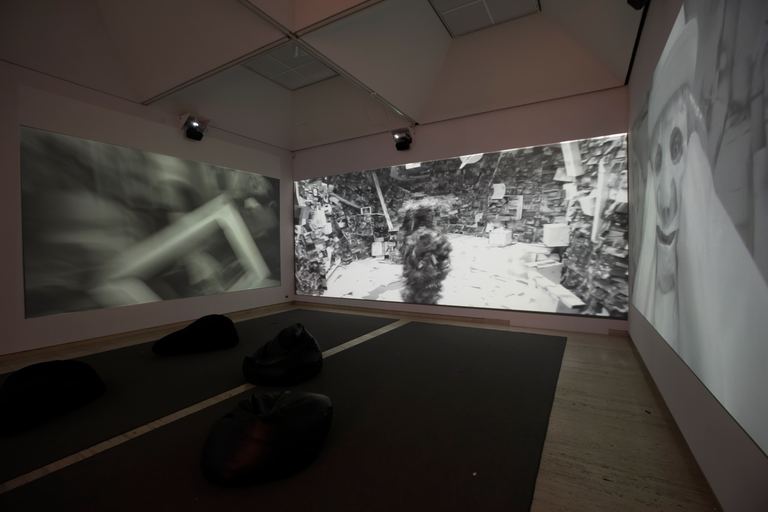
5 February 1916: A cold winter’s night in Central Europe. As the tempest of the Great War seethes outside the borders of neutral Switzerland, a new Zurich nightspot called the Cabaret Voltaire officially opens for business. This is not a long-running club; its survival will last a mere six months before it shuts its doors. Yet over the course of these six months, in this brief oasis from the bitterness of winter and the hellishness of war, European modernism will undergo a significant change of direction. In lieu of the cool deliberations of German expressionist painting popular at the time, the Cabaret will host a carnival of men and their anti-art antics. Sound poetry that verges on aural nonsense will flit between bizarrely costumed performances of strangely machinic dances. A chaos of shouting and fighting will mix with anti-war rhetoric and über-boozy machismo. In the process, one of 20th-century Europe’s greatest cultural movements will emerge from this momentary madcap hangout, developing branches from Zurich to Berlin to Paris to New York to become art’s first truly international movement: the avant-garde phenomenon known through the babble of dada.
Many of dada’s founding fathers now rank among the most celebrated European artists of the 20th century, with such figures as Hans Arp, Hans Richter and Oskar Schlemmer impossible to ignore in the modernist art canon. For the women in the movement, however, art history has been a much less generous advocate. Precious few records of their work have survived into the 21st century: Emmy Hennings’ co-creation of the Cabaret is invariably ignored in the interests of her partner Hugo Ball; Marcel Janco’s angular masks have taken precedence over those by Sophie Täuber, whose dances and knuckly marionettes have suffered a similar consignment to the dustbins of memory. All that remain, for the most part, are anecdotes, tattered costumes and the occasional grainy photograph salvaged by historians to recast the manliness of modernism.
Such scrappy source material has equally transfigured Justene Williams’ practice in recent years. In the 1990s, Williams was known for her photographs of the overlooked and the kooky within the quotidian, from racks of bottles that resemble telescopes staring at the viewer, to images of a man dragged up as a Bunny boy(1997), replete with white face paint and fluffy rabbit ears. Williams has since stopped exhibiting her own photographs, choosing instead to trawl through traces of the overlooked within art’s histories and to embody those remnants in some way. In her 2005 series Blue foto, green foto, red foto, Williams cut up images from her photographic archive and trussed the fragments together to make fragile paper costumes. She then videoed herself dancing to camera in this photographic skin. For Williams, this process was both a nod to the DIY costuming of Europe’s historical avant-garde (the outfits fashioned by the futurists, the makeshift cardboard clothing in Zurich dada) and a literal attempt to get inside photography, to push the two dimensions of the image into three-dimensional experience and thence into the flat screen of the video projection. What had been relatively forgotten in art history – both avant-garde fashion and Williams’ private archive of images – became foregrounded through performance, a moment of life breathed back into a past moment that was scarcely recorded.
This reanimation process continues in Williams’ current series of video performances, which draw largely from the fragmentary fantasy worlds of European dada. Tauber guard freak mix reconstructs one of Täuber’s marionettes, Wachen (1918), with the original sculpture’s blue and silver paint reduced to the grey of the photographic reproduction seen by Williams in an essay about Täuber’s work. In Derr sonata, Williams performs robotically to the sounds of Kurt Schwitters’ phonetic poem Ursonate from 1922–32, her truncated actions resembling the rushed staccato movement of actors in early cinema. At the same time, her performance both mimics (or, rather, extrapolates from) a Man Ray photograph of Schwitters re-enacting his text, and alludes to Täuber’s own machinic dances performed to the sounds of Hugo Ball’s poems at the Cabaret Voltaire.
Together, these videos suggest an insistence on Williams’ part to embrace the force of history in the present, an aesthetic of re-enactments that has become crucial in contemporary art’s defiance toward conditions of social and cultural amnesia. Whether we think of the work of Francis Alÿs or Jeremy Deller, of Marina Abramović or Tom Nicholson, or even the most recent Biennale of Sydney, this aesthetic of restaging past events reveals a broadscale return to the historical, to the ostensibly obsolete or overlooked, so as to pierce the pall of amnesia with the counterpoint of memory. To a large extent, such strategies of re-enactment provide a means to work in opposition to the overwhelming surfeit of imagery today, a way to remodel art practice and its potentialities in the future by recycling the latent possibilities imagined in art work from the past. The same could be argued of Williams’ return to dada in her videos – as, perhaps, a reanimation of dada’s anti-war activism amid contemporary states of conflict, and a reminder of the central roles that women played in these activist practices despite decades of art historical myopia seeking to repress them.
Nonetheless, I think that Williams is doing something slightly different from this almost-desperate search through history to find answers to present circumstance. To restage dadaist precedents is, after all, to return to an aesthetic of confusion rather than an easily understood activism; it threatens any yearning for stability with the nonsensical babble and bubbling chaos for which dada is renowned. That Williams is aware of this is clear from the very presentation of her series. Shown together with their volume levels turned up, her videos sound like a suite of twangling instruments crashing and bashing against each other, an isle full of noises in the otherwise rational calm of the gallery. The videos’ content is similarly hard to discern: the silvery slipperiness of the figure often bleeds into the equally silvery ground, with one image layered upon another upon another upon another so that her restagings risk dissolving into the grey photograph-lined set around her. Williams’ performance as Täuber’s puppet in Tauber guard, for example, becomes an amorphous throb against the background. Her clowned-up face in Merzl/ Merde similarly pulses in-and-out of recognition, much as the words ‘Merz’ and ‘Merde’ – themselves an oscillation between the avant-garde histories of Schwitters’ Merzbau and the Italian neo-avant-garde of Mario and Marisa Merz and Manzoni’s shit-in-a-can – threaten to slide into sameness in their repetitive incantation. The viewer is, as a consequence, nearly blinded to the artist’s actions and allusions – a process of blinding made literal by the lights that pierce out through the screen in Williams’ video Bighead.
Williams’ works, in other words, refuse to yield a clear sense of harmony for the viewer, or an overtly activist usefulness through the presumed laboratory of art. So what exactly is their point? Is it to find in history a potentiality for the future, or a disavowal of art having such a social utility? Is it to foreground the overlooked again, as in Williams’ prior practice, or is it about the impossibility of ever being able to replicate past events long after they’ve occurred, of being trapped in a web of simulation or flailing in our perpetual stream of imagery? The point of Williams’ new work, I think, concerns all of these matters, and none of them. It is to recognise the important roles that art can play in rethinking current contexts, but that expecting art to have a social or political purpose can transform artists into puppets to those demands. It is about weaving through tempests of image and sound to regather a sense of self – much like Williams’ Headcam traces her similar search through the thousands of images on her studio wall, pausing and shifting in line with her gaze, tracking her desire – while being aware that this search may not reap resolution. It is about neither art nor the artist being perceived as redemptive or nihilistic, restorative or amnesic, stuck to a script or changing it. What Williams ultimately wants, perhaps, is to refuse all circumscription.
‘It’s about how we deal with our situation today, because I don’t know’, she proposes. ‘I don’t have the answers. It’s about playing with the questions.’