Readings
Remnants Of My Father
Archie Moore
HAND-DRAWN MAP
X marks the spot on the map
where the treasure was found.
A glint of brilliance when we all
started to dig underground.
(‘Full circle’, Descendents)
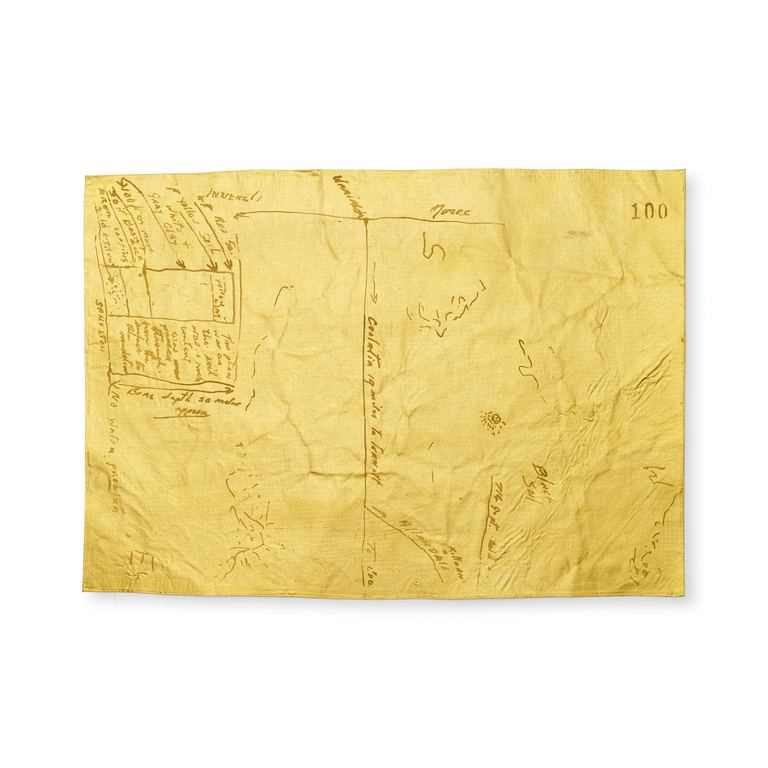
In my father’s deceased estate I found a hand-drawn map with a vague location where
something valuable lies, letters written to mining companies seeking an assay
test, and mining lease notices. The information in these documents perhaps
isn’t worth the paper they are written on but what if one could fulfil the father’s
preoccupation by turning these documents into gold? To realise the prospect of
a better future. To make what he said and promised, true.
DENTURES
The voices talking somewhere
in the house, late spring,
And you’re drifting off to sleep
with your teeth in your mouth.
(‘You are the everything’, R.E.M)
Speaking of gold, it was in his mouth the
whole time. A crown in the upper central incisor on the left, in his dentures.
This was a dental restoration for damage to the false teeth. How it was
damaged, I don’t know.
PISS BUCKET
Golden stream. In the cold. It turns to ice. Runs down my knees
in fright. Golden stream. Turns from warm to cold. In frightful
time. In the frozen dead of night.
('Golden streams', The Hidden Cameras)
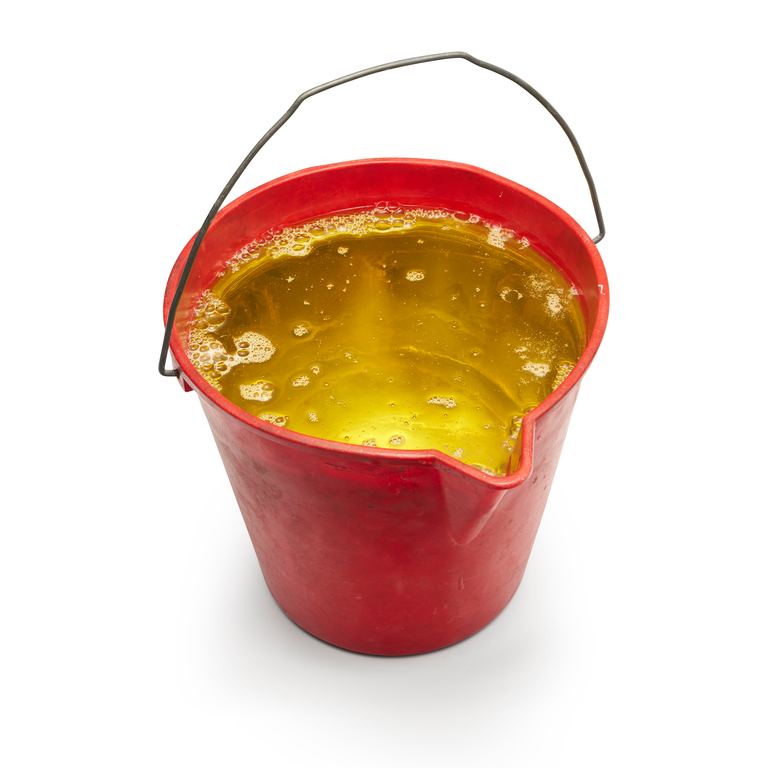
My father lived for eighty-six years and I never saw him sick or
go to the doctor. Not to fix his hernia nor to enquire about the frequent
urination during the night, which made him keep a plastic bucket in his room to
save the trip through the other bedrooms to the toilet on the other side of the
house. I never questioned this, as I assumed that maybe all old men keep a
bucket in their room. Sometimes he would expose the lump in his groin and warn
us about lifting heavy objects in the wrong way. This hernia was only fixed
during the hospitalisation for stage C carcinoma of the prostate. ‘Too much
sex’ was what caused the cancer, he told me from his hospital bed.
HEART OF
GOLD
I want
to live, I want to give, I’ve been a miner for a heart of gold. It’s these
expressions I never give. That keep me searchin’ for a heart of gold. And I’m getting old.
(‘Heart of gold’,
Neil Young)
The idiom ‘heart of gold’ is of unknown
origin but was popularised by Shakespeare’s war play Henry V, written around
1599. On the eve of the Battle of Agincourt, King Henry disguises himself as a
commoner and under the cover of night talks with soldiers to uncover their
morale. When he asks Pistol if he considers himself ‘better than the king’,
Pistol says, ‘The king’s a bawcock, and a heart of gold, a lad of life, an imp
of fame …’ (Act 4, Scene 1), suggesting his admiration for the king.
My father’s father was William Henry Moore – the fourth William Moore and third
to live in Australia, with the first arriving as a convict. In 1900 in a land
ballot for closer settlements, he won 2267 acres of Kamilaroi land, situated
off Agincourt Road near Coolatai. One day, defeated by this land, he threw the
branches used for severe lashings against my father to the ground and said to
my father, ‘Damn it. I can’t break you.’
My father’s mother, Margaret Lily, was also ‘tough’ but a ‘good woman’,
according to my father. Someone who possessed a heart of gold. This is the view
of my father by those who would keep him up to the wee hours pouring their
drunken hearts out in our kitchen. One such person was ‘Echo’. My father named
him that because he would repeat the same thing several times. I remember Echo
Evans being so hurt by a person coughing at my father’s funeral, thereby
disrupting the solemn occasion, that he told him, ‘I hope you die ya bastard!’
POSSESSION
I’ve
worked hard all my life. Money slips through my hands. My face in the mirror
tells me, It’s no surprise that I am, Pushing the stone up the hill of failure.
(‘Failure’,
Swans)
My father said that, one day when looking for a viable water source with a bore
drilling rig, he had uncovered a quartz rock with traces of gold. This may have
been the moment he abandoned his musical pursuits for earthmoving and ‘boring
contracts’, with the hope of discovering more underneath the earth. It doesn’t
appear that the rest of the farming family were convinced by the viability of
the discovery as they remained focused on the financial certainty of the
‘Golden Fleece’.
This possession – or delusion – driven by hope, quiet desperation and
irrational decision-making, was what ‘drove him broke’, an exasperated brother
told me when I asked about the gold. I don’t remember anyone taking this
promise of riches seriously. I didn’t, but it did remain in the back of my mind
as some hope of getting out of our straitened situation.
Many stories later came as excuses for why the exploration of the site never
eventuated: some mining representative pulled a gun on him; a lady linked to an
exploration company tried to seduce him to reveal the precise location of the
mother lode; and others were wary of financially losing out on joint venture in
an area not known for precious metals.
GOLD LEAVES
When money grows on trees. People live in
peace. Everyone agrees. When happiness is free. Love can guarantee, you’ll come
back to me, that’s when.
(‘When’,
Shania Twain)
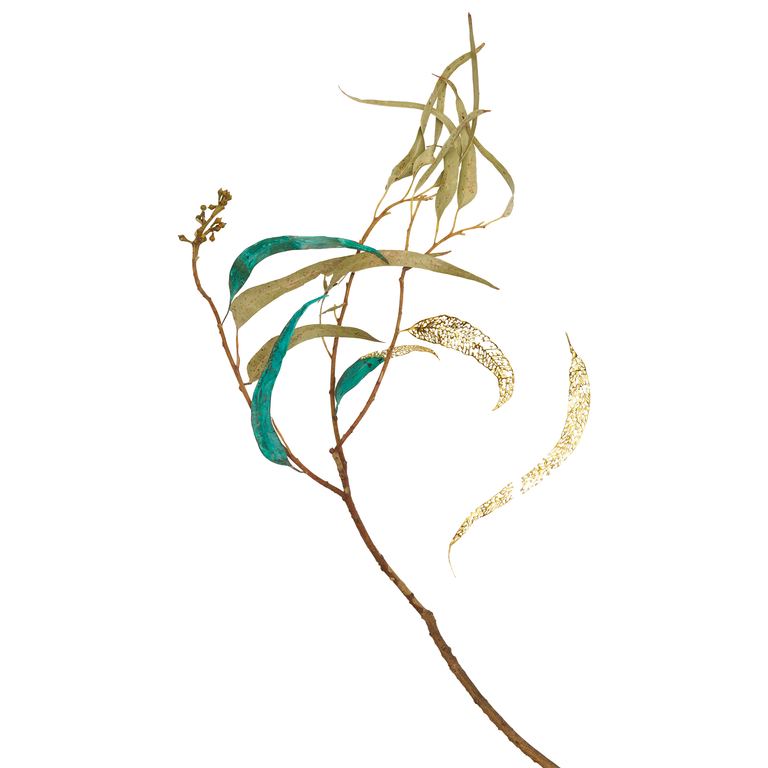
In 2013
the CSIRO published a paper in Nature Communications, which explains how
eucalyptus trees in the Kalgoorlie region draw up gold particles to their
leaves and branches from as deep down in the earth as fifty metres. The trees
are searching for water and are expelling the toxic heavy metals to their
leaves, where it can be shed to the ground. These traces are one-fifth the
diameter of a human hair and are only visible by using an elemental imaging
tool called a Synchrotron. This discovery confirms a correlation old
prospectors saw between trees and minerals: that blackbutt trees indicate a
potential deposit of gold in the area.
Of course Aboriginal peoples were aware of the gold deposits that lay on the
ground’s surface but lacked a reason to utilise the material. Aboriginal
peoples were instrumental in discoveries in Victoria, acting as guides to early
prospectors in an unfamiliar landscape. Directing these miners to the
goldfields led to further dispossession of Aboriginal land.
The impression that gold leaves in my father’s mind for four decades or more is
of a promise of things being better, which refutes his often-made statement to
us that ‘money is the root of all evil’; sometimes clarified by ‘the love of
money is the root of all evil’.
WAR MEDALS
Five metres! Four, three, two, one! Gold to Australia! Gold to Australia! Gold
to Australia! Gold to Australia! Gold! Gold!
(‘Give Up For Australia’, TISM)
When applying for a mining lease, my father used the same acronym as his
military unit – AMEC (2nd/1st Australian Mechanical Equipment Company) – for
his business name, the initials now standing for Australian Mineral Exploration
Company. The unit was used for plant operations like bulldozing, grading roads
and airstrips. My father’s medals, the most common medals for Australian Army
service – the War Medal 1939–1945, the 1939–1945 Star, the Pacific Star, and
the Australian Service Medal 1939–1945 – were delivered to an address of
another soldier’s mother: c/o ‘Mrs Cooper’ of Kallangur. These medals ended up
in the bin because my father rejected the idea of war and said it was ‘stupid’
and a ‘waste of time’. He especially denounced the jingoism leading up to the
commemorative national day and was greatly offended by how some would revere
the national flag, telling me, ‘It’s just a piece of cloth.’
PYRITE
I’m standing alone, I’m watching you all. I’m seeing you sinking. I’m standing
alone, you’re weighing the gold. I’m watching you sinking. Fool’s gold.
(‘Fools gold’, The Stone Roses)
I remember being handed a lump of quartz with traces of gold, and on another
occasion pyrite – once by my father and another time by someone working for my
father. I also remember people using ‘heart of gold’ as a sarcastic and
disparaging remark towards someone, either for their naivety or for their
insincerity.
All of my father’s possessions fitted into a not-very-large suitcase; he only
wore second-hand clothes and he would put everyone else’s concerns before his
own. He would say on many occasions that society needs to be more socialist. At
times he would spruik the virtues of communism but would back down on that and
confirm that socialism was a better political system – as if to say communism
was a step too far.
Some days part of his pay would be a live sheep, which he would kill in the
back shed and then butcher into food that would keep us fed for a few weeks.
Everything he did seemed to be not the easiest way to do things and later in
life I wondered if it was about necessary hard work, kindness and care – or a
penance he felt he needed to pay. When he scalded the cups, plates and cutlery
with boiling water to kill germs, was he protecting all of us or first and
foremost himself?
Whether true or false I’ll never know – very much as though there really is
something of great worth buried under the dirt, waiting to be brought to the
surface!