Readings
Archie Moore Interview
Steve Dow
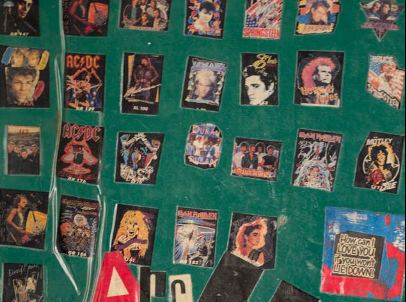
Archie Moore, Plan 2018
Photograph: Carl Warner
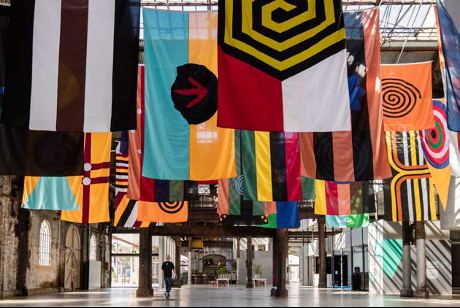
Archie Moore, United Neytions, 2014 – 2017
Photograph: Sofia Freedman
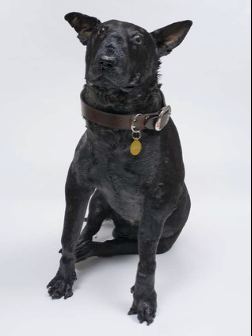
Archie Moore, Black Dog 2013
Photograph: Carl Warner
Queensland-born Archie Moore has long been interested in the memories of interior spaces, from his childhood home and school to the local church, and stretching back in time to his grandmother’s hut. It had a dirt floor, as did the home of Woollarawarre Bennelong, the first Aboriginal Australian to visit Europe, a man catastrophically caught between cultures.
Steve Dow (SD): You live in Brisbane, but grew up in the tiny town of Tara, 171 kilometres northwest of Toowoomba, where you were born in 1970. Last time I interviewed you, you said Tara was an “all-encompassing, stifling milieu”. 1 In what ways did Tara stifle you?
Archie Moore (AM): Apart from the lack of resources or access to anything creative from outside the town—there was no art gallery, no cinema, no record store, no book shop—people would not encourage you to do anything other than drink, fight and chase feral pigs. No one liked anything that was too far removed from the norm.
SD: You spent a lot of time at home, reading books and drawing. What did you most like to read, and what did you draw?
AM: There were limited options for buying books and I never went to our library much, out of fear of intimidation. I’d find books at a servo in the next, bigger town and buy them or order them from a magazine. I also got books through the book club they had at school. I read all sorts of books on esoteric things: astral travelling, self-hypnosis, etc. I got into Robert Anton Wilson’s esoteric books on the Illuminati, drugs and secret societies—although I didn’t understand much of them, or didn’t want to, as it felt they were dangerous or played some kind of mind tricks. Part of what he would seem to do was create significance for a certain thing and then you would see that thing everywhere and make a connection—like when I found a Rosicrucian book on the ground and it felt like it had been left there for me. My father was a member of a secret society: the Royal Antediluvian Order of the Buffaloes (which featured in The Flintstones as the Water Buffaloes). The only books I enjoyed at school were Lord Of The Flies and Animal Farm. Drawing involved making my own board games and violent super-humans—these highlighted my powerlessness, as I would never fight back at people. So I drew violent scenarios as a kind of revenge. I liked to turn photos of people in the newspaper into skulls and make them look like torture victims, coaxed by my uncle, who also had a violent disposition.
SD: Your work Dwelling (2010) was a recreation of your childhood home. The audience could walk through the domestic spaces, view the popular shows of that era running on the TV, and sift through your collection of old drawings, cartoons, magazines, books, etc. Did you hope to engender empathy between white and non-white people with this work?
AM: I’m a bit of a defeatist and nihilist at heart and this and other works are more about the impossibility of having a shared experience with another—the idea that two people or two groups can never fully understand one another. All the objects in that show had a significance for me—an aura, a feeling attached to a memory—and they would have different associations, or none at all, for the viewers of the show. But there’s a kind of paradox, too: I can never be certain that others haven’t had the exact same thoughts and feelings as me.
SD: You told me others in the town identified you through the “usual racist words for Aboriginal” while you “tried to be invisible”. How did you see yourself when growing up? Did you identify as Aboriginal? Did the word Aboriginal have any positive associations for you?
AM: “Aboriginal” as a descriptor was always either negative or of little importance, whether that was from white people, my own family, or from other Aboriginal people I met. I did my best to be less Aboriginal—to be inconspicuous, quiet, avoid the sun, and avoid other Aboriginal people. One of my aunties told me that when she was young she would sit with her elbow on the table with her index finger on the tip of her nose pushing it up to correct her “boong” nose. No positive associations; not one that I remember. Although I didn’t really fully know what the word meant, just that it was something horrible.
SD: One of your aunties disputes the designation of Kamilaroi as your clan. You sometimes identify as a Kamilaroi artist. How important is this identification for you?
AM: I was involved in an exhibition once where we had to use our native tongue and I went to the State Library and looked through all the Aboriginal dictionaries and it was the Kamilaroi one which had the few rude words that some of my uncles would use. My grandparents are from the northern border of the Kamilaroi nation but others say our language is from a neighbouring nation. I feel obliged sometimes to use it but I feel like it hasn’t been confirmed and to identify with it is disingenuous.
SD: You have said your own cultural identity is “unverified and in a kind of limbo space or perhaps an ever-shifting identity” and that your “ancestral history has been largely lost”. What impact does that awareness have on your art: is your art reaching for self-understanding?
AM: I’m always wondering who I am, who I really am, and if that matters. It may impact on my art in the sense that I am uncertain about what I am doing and what I am saying as I am always aware of other readings going on. There are always multiple perspectives—my art is never fully resolved, there is never a determinate position.
SD: The town of Tara was populated mostly by white Christians. How did your own family identify, religion-wise?
AM: The person who may be my father would want us to go to church every Sunday and my brother and I did until I was thirteen or so, by which time I thought it was a load of nonsense. I never believed what the priest was saying or thought it was worthwhile. I would’ve thought I’d be indoctrinated, but for some reason it always sounded like a fallacy to me. Probably twice I deluded myself into thinking there was an actual godly presence watching over me. I don’t have any spiritual beliefs either. I think feelings like that can be explained through psychology and chemistry.The closest I get to a spiritual moment is when I am in the countryside and I see a particular feature in the landscape—a pile of small stones, or a few trees huddled together—and I get a feeling that it is trying to communicate with me. Maybe the tools my ancestors had to understand that language have been muted by a lack of continuity. I remember reading an idea Carl Jung had about “archaic residue”, where parts of your ancestors’ knowledge exist in your brain/ genes and I used to believe that maybe that is what is happening in that moment.
SD: There’s a beautiful set of miniature churches you made from paper for a series called Ten Missions from God, in 2012. You used a colonialist passage from Deuteronomy which, in your words, “talks of God endorsing invasion of other nations, killing all the men but saving the women and children, . . . taking all the resources and [declaring] no treaty shall be entered into”. What’s your personal feeling towards religion?
AM: I am quite anti-theist now. I think the church and religion has done a lot of damage to people all over the globe. It certainly was a cog in the colonialist wheel that helped remove Aboriginal peoples from their land and to make them feel unworthy.
I think religion has too much sway in government policy. It is outmoded. I think tax exemptions for religious institutions should be removed. They involve themselves in too many decisions made by powerful men. I think people should be allowed to believe in whatever they want, but not for that belief to control the lives of others.
SD: Your 2015 series Blood Fraction consists of one hundred self-portraits ranging from “full blood” to “hectoroon”, with finely graded skin colour and facial features. Have you ever found yourself being categorised or analysed through this sort of racial sorting?
AM: Non-Indigenous people will identify Aboriginal people by skin colour but Aboriginal people do so by relationships. I’ve been identified as “half-caste” or asked “how much Aboriginal are you?” and have also wondered what people meant when they called me “black” because the colour of my skin isn’t anywhere near black.
I’m too pale to be Aboriginal for some non-Indigenous people and also not black enough for some Aboriginal people. I don’t know where I sit, and does it matter anyway? This work was about the absurdity of quantifying race in a fractional way.
SD: Last year’s Uluru Statement from the Heart, rejected by the Turnbull Government out of hand, called for the establishment of a First Nations voice enshrined in Australia’s Constitution. What value do you place on Makarrata?
AM: The idea of Makarrata values consultation with Aboriginal peoples and seems to have more concrete measures towards treaties, which the increasingly irrelevant and symbolic Recognise campaign lacked on both counts.
SD: In 2017, you produced a group of what you called false or fictional flags in a series called United Neytions, following the arbitrary map contours of the white lay anthropologist R. H. Mathews in 1900, who could identify only twenty-eight Aboriginal nations. How do you feel when you see the Australian flag with the Union Jack being waved and worn with nationalistic fervour on Australia Day?
AM: Those people have a paradoxical view of Australia: it’s the best place on Earth but also never good enough for them. They’re the descendants of boat people who don’t like boat people. They bemoan Aboriginal people for getting “free stuff” when they benefit from an entire continent that was obtained for free. They will say their grandfather fought under that flag when they did not. I always remember what Jerry Seinfeld said about the flag: “I love your flag—Great Britain at night.”
SD: Any suggestions for which date Australia Day could be moved to?
AM: I dunno. May 27, the day of the 1967 referendum? May 8 (‘maaate’)? Definitely not January 26, since it marks the arrival of the First Fleet and the day of the Waterloo Creek Massacre.
SD: You have told me both nationalists and religious fundamentalists “identify themselves with an idealised group and endeavour to gain political power for that group and behave just like colonialists”. When you create your art, do you hope to raise consciousness, perhaps to trigger visitors into an epiphany where they see the power structures that control them?
AM: Not really. I just make work about something I’ve noticed and it doesn’t really interest me so much how the audience reacts or where my work may sit within art history. Most of the time it starts from something personal but of course expression of that thing is also universal. I sometimes don’t even care for the finished product, the making of it. The process is more important. It’s a cathartic undertaking or is documenting something that happened in a place in time. A lot of the time I don’t know why I want to make a work in a particular way. It kind of begins with a suggestion or a rationale set out by a curator and then becomes a subliminal process. I feel I’m not in control. I know this contradicts what I’ve said about a continuing motif of putting the audience “in my shoes”.
SD: In the 2016 series Crop (Noun/Verb) you buried a series of Britannica encyclopaedias on the Lake Burley Griffin foreshore in Canberra. Was this an effort to make European knowledge kiss the earth, to force it to engage with country?
AM: I like that reading! It was certainly about western knowledge versus Indigenous knowledge. How the Indigenous view of the world is ignored in those Americentric encyclopaedias and how new information revises what was once ‘known’ as being true—that Aboriginal people had no agriculture, for example. I was also thinking about the confines of the book format compared to the limitless space of the Internet for accessing information and the consequences of discarding the written for the digital when, perhaps, the Internet may not be here forever.
SD: Your 2014 series Les Eaux D’Amoore is fascinating. This consisted of seven custom-made perfumes reminiscent of your childhood. Tell us which odours particularly trigger memories for you.
AM: They all do. Clay excavated from the ground always reminds me of my father out on earthmoving jobs. Pencils and paper remind me of the excitement of getting something new—the school New Year packs of textbooks and pencils—and the dread of going back to school. The wood-fire smoke was the one scent everyone identified with, perhaps because everyone goes on a family camping trip or has BBQs, or is some primal part of the brain activated?
SD: It’s always struck me as sad that we called the area where the Sydney Opera House stands Bennelong Point, given it’s Gadigal country and Bennelong was a Wangal man. Tell us about the construction of Bennelong’s hut for your 2016 Biennale of Sydney series A Home Away from Home?
AM: All the areas named after Bennelong have the possessive apostrophe absent—they don’t even have an “s”. Yes, it wasn’t his country but it feels like the new owners of the land didn’t want to say it was anyone else’s. The building was a 1:1 replica of Bennelong’s hut, made from information written about it, as there were no detailed drawings or paintings—but the inside represented my grandmother’s hut.
It was intended to be built on the lawn directly in front of the Opera House but because this is used for weddings, which bring in lots of money, I was allocated the only area of the entire Botanical Gardens that was not maintained—an overgrown, weedy space next to the manicured lawn. It suited me, in a way, as it seemed more natural and I liked that attitude of offering me something worthless. The hut was built in the general area where the original one was, though no one knows the location exactly—some say it may have been on the slope that no longer exists that went down to where the Opera House is now. The builders wanted to age the tiles on top to make it look “authentic”. I said I wanted the hut to look like the new building built in 1790. I was thinking about what Ken Russell said when people complained about Derek Jarman’s design of the French city of Loudon in The Devils—that because it was a historical film about a city set in the 1400s, it should look old. Russell said the setting was when the city was just built. I liked the contrast between the historical building looking brand new and the contemporary interior looking old. Inside the new brick-and-tile structure it was dirt and rusted, old, corrugated iron. I wanted people to sit inside and look out to the Opera House—a building that went a thousand percent over budget—and think about where the wealth of Australia goes and why my grandmother was living inside a corrugated iron hut when everyone else in the town had a house. What were the circumstances that lead to that situation.
SD: Your grandmother’s hut was in Glenmorgan in Queensland and had a dirt floor like Bennelong’s. Were you conscious then of the inequality of wealth distribution?
AM: Not so much. I don’t think I was conscious of much at all—maybe subliminally. I think I was mostly in a depressive milieu, wandering in a fog. Although I did know that others had products that we couldn’t afford—when we got a TV, it was a black-and-white one, when everyone else had colour. Our house was full of holes and was sinking into an old “melon hole”, but I don’t think I considered then why that was so.
SD: What does the concept of home mean to you?
AM: When I’m outside in a green space, especially if it is raining or wet, I feel an intense pull towards to the earth, like I want to be buried, to be inside the ground. Maybe that’s home for me. I’ve never felt comfortable inside a house.
SD: Your 2017 work Whipsaw invited people into a psychological space,its gaseous architecture generating a meditation of time and memory. How have people responded to this work?
AM: At the opening night they said it was oppressive—the sounds of the loud rain on the tin roof, low lighting and a fog machine, though the dirt on the floor deadened quite bit of the sound. To be surrounded by so much corrugated iron made you feel small and confined. It also generated a strange optical effect with the lines running to the vanishing point, and felt a bit dangerous with the sharp edges on the rusty iron. Some people said they felt cold inside.
SD: The materials you use in your work vary widely from one exhibition to the next. Were there other artists who influenced your desire to work across mediums?
AM: I’m bad—I don’t really look at other artists’ work, except when I go to an opening. I get overwhelmed by it all so easily, and I shut down. I get bored with using one medium and I have to try something else, but also I think about which medium is best for the idea I have for a work.
SD: The taxidermy dog used in Black Dog (2013) has such an extraordinary look about it.
What is the story here, and what resonance does the black dog have for you?
AM: When I was young someone named their dog Archie—calling me a “black dog” essentially. The connection between racism and mental illness—depression—is noted in several studies. The fact that the material is taxidermy was important too, as it is something that has died but has been kept alive in some way. It is just like when you think we have moved on as a society from all forms of discrimination, it is revived again and again.
SD: What is occupying your thoughts now as an artist? What can we expect next from you?
AM: I think about myself, my dissociation, am I really here in this world . . . not a fear of death but a fear of missing out, as I yearn to know what happens at the end of the world, and I want to know more about film and politics. I’m working on a t-shirt show, a landscape painting show for 2018, and would like to do film and something in a book format.