Readings
as-if-by-chance the medium is the emergent atmosphere
Robert Cook
Exhibition text accompanying Agatha Gothe-Snape's solo exhibition at the Art Gallery of Western Australia.
Robert Cook, 'as-if-by-chance the medium is the emergent atmosphere', in The Medium is the Medium: Agatha Gothe-Snape Material, exhibition catalogue, The Art Gallery of Western Australia, Perth, 2024
Exhibition text accompanying Agatha Gothe-Snape's solo exhibition at the Art Gallery of Western Australia.
Robert Cook, 'as-if-by-chance the medium is the emergent atmosphere', in The Medium is the Medium: Agatha Gothe-Snape Material, exhibition catalogue, The Art Gallery of Western Australia, Perth, 2024
(Photo: Dan McCabe)
Agatha
Gothe-Snape approaches her practice from a position of ceaselessly inquisitive
connectivity. Unsurprisingly, therefore, her works are rarely presented as
‘standalone objects’ but instead as dynamic accretions of formal and informal
research, material and relational considerations that unfold in particular
locations, over particular periods. In this way, they become entwined with
their sites of construction and presentation; a stitching-into based on
personal platforms of trust and openness to incident and accident.
Adventurously participatory, Gothe-Snape’s working methods constitute her as a
medium for a collaborative spirit that subsequently guides her alters/mediums:
not towards the work’s concrete manifestation according to her instruction or
will, but to an as-if-by-chance co-finding
of it. It’s a process full of moments of surprise and wonder, shaped by an
intentional leaning towards each project’s un-given a-liveness. In doing so,
her work activates a certain kind of attention—what Marian Milner called 'wide
attention', where, as Adam Phillips paraphrases, ‘there can be no knowing
beforehand what one wants, and no assumption that wanting is the thing…’.i
The formal and intellectual nuances of Gothe-Snape’s mediumship attends, amongst other things, to the entanglements between individuals and groups, their pasts and futures and their modes of organisation/arrangement. These passages from Johanna Drucker summarise a little about her take in this regard:
Each individual is a medium, a substrate, through which the event takes place and within which it registers even as the whole aggregate of the system constitutes a larger field produced in a social configuration. The coming and going of attention is a calculable physical entity. Exhaustion is one of its measures, a by-product that is evidence of the opacity of the social medium and the expenditure required to penetrate it… ii This leads to the realisation of the social as a primary medium which is the field, the site of record and trace, the emergent atmosphere of exchange, the web of interrelated glances, or shared interests, and acknowledgements, seen, heard, felt forces and vectors of shifting mood, judgement and assessment…iii
Gothe-Snape’s work is created in a way not to resolve these forces and vectors, but to reframe them in the form of a kind of productive ambiguity generating moments for embedded, embodied reflection. In this project, her works contribute to an actual/possible tilting of the Gallery a little off-axis to allow its ‘emergent atmosphere of exchange’ to be a more visible, a more experientially considered, medium for the sign-sighs of a non-fixed public who is, in fact, no ‘public’ at all but a loose collective of mediums channeling and projecting, listening and waiting, correcting and accommodating. Even, even, even, just imperceptibly, so.
Such subtle qualities, affects, and ideas take place here around a selection Gothe-Snape’s works made between 2015 and 2024. Located on several walls across three levels of AGWA, the rooftop gallery and under the central concrete staircase. Each work speaks to and through the building’s central ‘void’ area, and the interplay between inside and outside (physically and conceptually). Gothe-Snape’s works dialectically recast this civic structure so we might hear the manner in which it mediums exchanges and mergings between expression and containment, subjects and objects, matter and the immaterial, blocks and possibilities… and therefore becomes a little more propositional and contingent.
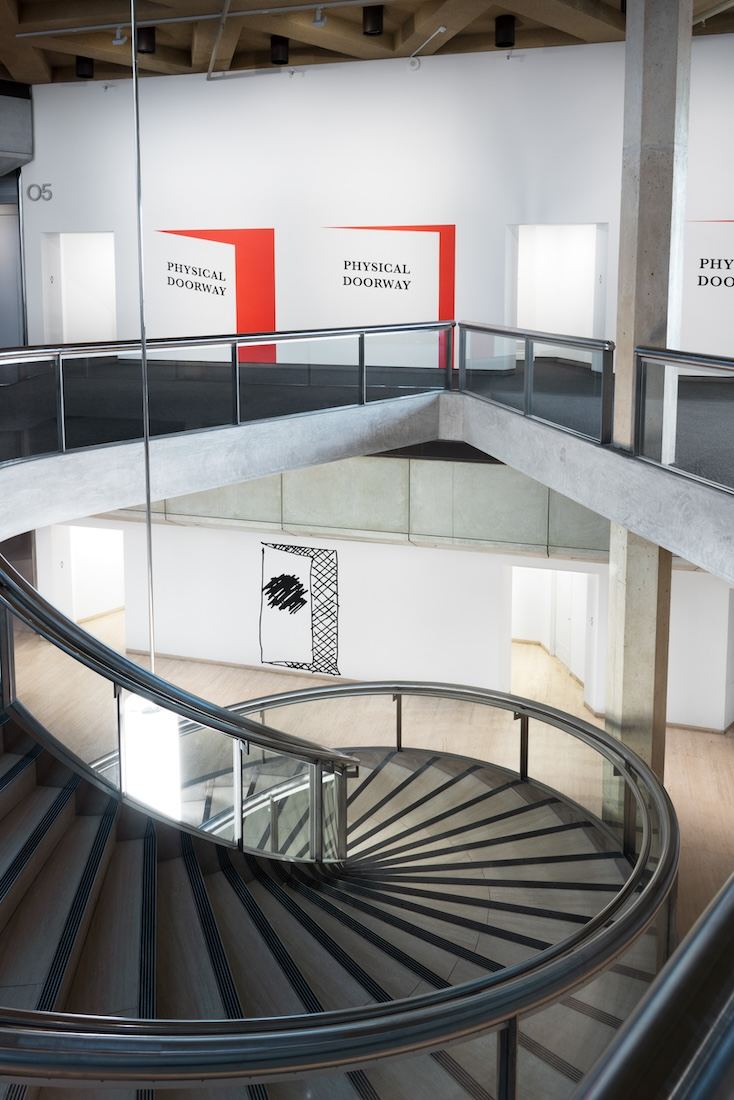
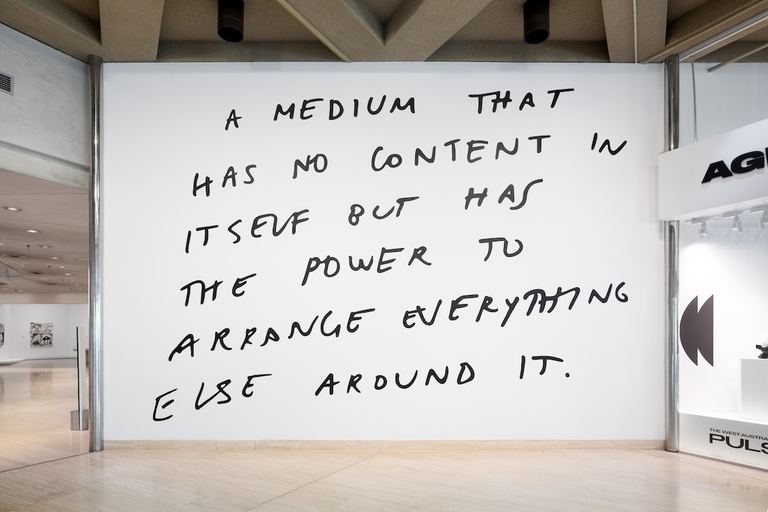
The openness to chance and alternate passage this implies is gently dramatised in her wall paintings that appear simultaneously monumental and discretely suggestive. Reflecting how Gothe-Snape comes at the world from a point of prac-tical-poetic adjacency, the paintings’ sources range from misquotes—a medium that has no content in itself, 2022, takes Marshall McLuhan in a new direction—to spiritualism—my ideas of pleasure, 2022, references spirit medium Jane Roberts. This dis-cursive span is the basis for the exhibition title, that conjures the ways Gothe-Snape is so specifically sensitive and creatively susceptible to how attention moves/is guided. And so, in Physical Doorway, 2015, and Physical Doorway (Three ways), 2016, we find works whose genesis lies in an object Gothe-Snape found: a business card with the words ‘Physical Doorway’ on one side, and ‘CLEANSE’ on the other. Tapping into the generative potentiality of this conundrum, she composed works that function as evocative gaps and boundaries, screens and filters, channels and mediums and buffers. In a related vein, Agnes’ Gate, 2019, attends to the slippages between dream and reality, confinement and liberty—the work manifesting key feminist-political themes from August Strindberg’s A Dream Play of 1907.
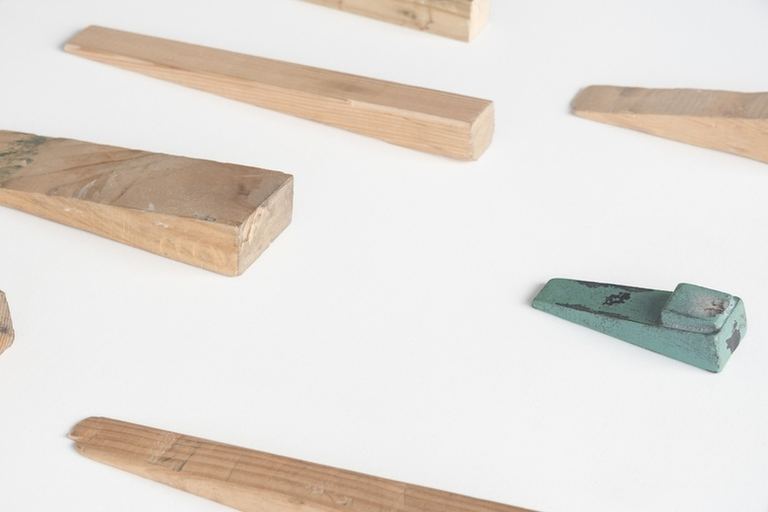
The show also includes numerous wedges; all of these bar two, are in the form of doorstops sourced from AGWA’s admin block. These wedges are a sought-object and performance triptych made by the staff’s negotiation of passage. The other two wedges are in the lower concourse. One is the ‘negative’ space under the Gallery’s central concrete stairwell; this is a readyunmade wedge. The other is a smaller wedge holding up an internal facade column.
There is a reserved elegance to all of these works that carries a calmly playful hinting at a game still in motion, accepting of new participants, and new rules. Key to their imaginal functionality are fragments of both conceptual and minimalist traditions that Gothe-Snape employs as ‘attunement’ points. By slight turns they are ◺ (minimal revolutionary), ◺ (absurdist, inflamed take-it-or-leave-it ennui), ◺ (time and space of chance). These historically position the display of the already visible—the energy of which is wedged to attention by the staircase readyunmade wedge that focuses on it as the medium of the centripetal pull of this 1979 building, fashioned to show/protect art while connecting visually to the outside at each point of its hexagonal form. As these works circulate through this context, it is possible to think of them instances of restrained theatre that also links (without merging) representation, abstraction, and critique as a measured release. Here, Gothe-Snape’s open-ended precision is the medium for a respectful consideration of what things are and have been, as they simultaneously carry a capacity to be other than themselves. This is a tacitly Aristotelian action (for whom in The Rhetoric, a statement about something having a certain quality implies that it can also have, or be, another) and one that Gothe-Snape orients so that every statement of fact or observation is equally a statement of the imagination.
Such generative ambiguities are intended to animate gaps (provide doorways) whereby new arrangements might be found or occur; ‘wide arrangements’ that are yet to be defined. Her use of words in this way resonates with how Judith Butler frames Shoshana Felman’s take on speech and body:
For Felman, what remains unconscious in a bodily action such as speech might be construed as the instrument through which the assertion is made. Similarly, that unknowing body marks the limit of intentionality in the speech act. The speech act says more, or says differently, than it means to say.[iv]
A direction this might go: the medium might surprise itself by how it has been moved; by what/how it has transmitted; it is never totally in control; it is always wedged open, as it itself wedges open the im-possible. It is this nuance that Gothe-Snape’s works heighten, as she carefully attends to the interstitial moments in our split consciousnesses/institutions/ practices of being mediums for mediums and ◺.
The formal and intellectual nuances of Gothe-Snape’s mediumship attends, amongst other things, to the entanglements between individuals and groups, their pasts and futures and their modes of organisation/arrangement. These passages from Johanna Drucker summarise a little about her take in this regard:
Each individual is a medium, a substrate, through which the event takes place and within which it registers even as the whole aggregate of the system constitutes a larger field produced in a social configuration. The coming and going of attention is a calculable physical entity. Exhaustion is one of its measures, a by-product that is evidence of the opacity of the social medium and the expenditure required to penetrate it… ii This leads to the realisation of the social as a primary medium which is the field, the site of record and trace, the emergent atmosphere of exchange, the web of interrelated glances, or shared interests, and acknowledgements, seen, heard, felt forces and vectors of shifting mood, judgement and assessment…iii
Gothe-Snape’s work is created in a way not to resolve these forces and vectors, but to reframe them in the form of a kind of productive ambiguity generating moments for embedded, embodied reflection. In this project, her works contribute to an actual/possible tilting of the Gallery a little off-axis to allow its ‘emergent atmosphere of exchange’ to be a more visible, a more experientially considered, medium for the sign-sighs of a non-fixed public who is, in fact, no ‘public’ at all but a loose collective of mediums channeling and projecting, listening and waiting, correcting and accommodating. Even, even, even, just imperceptibly, so.
Such subtle qualities, affects, and ideas take place here around a selection Gothe-Snape’s works made between 2015 and 2024. Located on several walls across three levels of AGWA, the rooftop gallery and under the central concrete staircase. Each work speaks to and through the building’s central ‘void’ area, and the interplay between inside and outside (physically and conceptually). Gothe-Snape’s works dialectically recast this civic structure so we might hear the manner in which it mediums exchanges and mergings between expression and containment, subjects and objects, matter and the immaterial, blocks and possibilities… and therefore becomes a little more propositional and contingent.
The openness to chance and alternate passage this implies is gently dramatised in her wall paintings that appear simultaneously monumental and discretely suggestive. Reflecting how Gothe-Snape comes at the world from a point of prac-tical-poetic adjacency, the paintings’ sources range from misquotes—a medium that has no content in itself, 2022, takes Marshall McLuhan in a new direction—to spiritualism—my ideas of pleasure, 2022, references spirit medium Jane Roberts. This dis-cursive span is the basis for the exhibition title, that conjures the ways Gothe-Snape is so specifically sensitive and creatively susceptible to how attention moves/is guided. And so, in Physical Doorway, 2015, and Physical Doorway (Three ways), 2016, we find works whose genesis lies in an object Gothe-Snape found: a business card with the words ‘Physical Doorway’ on one side, and ‘CLEANSE’ on the other. Tapping into the generative potentiality of this conundrum, she composed works that function as evocative gaps and boundaries, screens and filters, channels and mediums and buffers. In a related vein, Agnes’ Gate, 2019, attends to the slippages between dream and reality, confinement and liberty—the work manifesting key feminist-political themes from August Strindberg’s A Dream Play of 1907.
The show also includes numerous wedges; all of these bar two, are in the form of doorstops sourced from AGWA’s admin block. These wedges are a sought-object and performance triptych made by the staff’s negotiation of passage. The other two wedges are in the lower concourse. One is the ‘negative’ space under the Gallery’s central concrete stairwell; this is a readyunmade wedge. The other is a smaller wedge holding up an internal facade column.
There is a reserved elegance to all of these works that carries a calmly playful hinting at a game still in motion, accepting of new participants, and new rules. Key to their imaginal functionality are fragments of both conceptual and minimalist traditions that Gothe-Snape employs as ‘attunement’ points. By slight turns they are ◺ (minimal revolutionary), ◺ (absurdist, inflamed take-it-or-leave-it ennui), ◺ (time and space of chance). These historically position the display of the already visible—the energy of which is wedged to attention by the staircase readyunmade wedge that focuses on it as the medium of the centripetal pull of this 1979 building, fashioned to show/protect art while connecting visually to the outside at each point of its hexagonal form. As these works circulate through this context, it is possible to think of them instances of restrained theatre that also links (without merging) representation, abstraction, and critique as a measured release. Here, Gothe-Snape’s open-ended precision is the medium for a respectful consideration of what things are and have been, as they simultaneously carry a capacity to be other than themselves. This is a tacitly Aristotelian action (for whom in The Rhetoric, a statement about something having a certain quality implies that it can also have, or be, another) and one that Gothe-Snape orients so that every statement of fact or observation is equally a statement of the imagination.
Such generative ambiguities are intended to animate gaps (provide doorways) whereby new arrangements might be found or occur; ‘wide arrangements’ that are yet to be defined. Her use of words in this way resonates with how Judith Butler frames Shoshana Felman’s take on speech and body:
For Felman, what remains unconscious in a bodily action such as speech might be construed as the instrument through which the assertion is made. Similarly, that unknowing body marks the limit of intentionality in the speech act. The speech act says more, or says differently, than it means to say.[iv]
A direction this might go: the medium might surprise itself by how it has been moved; by what/how it has transmitted; it is never totally in control; it is always wedged open, as it itself wedges open the im-possible. It is this nuance that Gothe-Snape’s works heighten, as she carefully attends to the interstitial moments in our split consciousnesses/institutions/ practices of being mediums for mediums and ◺.
[i] Adam Phillips, Giving up, 2024, Penguin: London, Kindle edition, p7
[ii] Johanna Drucker, The General Theory of Social Relativity, 2018, Elephants, p31 (sent to me by Agatha)
[iii] Ibid, p 40.
[iv] Judith Butler, Excitable Speech, 2021, Routledge: London, p11
[ii] Johanna Drucker, The General Theory of Social Relativity, 2018, Elephants, p31 (sent to me by Agatha)
[iii] Ibid, p 40.
[iv] Judith Butler, Excitable Speech, 2021, Routledge: London, p11