Readings
Disobedient Bodies
Hamish Sawyer
In her 2011 video performance Crutch Dance, Justene Williams dons a makeshift costume of cardboard, magazine pages and tape to improvise a series of absurdist actions against a Mondrian-esque grid of red, yellow, black and white. Across 12 channels, the artist simultaneously camouflages herself in the backdrop, hobbles around on crutches and jogs on a treadmill. To what end, it’s not entirely clear. Writing about the work in frieze magazine at the time, curator Justin Paton suggested: “What comes through unmistakably here is the theme of perseverance, of art as a blind mission that carries its maker uncertainly between toil and joy.”1
Williams’ genre-bending practice now spans 30 years. Originally a photographer, the artist’s chaotic, multi-channel video installations of the past decade have given way to live performance and sculpture projects which collapse art history and autobiography into a DIY aesthetic.
Graduating from the influential now-defunct visual arts program at the University of Western Sydney in 1991, Williams first came to prominence with photographs that pushed the boundaries of the medium. Her early oeuvre comprised blurry images made using analogue techniques that suggested the body in movement, foreshadowing the artist’s performative turn. Characterised by their saturated colour, the images were shot in shopping centres, music halls and strip clubs, a nod to Williams’ suburban upbringing. As a teenager, the artist worked in cabaret, singing and dancing at the South Sydney Junior Leagues Club, and her father owned a wrecking yard. These formative experiences infiltrate the artist’s practice and processes to this day.
After completing her Masters degree at Sydney College of the Arts in 2006, Williams moved to the United States with her then-partner, artist Tony Schwensen, who had taken up a position teaching performance art. Williams credits this experience with exposing her to a breadth of practice and a realisation of the body’s potential in relation to her work. “Performance art is its own particular world that doesn’t really exist in Australia,” the artist notes. In 2008, Williams produced a series of grainy, single-channel videos in the basement of her Boston apartment. BIGHEAD GARBAGEFACE GUARDS GHOST DERR SONATA features the artist performing a series of robotic dance moves in a claustrophobic space decorated with domestic rubbish including cardboard, newspapers and pizza boxes, wearing costumes made from the same materials. The videos are now held in the collection of the Museum of Contemporary Art Australia, Sydney.
Returning to Australia, Williams continued staging performances to camera as she was “too shy to do it live,” but she began scaling them up. Crutch Dance (2011) consisted of a single recorded performance edited and split across 12 channels – the viewer’s focus is constantly shifted from screen to screen, an acknowledgement, the artist notes, of “how we consume images in the digital age.” Williams’ fragmented and mediated approach was also a conscious reaction against the overtly masculine style of durational performance, popularised in Australia by a previous generation of artists including Mike Parr and Stelarc.
Williams presented Crutch Dance and subsequent works on banks of old television monitors stacked on top of wooden packing pallets. Williams’ use of redundant technology reflects the artist’s nostalgia for the displays at the electrical goods store she recalls visiting as a child. Over several years, these installations became increasingly expansive and sculptural, often incorporating props from the filmed performance (see, for instance, No mind, 2015). Watching Williams’ high-energy performances on video, it is as if the artist is literally trying to break out of the confines of the screen. It was perhaps inevitable that she would eventually turn her hand to live performance.
Over the past six years, Williams has presented a cycle of ambitious live works, recreating seminal examples of the early 20th century avant-garde. In 2016, Williams collaborated with the Sydney Chamber Opera on a re-visioning of Victory Over the Sun, a 1913 futurist anti-opera, as part of the 20th Biennale of Sydney. The original St Petersburg production was infamous for its libretto in a made-up language and stage design by Suprematist artist Kazimir Malevich. For this latter rendition, Williams fashioned costumes for the performers out of utilitarian materials like cardboard, felt and marine carpet, often repurposing elements of previous projects. Indeed, recycling is a defining characteristic of the artist’s output; sculptures are often transformed into costumes and vice versa. Williams describes this process as “cannibalising” or pulling things apart in order to make something new. The National Gallery of Australia has acquired William’s costumes, video and the electronic score from the production, and the institution plans to restage the opera in October of 2022 as part of its 40th birthday celebrations.
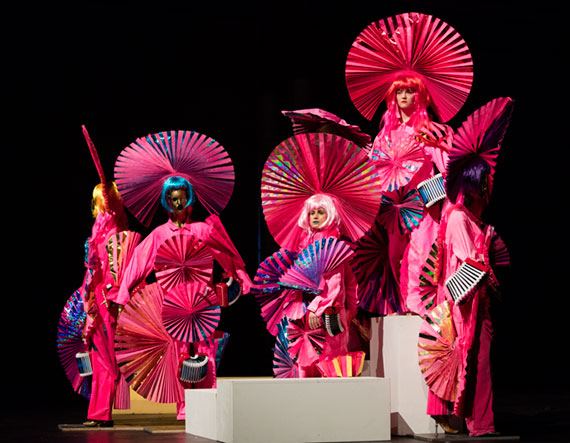
In 2017, Williams created Metal Cry for The National: New Australian Art at Carriageworks, Sydney. Inspired by designs and instructions for an unrealised 1916 performance by the Italian Futurist Fortunato Depero, the artist dressed performers in brightly coloured costume-instruments incorporating chimes, accordions and fans made from pleated paper blinds, set against a patchwork backdrop of sound-generating assemblages made from chairs, televisions and mirrors. With these fantastical and nonsensical productions, Williams updates iconoclastic examples of 20th century art history for a contemporary Australian audience, complete with costumes and backdrops sourced from Gumtree and Bunnings. The utopian vision of Williams’ source materials, which proposed a new kind of art in reaction to the horrors of World War I, resonate in an era of climate emergency, online misinformation and rising authoritarianism.
In addition to exhibiting the costumes and ephemera from her live and recorded performances, Williams has developed a parallel sculpture practice that extends her interest in the body. The artist will premiere a major new sculptural installation in a forthcoming exhibition of work by Queensland contemporary artists at the Queensland Art Gallery | Gallery of Modern Art (QAGOMA), opening in August 2022 (Williams currently lives in Brisbane, where she is a Senior Lecturer at the Queensland College of Art). Commissioned with the support of the Gallery’s Contemporary Patrons, The Vertigoats weaves together art history, consumerism and popular culture in a giant retail-wall display. Foil-covered slat-walls, indoor-climbing holds and even a gondolier are interspersed with mannequins wearing virtual reality headsets and video screens playing text fragments written by the artist. Ellie Buttrose, QAGOMA’s Curator of Contemporary Australian Art, says of the work: “With her visually sophisticated, punk approach Williams humorously comments upon wanton consumption and the desire to ‘climb the ladder’ of the social and economic order.”2
Slat-walls and mannequins are recurring forms in Williams’ visual language, a throwback to her former job as a visual merchandiser. More recently, the artist has looked to mythology, in particular the Celtic crone/fertility symbol Sheela-na-gig, as a subject for sculptural investigation. The Sheela-na-gig is most commonly depicted as a naked woman with an older-looking face and an exaggerated vulva, used to decorate churches and related architecture. Its exact meaning and genesis are uncertain, but experts generally believe that the figure represents female values of protection, wisdom and fertility. Academic Georgia Rhoades has posited that the Sheela-na-gig “marks the first and last of our doorways – the liminal space where anything can happen, with our lives occurring in-between.”3
Williams has presented a number of iterations of the figure – as part of her solo exhibition Penny on the threshold at Sarah Cottier Gallery, Sydney in 2021 and in Last night I had a dream and there were three of me, a collaboration with Julie Fragar at Carpark Gallery, Brisbane, also in 2021. Larger than human scale and appearing to be made of cast metal, the artist in fact hand carves the figures from lightweight surfboard foam before applying a layer of fibreglass and metallic paint. The sculptures are made in segments, making them easier to move around and store and for different segments to be swapped in and out, like a giant Lego set. Like the actual Sheela-na-gig symbols, each of Williams’ figures has its own unique characteristics. For her next exhibition at Sarah Cottier Gallery in May 2022, Williams is planning to exhibit a version that rocks back and forth – and another with a stocked bar in the large void between the figure’s legs, ‘spirits’ being a word play on the origins of the Celtic icon.
To the unfamiliar viewer, these ungainly bodies might seem out of place in the context of Williams’ practice. Keen observers, however, will understand them as another example of the artist’s playful subversion of the aesthetics and hierarchies of modernism. Like so much in Williams’ shape-shifting career, the sculptures privilege female agency and invention over fixed ideologies and objects.
1. Justin Paton, ‘Justene Williams, Sarah Cottier Gallery review,’ frieze, no. 140, June 2011.
2. Email from Ellie Buttrose to the author, December 2021.
3. Georgia Rhoades, ‘Decoding the Sheela-Na-Gig,’ Feminist Formations, vol. 22, no. 2, Johns Hopkins University Press, 2010, pp. 167–94.