Readings
'Caricaturing Art: Decoration, Relation, Ending'
James Gatt
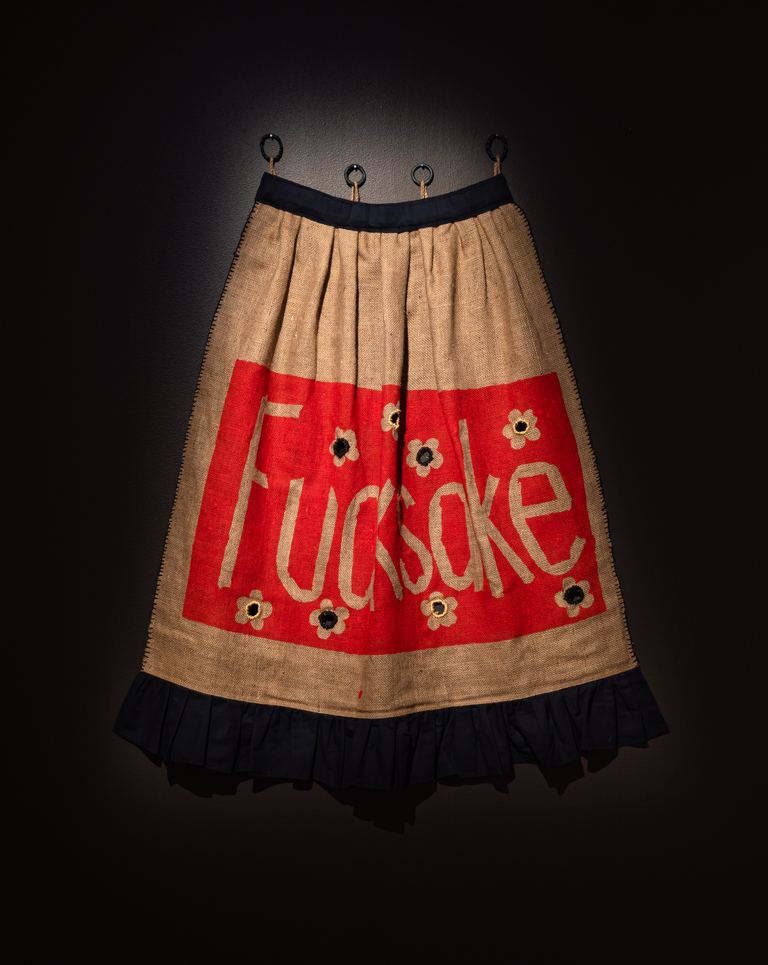
Elizabeth Pulie has been making art about art since 1988. Like thinking about thinking, making art about art is a philosophical undertaking, the motivation for which is not simply to accumulate or circulate products but to test limits in pursuit of knowledge. Though perennial, the question of what art is requires constant revisiting because the rules of the game change frequently—that is, the context from which art emerges and exists is constantly shifting. For Pulie, defining art is first a matter of identifying an ostensible problem or limit for art. By deliberately embodying these perceived problems and limitations, her practice affirms and emphasises them publicly for all to consider. The result is an extended commentary on what art really is and the mutual exclusivity of art and non-art. As the adage goes, “A problem well stated is a problem half solved.” Here, we can understand Pulie’s practice as a constant illumination of, or resistance to, crises for art.
Pulie’s practice comprises three distinct, self-assigned conceptual projects that each provide a framework for her critical investigation of art: Decorative Paintings (1988–99), Relational Art (2002–06), and End of Art (2012–ongoing), alongside ancillary Interim Works produced between 1997 and 2012. Arranged according to these projects, ‘#117 (Survey)’ maps her ever-building thesis on the ontology of art. The problems targeted by Pulie in these projects include the commodification, decorative uses, and speculative endpoint of art, but have inevitably presented other tangents of provocation.
Faced with the problem of characterising art, Pulie amplifies its features to clarify its cause, a tack that could be described as caricaturing art. Pulie and her works perform art, by re-enacting its function while simultaneously asking, “Is this art?”. The caricaturing is subtle. Hence, her quotation of art is potent because it is ambiguously critical, mistakably earnest, and acceptable according to the status quo. Because the problems criticised by Pulie are real to her experience of art, the sincerity with which she presents them creates a sense of unease: What if this is really art? What if the public believes it? Borrowing from Jean Baudrillard,¹ Pulie once analogised this to martial arts, wherein effective combat utilises an opponent’s own force against them in order to preserve energy.
Political activists, performance and conceptual artists have been using similar tactics since the 1920s. Mimesis or extreme identification with opposing ideologies is deployed as a strategy to question validity. This approach became known as ‘subversive affirmation’ in Eastern Europe, described by Inke Arns and Sylvia Sasse in their 2006 essay ‘Subversive Affirmation. On Mimesis as Strategy of Resistance’ as:
An artistic/political tactic that allows artists/activists to take part in certain discourses and to affirm, appropriate or consume them while simultaneously undermining them… Subversive affirmation and over-identification are forms of critique that through techniques of affirmation, involvement and identification put the viewer/listener precisely in such a state or situation which she or he would or will criticise later.²
In his 1993 essay ‘Why are Laibach and the Neue Slowenische Kunst not Fascists?’, Slavoj Žižek wrote on ‘over-identification’, which he believed effective because it “‘frustrates’ the system (the ruling ideology) precisely insofar as it is not ironic imitation, but over-identification with it”.³ Explanation, criticism and irony are less effective because they are discernibly distant and oppositional. Guy Debord’s collective Lettrist International (1952–57) developed détournement, a technique that adapted accepted forms to critique them. In 2010, Douglas Holt defined détournement (French for ‘hijacking’ or ‘rerouting’) as “turning expressions of the capitalist system and its media culture against itself”.⁴
The first of Pulie’s projects, Decorative Paintings, was formulated in response to the increasing utilisation and understanding of art as decoration. Nearly 200 paintings were produced during this project, from small individual panels to much larger multi-panel installations. The adopted styles vary, including Art Deco, Chinese Ornament, Folk Art, and Mid-century Modern, and are borrowed from a range of sources, most notably The Grammar of Ornament (1856) by Owen Jones. These hyper-aesthetic works embody the emptying of art and valorisation of its superficial qualities by assuming this very position as the basis for critical and philosophical redress. If indeed art is mere decoration, how is the decorative valued within art contexts, and how does this affect the perception of what art is? Painting, the undeniable emblem of art, is exploited by Pulie for this very purpose. Her decorative compositions flaunt their quaintness, revelling in their distinction from bravado works or their steely museum envelopes, confident too that their painterly guise might obfuscate this distinction and in so doing bring critical analysis to the function of art and its reception. Each painting is titled with a number, starting with One 1988. There are no metaphors. They are experiments, almost scientific in nature, intended to infiltrate and ‘frustrate’ (Žižek) the contexts in which they operate. Pulie’s Decorative Paintings are decorations as well as critiques of the use of paintings as decoration. Though they rely on what Russian formalist Viktor Shklovsky termed ‘defamiliarisation’, the recontextualising of familiar decorative motifs in Pulie’s paintings is less evident than in Marcel Duchamp’s Fountain 1917 or Andy Warhol’s Brillo Boxes 1964. Indeed, it’s possible to consider the decorative designs in Pulie’s paintings as readymades. For example, Pulie followed a method set out in a folk art painting instruction book to produce her folk art paintings, making them much easier to complete and further dislocating her artistic agency.
Pulie eventually perceived her Decorative Paintings project as a failure because its intended criticality was absorbed by the art world, with paintings curated into institutional exhibitions and collected by museums. This might also be considered the project’s success, highlighting the fine line Pulie walks between her participation in and critique of art. These artworks can, after all, only perform their criticality in art institutions. Nonetheless, Pulie dissolved her originally life-long intended project in 1999 and soon established her Relational Art project in 2002, shifting her practice from painting to consider the social and political dimensions of practice. Earlier, in 1996, Nicolas Bourriaud coined the term ‘relational aesthetics’, which he later defined in his 1998 book Esthétique relationnelle as “A set of artistic practices which take as their theoretical and practical point of departure the whole of human relations and their social context, rather than an independent and private space.”⁵ Within this project, Pulie operated a range of social enterprises. Her first initiative was Front Room, an artist-run gallery co-directed with Jay Balbi in the front room of their Chippendale home from March 2002 to December 2003. From March to December 2003, Front Room was accompanied by a concurrent exhibition programme in Pulie’s kitchen, aptly titled ‘Kitchen’. The combined programmes resulted in fifty exhibitions by nearly forty artists who were not commercially represented. Pulie then devised the magazine Lives of the Artists, self-publishing ten issues randomly between 2002 and 2005. The magazine included reviews, interviews, and articles, illustrating the social happenings and challenges faced by artists in Pulie’s orbit. In 2005, Pulie initiated the Sydney Ladies Artist Club (SLAC), into which she and artist Sarah Goffman invited a group of women artists mostly from Sydney. The group operated as “A social and support organisation for invited female artists.”⁶ Members attended organised events such as reading groups, sew-offs, catch-ups, and once a netball game. These activities are documented with member musings in an online blog.⁷
During her Relational Art project, Pulie amplifies the life of the artist, identifying the problems inherent to maintaining a practice. Her studies of art’s professional and social aspects reveal a myriad of issues faced by artists: where they live, what they do for work, how they survive, who they socialise with, funding, exhibition opportunities, and of course, the perpetual question of the necessity of their practices. The artist’s life is seen as tantamount to their practice, so knowing art becomes a task of knowing what motivates (or demotivates) the artist. Subsequently, the ‘non-art’ or everyday activities of the artist are framed as art. Conceptual artists have addressed this bridging between art and life since the 1960s, neatly summarised by Bruce Nauman’s premise, “if I was an artist and I was in the studio, then whatever I was doing in the studio must be art.” Art at this point “became more of an activity and less of a product”.⁸ For Lives of the Artists #6, Pulie writes as Ally Young, reviewing apricot danishes from around Sydney, satirising the form of written reviews in the context of an art publication and addressing the full gamut of artist experience, from the serious to the inane. Pulie authored several texts as Ally Young and also Adam (of the duo Adam and Loretta with her friend and artist Luke Sandral), developing her pseudonyms as characters who perform roles in art. This is both embodiment of and objective distance from her activities as an artist, not dissimilar to ‘method acting’ whereby actors practise extreme empathy for the characters they perform.
Pulie’s current focus is the crisis of the contemporary, which she understands as a time in which art cannot be concretely defined due to its extreme openness to form. After successive modernist developments, each superseding the last towards an increasingly open definition of art, contemporary art is taken by Pulie as the logical end of Western modernism. In this post-conceptual period, art has reached a dematerialised form and been immersed into the everyday, lived experiences of reality, or ‘non-art’, problematising the definition of art, as Pulie states in her 2019 essay ‘Crisis of the Contemporary: The End of Art’:
Various conceptual practices tried, to greater or lesser extents, to reveal art within the everyday, or within not-art: conceptual forms such as mail art, earthworks, walking as art, political activity or cleaning as art meant that art’s lack of differentiation from other objects, situations or concepts in the everyday world rendered it frequently invisible. If art can be embodied by cleaning, communication, cooking, and craft, what ultimately is art? If non-art is also art, what is art?⁹
How to approach a practice concerned with defining art when art can be defined as anything? Here is where Pulie inserts her End of Art project, which emulates the ontological adaptability of contemporary art by expanding to absorb all of Pulie’s output as an artist. Established in 2012, this project embraces all possible media and ideas, opening Pulie’s practice to new materials and techniques including sewing, embroidery and painting on hessian, sculpture, and video, alongside the parallel development of a discursive, theoretical practice. Though the project commences with more conventional, discrete paintings on canvas and linen, End of Art quickly evolves. In 2013 Pulie produced three of her largest works to date: a series of hessian banners titled The Female Form I, II, and III depicting abstracted female bodies. These paintings were inspired by the aesthetics of first-wave feminism, alluding to the concrete rights fought for by the movement’s proponents. Here, real-world circumstances, which affect reality and thus impact artmaking, are programmed into Pulie’s project. The labour of craft becomes synonymous with invoking ideology or performing practice—a materialisation of activity. Throughout the project, its emblematic end is contrasted with symbols of life: flowers, vaginas, faces, breath, eggs, and spiritual pursuits. The end of art, it seems, is just the beginning of life. The decorative remnants in Pulie’s Decorative Paintings also find new purpose as ornate motifs and embellishments, sometimes exaggerated to humorous or anthropomorphic effect, such as in #96 (Bauhaus Weaving Two). Also like Decorative Paintings, works in End of Art are titled with numbers, building chronologically to her most recent #120 (Wall Painting for Mac) 2022, which was produced for ‘#117 (Survey)’. This exhibition is itself assigned a number within the End of Art project, interpreted as a collaborative work between artist and curator, and absorbed by the extremely open definition of contemporary art. #117, #118, #119, and #120 were all produced for this survey exhibition and are all ephemeral media (exhibition, video, sound recording, and wall painting). Though the End of Art works are deliberately ambiguous, their content is inspired by various sources, including social and political movements, personal experiences, dreams, academic texts, and random observations noted in parentheses. Just like the Relational Art project, all manner of things specific to Pulie’s reality that impact her practice as an artist are possibilities for her work. Thus, the separation between individual and artist, person and practitioner blurs. Pulie herself becomes a metaphor for practice in seeking to delineate between these identities. Her reality as an artist becomes a testing ground, an experiment in the pursuit of defining the ontology of art.
Despite its egalitarian idealisms, the expanding definition of art has paradoxically led to the predicament of defining art. Pulie embodies this paradox, continuing to produce art regardless of, but in order to reach, a clearer definition of what art is. What she finds is that there isn’t really an end to art. The ‘end’ becomes a moving target, just as Claire Bishop outlines:
…the definition of ‘contemporary’ has become a moving target par excellence: until the late 1990s, it seemed synonymous with ‘post-war’, denoting art after 1945; about ten years ago, it was relocated to start somewhere in the 1960s; now the 1960s and 1970s generally tend to be viewed as high modernist, and the argument has been put forward that we should consider 1989 as the beginning of a new era, synonymous with the fall of communism and the emergence of global markets.¹⁰
Like Pulie, Bishop finds that contemporary art resists concrete definition, introducing the term ‘dialectical contemporaneity’ to comprehend it as an omnipresent categorisation which “does not designate a style or period of the works themselves so much as an approach to them”.¹¹ Pulie’s End of Art project indeed emphasises a contemporary approach to art, rather than its historical periodisation. As the third of three conceptual projects, End of Art is a cumulation of conceptual and material discoveries that seek a definition of art in the oscillation between doing and being, which vibrates backwards and forwards in time, possibly without end. Like many conceptual artists have illustrated—including Lee Lozano and Ian Milliss—there is no end to art, only an end to the practice, or categorisation of practice, as art. Faced with this dilemma, Pulie’s practice ironically becomes a resistance to its own end.
Instead of ending, or because it cannot end, art repeats itself, again and again. As Groys identified in his 2009 essay ‘Comrades of Time’, contemporary art is best represented by the potentially endless video loop.¹² In 2021, Pulie combined her parallel practices of yoga and art in #118 (Heaven in Love). The video functions as a musing on what it means to make art and be an artist contemporaneously, both in the sense of occupying present time, and practising in the current period of contemporary art. Exhibited as the conclusion to this survey exhibition, it also represents a trajectory through Pulie’s art practice from highly productive states of making art objects to deliberately unyielding routines of movement that focus instead on being. The cyclical loop of the digital medium is synonymous with Pulie’s yogic movements and breathing. To comprehend the ‘end of art’, Pulie occupies the looping that has come to characterise it. Unable to escape this omnipresence, art turns further inward. Jean Baudrillard famously criticises this self-reflexivity and inward criticality in his 1996 essay ‘The Conspiracy of Art’. Pulie ruminated on Baudrillard’s critique, drawing parallels to the problems of her own practice in her 2018 exhibition ‘The Conspiracy of Art by Jean Baudrillard’:
While Baudrillard refers only minimally to ideas of the end, he describes contemporary art as a situation of entrapment; a state wherein it is impossible to both participate within contemporary art and remain critical or objective about it, things that I had long felt in relation to my own attempt to practice art.¹³
Pulie’s practice continues to embody the fundamental paradox of art: the more it expands, the less easily it can be defined. Despite and because of this inherent problem, her strategic caricaturing has achieved, at least to some degree, to produce art in a manner critical of art—not as an attempt to shield her practice from critique but rather as insurance against its potential hypocriticalness. We can learn from Pulie’s practice that it is incumbent upon artists and art institutions to observe the same critical assessments internally that it poses externally. This, perhaps, is the most significant contribution art can make: to be a model for dialectically opposing behaviours and ideas. The risk is great. As Pulie’s practice attests, the extreme openness of art, in tandem with its self-criticality, have resulted in an ontological slipperiness and the looming potential of its own demise.
What brought art to this point? What prompts artists like Pulie to take such risks? There is no single answer. Though for Pulie and countless artists before her, it seems the existing and looming conservatisms of art trigger defences. In this sense, the decorative, relational, and adaptable functions of art that Pulie caricatures can be thought of as conservatisms, revealing the incisive humour of her strategy: that art is wrestled into a position wherein its own conservatisms are reabsorbed. What might originally be perceived as a failed radical initiative is, rather, a successful demonstration of art’s inherent conservatisms and own willingness to recycle them. By laying bare realities of and for art in her Decorative, Relational and End of Art projects, Pulie suggests that what is ‘real’ is radical, insofar as it problematises art. The possibility of liberation inherent to this problem is not won by imagining or mounting alternatives (the strategy of most Modern Art movements), but rather via extreme identification with existing reality. To this, Pulie submits her own practice, interrogating art through careful and calculated jabs, gently yet compellingly, sharing the burden with institutions and audiences. Thus, we have both generous and demanding artworks, critical and deferent, obliging and speculative; inherently and tactically paradoxical, which makes them so effective. Though it seems perverse for an artist to make an opponent of their enterprise, this is precisely what Pulie continues to do, one hopelessly hopeful caricature at a time.
- Jean Baudrillard, Baudrillard Live: Selected Interviews, ed. Mike Gane, Routledge, London, 1993, p 82.
- Inke Arns and Sylvia Sasse, ‘Subversive Affirmation: On Mimesis as a Strategy of Resistance’, East Art Map: Contemporary Art and Eastern Europe, MIT Press, Cambridge, 2006, p 445.
- Slavoj Žižek, ‘Why Are Laibach and Neue Slowenische Kunst Not Fascists?’, M’ARS, vol 3, no 4, Moderna Galerija, Ljubljana, 1993.
- Douglas B. Holt, Cultural Strategy Using Innovative Ideologies to Build Breakthrough Brands, Oxford University Press, 2010, p 252.
- Nicolas Bourriaud, Relational Aesthetics, trans. Simon Pleasance and Fronza Woods, Les Presses Du Reel, Dijon, 1998, p 113.
- Elizabeth Pulie et. al., Sydney Ladies Artist Club, 2005–07, http://sydneyladiesartistclub.blogspot.com (accessed 20 October 2021).
- Ibid.
- art21, ‘Bruce Nauman’, https://art21.org/artist/bruce-nauman, (accessed 22 October 2021).
- Elizabeth Pulie, ‘Crisis of the Contemporary: the End of Art’, Love(f)Art, Sydney, 2020.
- Claire Bishop, Radical Museology: or, What’s Contemporary in Museums of Contemporary Art?, Koenig Books, London, 2013, p 16.
- Ibid.
- Boris Groys, ‘Comrades of Time’, e-flux, no 11, 2009, https://www.e-flux.com/journal/11/61345/comrades-of-time, (accessed 20 October 2021).
- James Gatt, ‘Interview with Elizabeth Pulie’, Sarah Cottier Gallery, 2018.