Readings
From the ashes, trees tell their stories
Sarah Rees
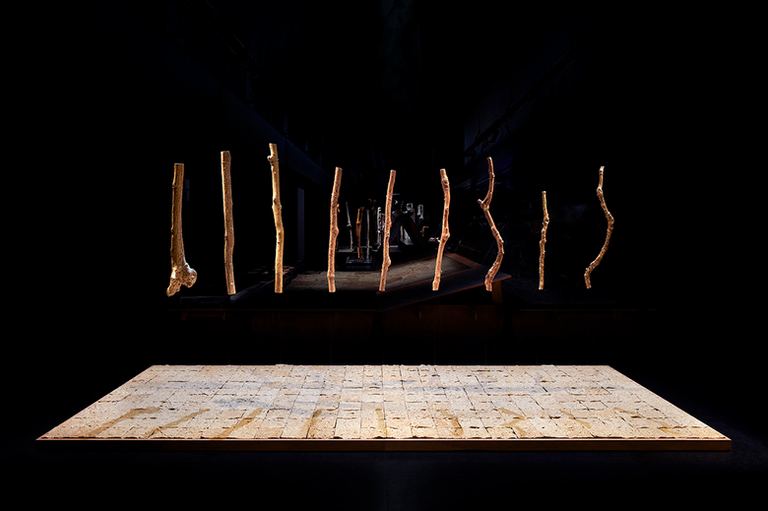
Yasmin Smith, Stars (Castle Hill Plantation 2021), Collection: Powerhouse Museum, Sydney. Commissioned by Powerhouse Museum for the exhibition Eucalyptusdom, 2021 (Photo: Luc Remond)
This artist's practice involves collecting and burning parts of trees to make site-specific ceramic installations that explore the potential of forms and
glazes as aesthetic indicators of ecological and human history.
SARAH
For Eucalyptusdom, you created a major new work specific to the site of the museum's former Castle Hill Experimental Research Plantation, which was planted in the 1940s when one of the museum's main activities was research into the phytochemical properties of eucalypt oil. What was it like to engage with that history?
YASMIN
I had access to the Powerhouse collection and archive and it was very interesting to learn about the research into the economic uses of eucalypts. STARS (Castle Hill Plantation 2021) is a permanent archive of that place, the plants and work that shaped that environment. The plantation was an artificial environment. The trees in the part of the plantation on which my work is based were lemon-scented gum (Corymbia citriodora) and spotted gum (Corymbia maculata), which aren't naturally occurring in the area. They were planted by museum staff to investigate the phytochemical properties of eucalypts, experiment with harvesting techniques, and create a potential seed bank.
It was interesting to be in that place and see the European traditions of science and research trying to contain the eucalypts. For over 200 years in Australia, European sciences have been used to try to understand the eucalypt. But that deeper, older knowledge that exists within First Nations cultures around how these trees have always been used by and benefited humans is something I have a deep respect for.
A lot of the processes I undertake are embedded in the empirical sciences. But I don't separate the sciences from spirituality or my artistic expression. Understanding and learning about chemical histories makes me feel a greater connection and belonging to a place.
SARAH
And you've said that sense of connectedness influenced the title of the work?
YASMIN
Yes. The title, STARS (Castle Hill Plantation 2021), speaks to the idea that in the end, fundamentally, we are all made of stardust-which connects us with the trees in a kind of cosmic chemical romance. I was motivated by the writing of potter and chemist Linda Bloomfield.
SARAH
Restrictions imposed across Greater Sydney in response to the COVID-19 pandemic in the lead-up to the plantation's removal, combined with exhibition deadlines, created some practical challenges in the development of your work.
YASMIN
There were other factors, too, that meant the timeline was never going to be straightforward. But a collaborative relationship with the curators and museum staff contributed to an evolutionary decision-making process that resulted in the decision to exhibit the work in two phases, so it could be produced at its own pace.
Phase one, which was installed for the exhibition opening, included 260 square plaster relief moulds, created when I visited the site before the removal of the trees. I poured plaster into 15 x 15 cm square mould boxes placed directly on the plantation floor. One mould from each square section of the plantation-as delineated by a plantation map that detailed its gridded planting formation. The plaster collected leaves and twigs and rocks. They were arranged in the formation of the plantation grid from which they were taken; the result was a kind of aerial map of the site, using the organic material of the plantation floor.
Phase two replaced this with 260 clay relief tiles impressed from the original moulds and glazed in the ash of leaves raked from the plantation floor. I also collected one young tree, about 8 metres tall, that was growing from the root system of a long-ago lopped tree, which I dissected into nine sections. Then I made plaster moulds of each part and cast clay replicas. These were suspended from root to tip above the tiled terrain. The ashes that I used to produce the different glazes that furnish these tree sections come from the burnt remains of the corresponding parts of another long-dead elder tree that shared the plantation with the juvenile tree that was cut down during the same site visit.
SARAH
So that process of producing glazes from ash corresponding to specific parts of the tree was an extension of your practice?
YASMIN
I wanted to explore how trees absorb and disperse chemical elements to different parts of their bodies. I wanted to show how intelligent trees are, not only their biochemical relationship to the earth but also how they intelligently manage their own biological systems. Oxygen, carbon and hydrogen are taken from the air by the leaves in a process of respiration. Other nutrients and soluble minerals are derived from the soil through the trees' roots via osmosis.
Eucalypts can release acid to promote mineral weathering and dissolve some insoluble minerals locked up in rock sand, suchas iron oxide and silica, which can then pass though the roots. Eucalypts can also use a process of active transport for very poorly soluble minerals where the root hair cells push mineral ions across the membrane in a kind of pumping action.
All this richness enters the root stele, the heart of the root, and passes into the xylem, the veins of the tree, which disperse nutrients and minerals up into the trunk, branches and leaves. There is a very direct relationship between the chemical composition of a tree and that of the soil in which it grows, a circular economy sustaining life in much the same way a human body operates.
When all the carbon and organic matter is burnt away, the inorganic elements derived from the environment remain in the ashes. Trees usually accumulate metals in water-soluble form and accumulate them in their roots, leaves, bark and virgin wood.
SARAH
It's incredible to think that the trees can be repositories of information about their environment. Your work transforms that into beautiful visual forms.
YASMIN
It was an exciting moment when I opened up my kiln and found that, indeed, the tree's glaze colours differed drastically, tracing the aesthetic of the tree's chemical accumulation from its roots to its tip. The glaze derived from the leaf ash of the plantation floor is a warm caramel colour. Because of the undulations and fissures formed by the impression of leaf foll, the glaze pools in places, making richer puddles of thicker glaze, and also thins on the ridges. The glaze of the root-base of the tree is closest to the leaf ash glaze in colour but a brighter, more yellow-amber.
At the lower part of the tree, between the root and middle, there is drastic loss of yellowness; instead, it's a subtle light taupe with hues of violet-grey and pink-brown. The middle of the tree is distinctly and vibrantly purple, which continues into the top half of the tree until the tip then shifts again, into a deeper, darker taupe.
While the colours of the ash glazes of the tree's parts vary significantly, other aesthetic characteristics, the melting behaviour for example, are familiar from one segment to the next, creating the visual appearance of dripping and running of glaze around the tree's form that displays a continuity between the dissected sections.
SARAH
And through those glazes, what did the trees tell you about the site?
YASMIN
The lab tests of the six ashes-'leaf', 'root-base', 'base', 'base-mid', 'middle' and 'tip'-show the most abundant and significant elements, that determined the way the glaze behaved; that is, its colour, gloss, crystallisation, melting behaviour, hardness, durability and thermal expansion.
Significant to the glazes in STARS are: fluxes (including calcium, barium, strontium, potassium, sodium and zinc); the glass formers (silicon and boron); the melt stabiliser alumina; and the colourants manganese, iron, copper, cobalt and nickel.
The work describes both a chemical narrative and the morphology of form that relates to the specific biology of the tree, the geological location of growth and the activities of humans within that environment that may have chemically or otherwise impacted the tree.
The very presence of the trees at the Castle Hill site, deriving chemicals from that exact soil, is a part of the museum's history of research into essential oil production and the museum's cultural heritage. The final installation shows the varying degrees of metal elements that the tree's different parts retain, a shifting spectrum of colour, an apparition of the tree removed from one place and transposed into another form- a manifestation of the tree's own memory.
There is a very direct relationship between the chemical composition of the tree and that of the soil or water in which is grows. In this way, trees are record keepers. It's a form of visual alchemy seeing the ash glaze transform. My final aesthetic representation of the tree, or the trees, is also a representation of their chemical makeup.
SARAH
It sounds quite magical, but you take a scientific approach to understanding how the alchemical process works.
YASMIN
There's a beautiful thing called the Potter's Periodic Table, which shows the 61 out of the 118 elements in the periodic table that play a role in ceramic processes. I have all my ash tested by a laboratory to determine the levels of 52 of those elements that hove the most significant effects on glaze colour and texture. I use the same glaze recipe and fire all of my glazes in oxidation and to the same temperature across all projects, so that every glaze is comparable to the next. I also fire samples of all the ash glazes in reduction to double test my results. The process of making the glaze is alchemical in that melting the ash reveals what is inside it, and what was inside the tree it came from, which con tell us something of the history of the place where the tree grew.
SARAH
How did the long-standing relationship between your practice and the eucalypt begin?
YASMIN
The first plant that I worked with was a river red gum from the Central Desert when I was working with the Hermannsburg Potters on Arrarnta Country in Central Australia. The house I was staying in had river red gum branches decorating, or maybe also fortifying, the fence line. I collected some branches and asked for permission from the potters to collect some ash from a fire pit behind the church. The resulting glaze from this ash was bright orange like the desert sands. That work, Ntaria Fence (2014), started my process of bringing form, materiality and chemistry together to explore the histories and essence of a site.
That was the starting point of my practice methodology and the beginning of my ash glaze archive, which records the details and samples of every ash glaze I have ever produced. I have been undertaking this research for the past seven years and so for, the archive amounts to 25 specific ash glazes across major projects derived from trees growing in soils around Australia, China, France and Italy. Eleven of these glazes are derived from five trees of the eucalypt tribe.