Readings
Historicism & Manic Revolt
Tim Schultz
The history of art may have ended in 1989. This was the year that Salvador Dalí died, the last undisputed giant of modern art, a hero of postmodernism, friend of Picasso, Warhol and Duchamp, and the apostle of André Breton’s Surrealism, itself the subject of innumerable histories.
But it seems the end of art history began much earlier, 200 years earlier, in 1789. The French Revolution began the era of mass culture, debasing artistic taste. At the same time, the Industrial Revolution created mass production and mass reproduction, annulling the auratic authority of the art object. Together these events created the conditions for the end of art, or at least its inexorable decline. This was the artistic crisis faced by the artists of the nineteenth century, the traumatic end of art, which fed the nineteenth-century hunger for art history.
Historicism is the paradoxical quintessence of modernity. In 1830, after the grip of revolutionary neo-classicism was loosened, the first Neo-Rococo objects were produced in Paris. Soon after, the Romantics appeared, reviving outlandish medieval costumes and brazenly ‘historical’ attitudes. The rest of the century progressed in a fever of historicism and decadence, culminating in the lugubrious Rococo of the Second Empire, with encrustations of the Neo-Baroque and the neo-gothic obliterating every visible trace of the hated American century.
The triumphalism and over-activity of nineteenth-century historicism is a ‘manic revolt’ against the death of art. This is the position of Surrealist perversity, an equivalent to the ‘manic revolt’ of the pervert against the Oedipus complex. Modernity is an Oedipal process in which the traumatic loss of the pre-Oedipal paradise is recast as the traumatic loss of art. The moderns of the nineteenth century invented the ‘perverse dodge’ of historicism and the religion of art to disavow this loss, just as the sexual pervert, by resisting Oedipalisation, disavows the loss of the archaic mother.
The Freudian subject is the nineteenth-century bourgeois, more or less Oedipalised by the traumatic ruptures of the French Revolution and the Industrial Revolution. We cannot speak of a medieval unconscious, since the unconscious in the Freudian sense is predicated on the repressions of the nineteenth century. In its address to the nineteenth-century condition, the discourse of psychoanalysis provides a metaphoric cultural history, which may be summarised as follows: the infancy of the Freudian subject, his unconscious amnesia, is the hysterical prehistory of the nineteenth century, the Rococo. The polymorphous perversity of the Rococo is the model of the nineteenth-century perversity of historicism.
In the Freudian account, the pervert attempts a regression to the pre-Oedipal. His perversity is an untimely duplication of the polymorphous perversity of infancy—the pre-genital stages of the oral and the anal. This is the imaginary universe of the Rococo.
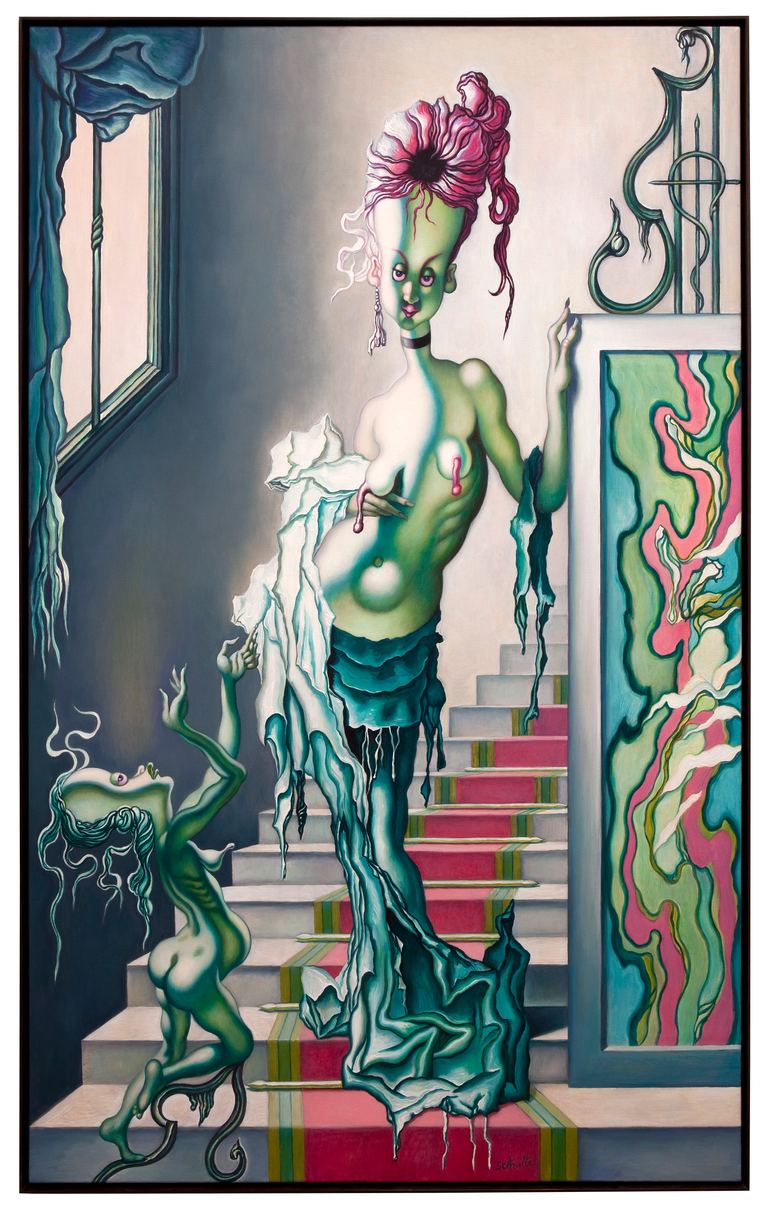
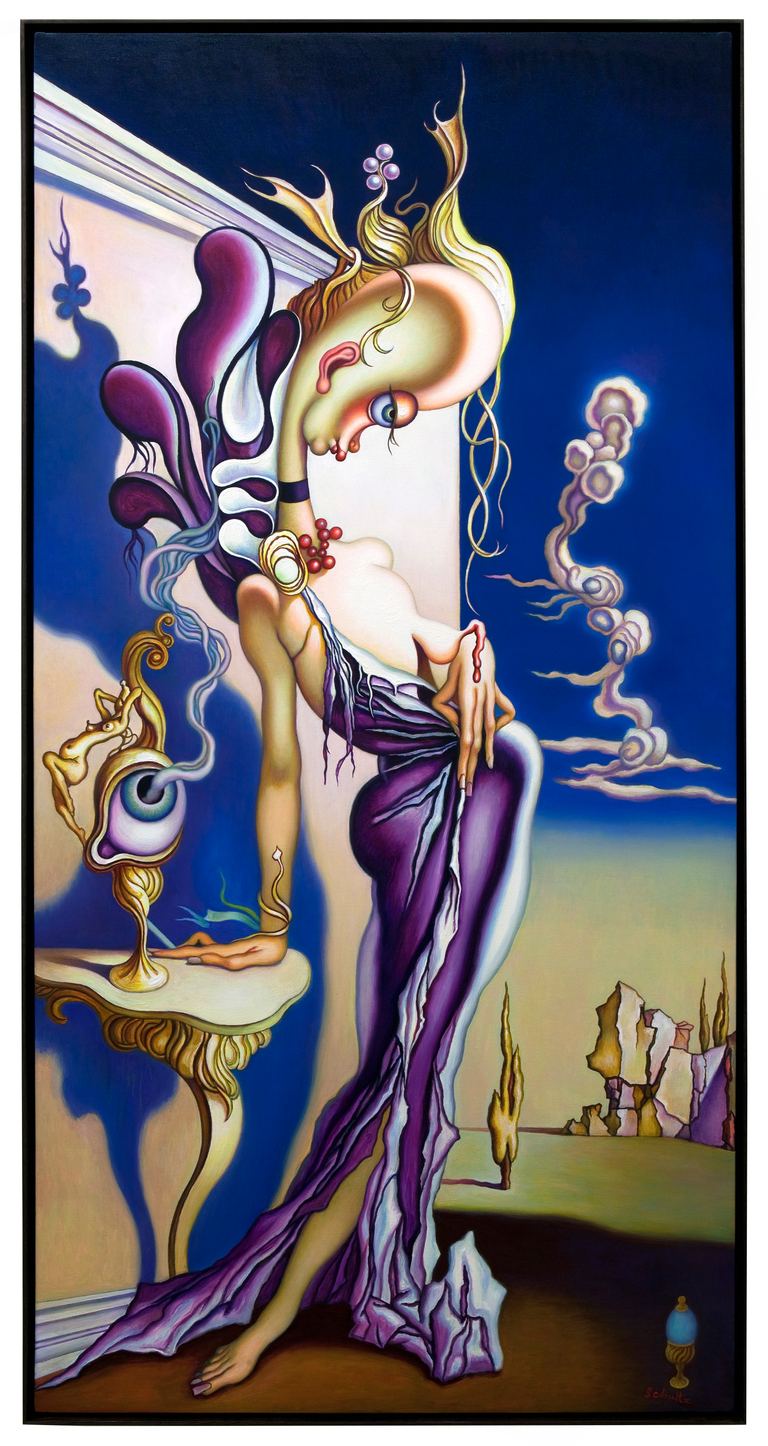
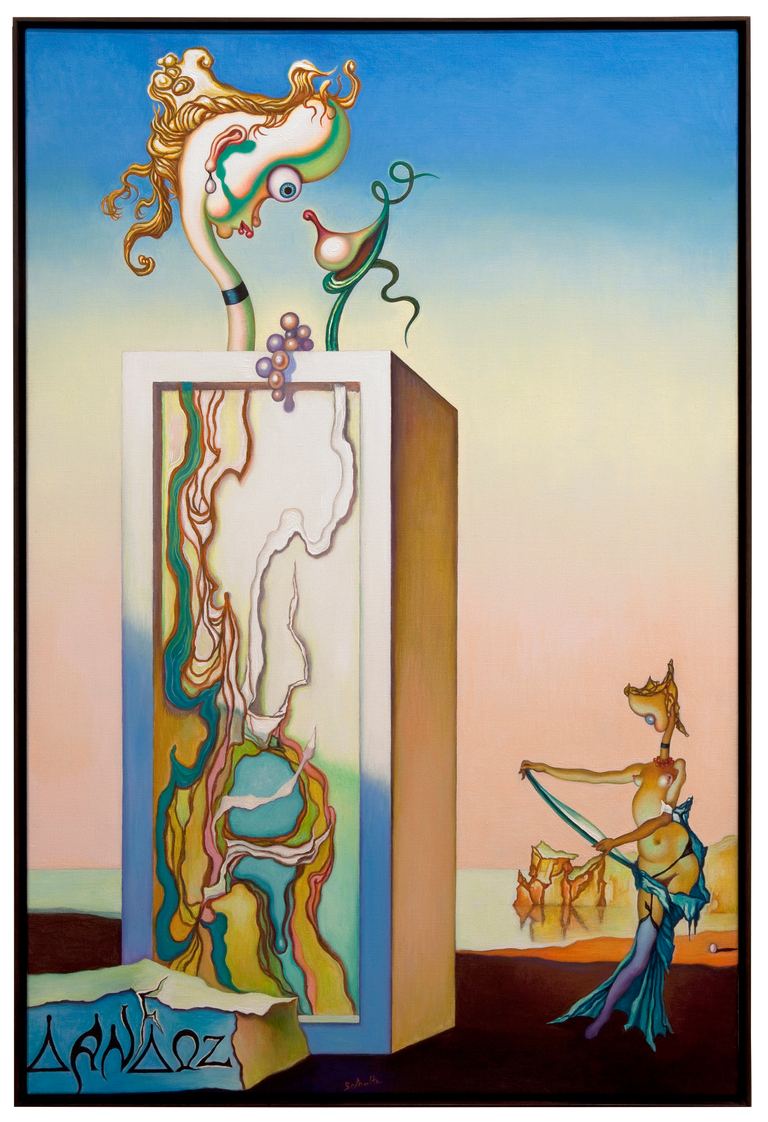
The ‘Boucherism’ of my Rococo paintings can be summarised in two contemporary statements about his work. François Boucher was said to have told one of his students that a woman’s body should be depicted as if having ‘no bones’. At the same time, his paintings were criticised because the draperies had ‘too many folds’. These characteristics, ‘no bones’ and ‘too many folds’, describe a morphology of polymorphous perversity. ‘No bones’, a fleshy roundness approaching the form of the breast, is the morphology of the oral. ‘Too many folds’, the excessively wrinkled and hollow scatology that surrounds the figure, is the morphology of the anal.
Dalí has written about these morphologies. He called them the ‘phantom’ and the ‘spectre’. The phantom is defined in terms of nutritive volume and narcissistic tactility; the spectre in terms of disintegration, metallic brilliance and ‘fine biological terror’. The phantom is the oral dimension of the maternal phantasm, the filled and reassuring volume, the radiant orb of the mother’s breast, the ‘good object’. The spectre is the anal dimension, which Freud calls ‘anal sadism’. The anal stage succeeds the oral, weaning has begun, and the mother must be punished for her repeated absences. The spectre is the hollow maternal phantasm. Its archetype is the empty mouth of the weaned child, projected to the outside as a ‘phobic object’.
These morphologies govern the Rococo, whether as flesh ‘without bones’ housed in chaotic settings with ‘too many folds’, or, in the Rococo interior, as puddles of phantom comfort (over-blown paintings) displayed in the gilded splendour of spectral rocaille frames, above skeletal mirrors placed opposite one another and reflecting to hollow infinity (the ‘spectral enfilades’).
The historicism of my work has often led me back and forth across the Oedipal divide between the eighteenth and nineteenth centuries, negotiating the shift from polymorphous perversity in its Boucherist innocence to a darker regressive perversity which is decadent and essentially masochistic. The masochist, in psychoanalytic discourse, reinstates in fantasy the primacy of the oral mother. But the mother-child unity can only be imperfectly recreated in a master–slave dialectic; nor can the Oedipal problem be fully rectified, but the punishing role is taken from the father, who is abolished from the fantasy, and given over to the (phallic) mother. The ‘perverse dodge’ is to make the punishment the sexual aim. This is the problem of decadence, and accounts for the mixture of pleasure and horror in art of this kind. (I have in mind an entire trajectory of the gothic neurosis of decadence, starting with the Romantic rehabilitation of melodrama, through to gothic literature, Grand Guignol, Satanic revivalism, corrupt Second Empire opulence, Art Nouveau, Surrealism, the excesses of horror, vampire cinema, death metal etc.).
The primary narcissism of the pre-Oedipal state, the undifferentiation of child and mother (note the signifying mirror at the centre of large Rococo paintings filled with the face of the goddess, or the mother elevated to mythic status in Diego Velázquez’s The Toilet of Venus, c.1647–51) has given way to secondary narcissism via the alienation of the mirror formation. Narcissus has been called the ‘god of painting’. Painting is the fragile flower of the ego reflected in the surface of the pool, castrated, demounted and reassembled with phantom and spectral morphologies.
I was recently in Paris and found uncanny evidence of the phantom and spectral morphologies in a monument of nineteenth-century historicism, the Saint-Michel fountain of 1860. Beneath the neo-mannerist façade with the sculpture of Saint Michael vanquishing Satan, two bronze satanic griffins are spouting water into the pool. They are virtually identical, each with the heads and talons of eagles, the wings of enormous bats and the coiled tails of serpents. The only noticeable difference between the figures, and therefore significant, is that one of the tails ends in a fleshy form, like a swollen tongue, while the other ends in a crab claw. The phantom and the spectre.
Upon discovering this, my first thought was that, like a phantom and spectral déjà-vu of the lost object, Satanism is nowadays the only vital remnant of the Christian tradition, its unconscious residue. Then I realised that within the unconscious, infernal dimension of this ‘Christian’ monument, the oral-masochistic and anal-sadistic components were being directly announced by these phantom and spectral tails.
Finally I wondered if it was here, at this Romantic and Satanic spot in the heart of Paris, that André Breton conceived his famous description of Surrealism, as the ‘prehensile tail of the comet of Romanticism’.
Walter Benjamin observed that ‘the nineteenth century ran its course without in the least appearing to announce the twentieth’. The triumphalism of Art Nouveau in the hysterical setting of the Paris World Fair of 1900 gives no indication of the direction of artistic taste. Far from being the style of the coming century, Art Nouveau was destined to be the swan song of the nineteenth. The twentieth century was instead a new process of Oedipalisation to eradicate the perversity of nineteenth-century historicism. New cruel fathers emerged to rival those of the revolution; first Diderot, then Le Corbusier and Clement Greenberg, vanquishing the excesses of Boucherism, Art Nouveau and the Daliesque.
The orthodox history of twentieth-century modernism, which may be summarised in the sequence: Cézanne–Cubism–abstraction, is a dreary submission to the Oedipus. After the triumphal perversity of nineteenth-century modernity, in manic revolt against the decline of art, the orthodox history of the twentieth century is something like a slow death of art by suicide: the minimalist reduction.
But there is another history, largely unwritten, which may take its inspiration from André Breton’s ‘prehensile tail of the comet of Romanticism’. The sequence here would be: Gustave Moreau–de Chirico–perennial Surrealism. This history would pay heed to the vitality of Surrealism as a force in the art of the present. It would reconstruct the story of twentieth-century art by taking into account the later careers of the symbolist painters of 1900, many of whom lived until the middle of the century. It would give due consideration to the later periods of de Chirico and Dalí, whose grudging inclusions in the history of modernism are limited to the 1910s and 1920s respectively, although both continued painting for decades. Forgotten movements like the Neo-Romantics would be remembered. And above all, the immemorial supremacy of eroticism in the art of painting, briefly reignited in Surrealism and today all but buried beneath the surface of contemporary art, would be restored to its central place as the raison d’être and destiny of painting. This ‘lunar’ history of recent art will need to be written, and it is only within this alternative, perverse and atavistic tradition that my paintings can properly be termed ‘historical’.