Readings
Augusta Vinall Richardson interview with Tim Riley Walsh, curator of Primavera 2025: Young Australian Artists
Tim Riley Walsh
An interview with Augusta Vinall Richardson by Tim Riley Walsh curator of Primavera 2025: Young Australian Artists at the Museum of Contemporary Art Australia
Tim Riley Walsh, 'Augusta Vinall Richardson interview with Tim Riley Walsh, curator of Primavera 2025: Young Australian Artists', interview with Augusta Vinall Richardson, Museum of Contemporary Art Australia, 2025, https://www.mca.com.au/exhibitions/primavera-2025-young-australian-artists/augusta-vinall-richardson/
An interview with Augusta Vinall Richardson by Tim Riley Walsh curator of Primavera 2025: Young Australian Artists at the Museum of Contemporary Art Australia
Tim Riley Walsh, 'Augusta Vinall Richardson interview with Tim Riley Walsh, curator of Primavera 2025: Young Australian Artists', interview with Augusta Vinall Richardson, Museum of Contemporary Art Australia, 2025, https://www.mca.com.au/exhibitions/primavera-2025-young-australian-artists/augusta-vinall-richardson/
Collection: Museum of Contemporary Art Australia
Tim Riley Walsh (TRW): When did abstraction enter your life?
Augusta Vinall Richardson (AVR): I’ve always thought abstractly. At a younger age, I remember thinking figurative representation wasn’t important. Some people think that if it's not representational, it's not art. Or, at least, that used to be a common way of thinking. But it didn't bother me. It's been a constant presence, with all the drawings I'd do in my room when I was younger. When I was much younger it was faces and figures, but as I got older, it was abstract shapes and compositions. I knew that I wanted to always be doing something creative because it made me feel the most content. I guess it helped me understand the world I was in.
TRW: Primavera 2025 has been shaped by this loose idea of industrial abstraction, and more generally, art-making in relation to industrial processes and the machine, and technology’s involvement in this. How do you see your work fitting into this?
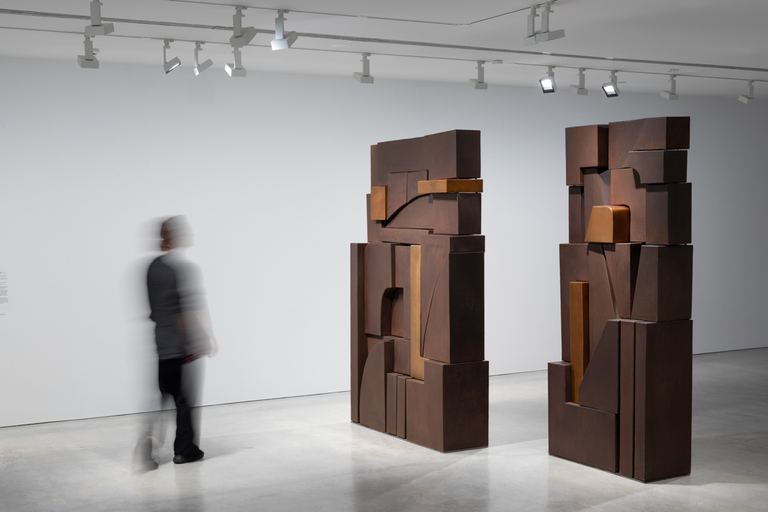
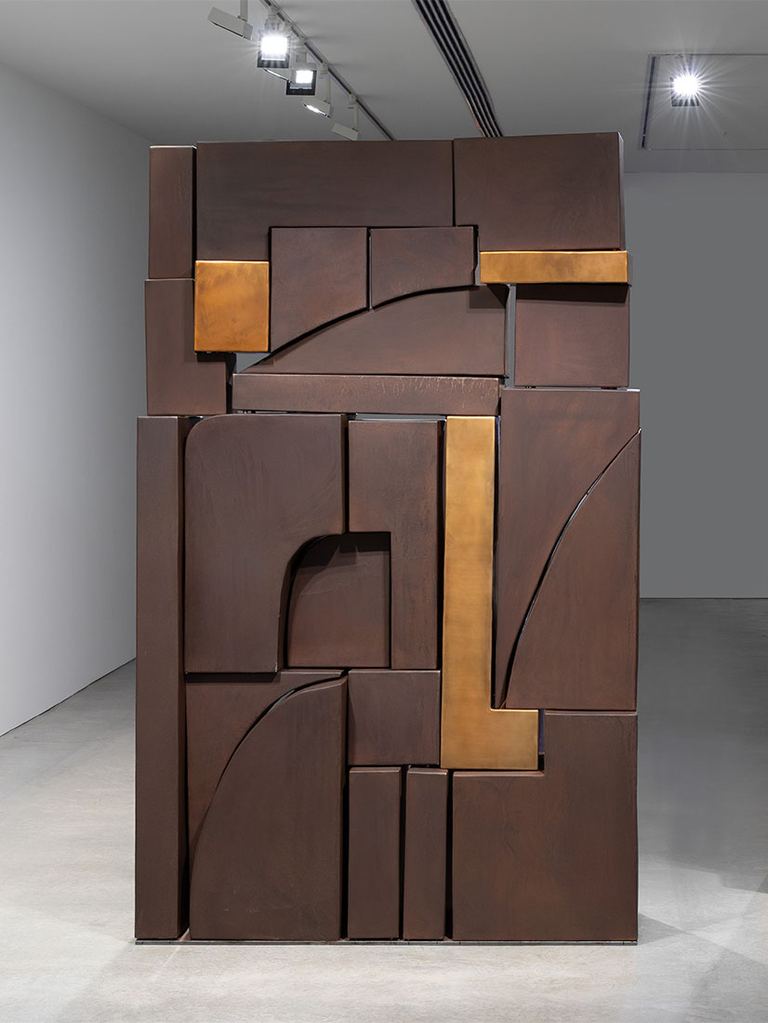
AVR: I think, in terms of art-making, my work for this show is deliberately very analogue – from the planning to the fabrication. I'm not against technology. I'm just sidestepping those processes, because that's what I need as an individual. But more importantly, I want the work to express my need, but also, our social need, for tactile engagement, tactile experiences, immediacy beyond screen-based interactions.The social world is present in my practice. I like to think of the abstract forms I create as representations of social structures. Society is made up of many individual parts that come together to make a larger structure. And the interlocking shapes in my work all rely on one another to form the composition. In all my work that's the case.But also, the materiality, as much as the forms and composition, play an important role in the works’ communication. I choose to leave the material itself raw, showing its essence, showing the surface, and how it's been affected by the environment physically. I have purposefully left parts of my works for Primavera out in the yard to age.The work is a process of trying to humanise a material that is historically seen as unforgiving, mechanical, practical. I've softened the edges of the shapes and applied all these treatments with intention. I'm attempting to challenge the so-called limitations and capacities of steel.
TRW: Are there other unifying ideas in your art that you’d like to touch on?
AVR: The compositions of my works are defined by their precarious nature. It is a reminder that everything is contingent on one another, it could all just fall apart. The glue – society – is tenuous and volatile. It is not solid. I'm playing on that idea with the metal itself; typically, it is treated as immovable, forever. There is also a tendency to see the structures built from it as immovable. And that they don't need tending or work or questioning. Those themes are imbued in the work for me.
TRW: What drew you to metal?
AVR: I'd always been interested in using metal because of its structural integrity and the quick, very procedural immediacy of it. In a way that wood doesn't have, nor stone, or other materials. Before metal I was working with fabric and papier mâché and wire. Flimsy, crafty, transient materials. I was looking for something that would provide authority – authority outside myself.In a way, metal is a known quantity. The material itself, people understand it. At the same time I was thinking all these things I became friends with a metal fabricator. And we worked together to make my first work with metal, and once I'd made that I felt like this was exactly what I've been searching for. It felt right.
TRW: What does the factory line, as a structure of mass industrial labour, a commercial mechanism, mean in the context of your practice – which is very much a solo, creative production. How does that that tension function for you?
AVR: It's a productive tension, because I'm constantly having to resist using technology to make it easier to produce these works. If I do that the work will lose something. I think that's the whole point of the work itself – well, not the whole point – but there's no point working in metal if I'm going to work with it the way everyone else is working with it. You're just echoing a system that's already in place.It is important for me to constantly resist these commercial and ‘productive’ means of production. Everyone wants me to get all my shapes laser cut for example. The work would lose its essence, if that were to happen. Being reminded of those processes through their presence in my immediate environment is important, it helps me realise and refocus my energies.
TRW: You’ve chosen to use corten steel for your Primavera works. What was the impetus?
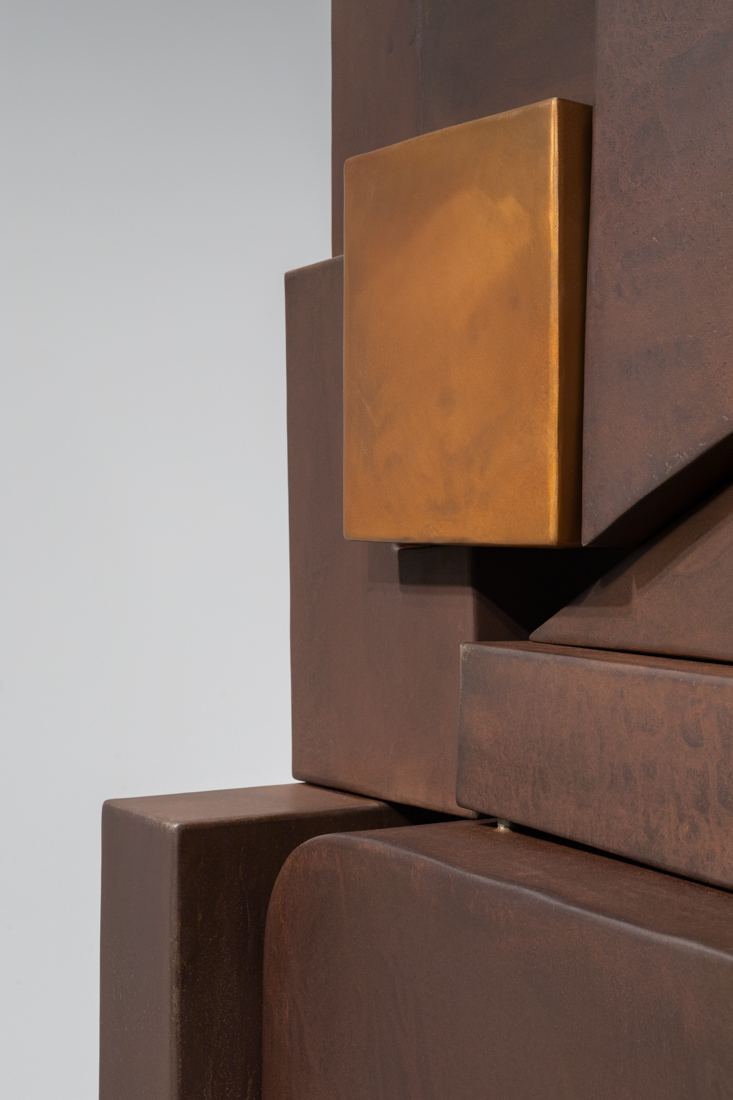
AVR: Art historically, I'm very inspired by the American artist Louise Nevelson. She made these series of works called Atmosphere and Environment, and with some of these works she worked closely with the famous Lippincott Inc. fabrication company in America and used corten for a lot of these works. Like Nevelson, my works are monochromatic as well, so to speak. Or at least, no colour is added. I use the natural colour that the material is.I'm interested in corten being quite expressive – in the sense that it's being changed, altered, affected by the environment it's in. It's more explicit in corten, because it's designed to weather, whereas all other metals are more subtly affected by their environment. Or they lend themselves to have treatments applied to allow them to remain unchanged for longer periods of time. This quality of sensitivity means, at times, corten is less desired.It is a very practical material as well. In a way it's so ugly and kind of gross? I find it really unattractive and challenging to work with, in one sense. In another, it's far softer and more pliable than stainless steel – which is what I usually work with – so, it's freeing. Because I don't have to preserve its surface. I don't have to worry, its inherent experience is to age. It's designed to. And ultimately, I have a vision of these works being outside and being fully altered by the environment. Over and over again; and over a long period of time.I think that was the draw to bronze. Though predominantly corten, there are bronze pieces within these works as well. There's an existing hierarchy between them. Corten is cheaper and less valued in society and as an art-making material, compared to the bronze. With corten, I was also interested in the colour, it being brown, and over time green browns emerge, and it becomes darker. If it's left outside untreated, it can get a velvety surface also. These qualities drew me to working with it.
TRW: Coming back to abstraction. It is a language that lends itself to timelessness. You said there's been this presence of abstraction for you since you were young. What is the power of it, for you, and what is its relationship to time?
AVR: Well, abstract art, there's a freedom in it. There's an openness. For me, defining a work in words, in language, defies the whole point of art. Undefinable through language. That's why abstraction is so important to me. I've always found it hard to communicate what I was thinking, what I was feeling. Using a visual language – drawing, brushstrokes, mark-making, textures, layering – all that communicates something that doesn't have to be spoken. It can just be experienced.That's what draws me again and again to making sculpture. That's why I feel like sculpture is important now. It forces an embodiment. It forces you to be embodied, in the moment. And that connection to the physical self, I think, is what I'm interested in and what I think is important.
Augusta Vinall Richardson (AVR): I’ve always thought abstractly. At a younger age, I remember thinking figurative representation wasn’t important. Some people think that if it's not representational, it's not art. Or, at least, that used to be a common way of thinking. But it didn't bother me. It's been a constant presence, with all the drawings I'd do in my room when I was younger. When I was much younger it was faces and figures, but as I got older, it was abstract shapes and compositions. I knew that I wanted to always be doing something creative because it made me feel the most content. I guess it helped me understand the world I was in.
TRW: Primavera 2025 has been shaped by this loose idea of industrial abstraction, and more generally, art-making in relation to industrial processes and the machine, and technology’s involvement in this. How do you see your work fitting into this?
AVR: I think, in terms of art-making, my work for this show is deliberately very analogue – from the planning to the fabrication. I'm not against technology. I'm just sidestepping those processes, because that's what I need as an individual. But more importantly, I want the work to express my need, but also, our social need, for tactile engagement, tactile experiences, immediacy beyond screen-based interactions.The social world is present in my practice. I like to think of the abstract forms I create as representations of social structures. Society is made up of many individual parts that come together to make a larger structure. And the interlocking shapes in my work all rely on one another to form the composition. In all my work that's the case.But also, the materiality, as much as the forms and composition, play an important role in the works’ communication. I choose to leave the material itself raw, showing its essence, showing the surface, and how it's been affected by the environment physically. I have purposefully left parts of my works for Primavera out in the yard to age.The work is a process of trying to humanise a material that is historically seen as unforgiving, mechanical, practical. I've softened the edges of the shapes and applied all these treatments with intention. I'm attempting to challenge the so-called limitations and capacities of steel.
TRW: Are there other unifying ideas in your art that you’d like to touch on?
AVR: The compositions of my works are defined by their precarious nature. It is a reminder that everything is contingent on one another, it could all just fall apart. The glue – society – is tenuous and volatile. It is not solid. I'm playing on that idea with the metal itself; typically, it is treated as immovable, forever. There is also a tendency to see the structures built from it as immovable. And that they don't need tending or work or questioning. Those themes are imbued in the work for me.
TRW: What drew you to metal?
AVR: I'd always been interested in using metal because of its structural integrity and the quick, very procedural immediacy of it. In a way that wood doesn't have, nor stone, or other materials. Before metal I was working with fabric and papier mâché and wire. Flimsy, crafty, transient materials. I was looking for something that would provide authority – authority outside myself.In a way, metal is a known quantity. The material itself, people understand it. At the same time I was thinking all these things I became friends with a metal fabricator. And we worked together to make my first work with metal, and once I'd made that I felt like this was exactly what I've been searching for. It felt right.
TRW: What does the factory line, as a structure of mass industrial labour, a commercial mechanism, mean in the context of your practice – which is very much a solo, creative production. How does that that tension function for you?
AVR: It's a productive tension, because I'm constantly having to resist using technology to make it easier to produce these works. If I do that the work will lose something. I think that's the whole point of the work itself – well, not the whole point – but there's no point working in metal if I'm going to work with it the way everyone else is working with it. You're just echoing a system that's already in place.It is important for me to constantly resist these commercial and ‘productive’ means of production. Everyone wants me to get all my shapes laser cut for example. The work would lose its essence, if that were to happen. Being reminded of those processes through their presence in my immediate environment is important, it helps me realise and refocus my energies.
TRW: You’ve chosen to use corten steel for your Primavera works. What was the impetus?
AVR: Art historically, I'm very inspired by the American artist Louise Nevelson. She made these series of works called Atmosphere and Environment, and with some of these works she worked closely with the famous Lippincott Inc. fabrication company in America and used corten for a lot of these works. Like Nevelson, my works are monochromatic as well, so to speak. Or at least, no colour is added. I use the natural colour that the material is.I'm interested in corten being quite expressive – in the sense that it's being changed, altered, affected by the environment it's in. It's more explicit in corten, because it's designed to weather, whereas all other metals are more subtly affected by their environment. Or they lend themselves to have treatments applied to allow them to remain unchanged for longer periods of time. This quality of sensitivity means, at times, corten is less desired.It is a very practical material as well. In a way it's so ugly and kind of gross? I find it really unattractive and challenging to work with, in one sense. In another, it's far softer and more pliable than stainless steel – which is what I usually work with – so, it's freeing. Because I don't have to preserve its surface. I don't have to worry, its inherent experience is to age. It's designed to. And ultimately, I have a vision of these works being outside and being fully altered by the environment. Over and over again; and over a long period of time.I think that was the draw to bronze. Though predominantly corten, there are bronze pieces within these works as well. There's an existing hierarchy between them. Corten is cheaper and less valued in society and as an art-making material, compared to the bronze. With corten, I was also interested in the colour, it being brown, and over time green browns emerge, and it becomes darker. If it's left outside untreated, it can get a velvety surface also. These qualities drew me to working with it.
TRW: Coming back to abstraction. It is a language that lends itself to timelessness. You said there's been this presence of abstraction for you since you were young. What is the power of it, for you, and what is its relationship to time?
AVR: Well, abstract art, there's a freedom in it. There's an openness. For me, defining a work in words, in language, defies the whole point of art. Undefinable through language. That's why abstraction is so important to me. I've always found it hard to communicate what I was thinking, what I was feeling. Using a visual language – drawing, brushstrokes, mark-making, textures, layering – all that communicates something that doesn't have to be spoken. It can just be experienced.That's what draws me again and again to making sculpture. That's why I feel like sculpture is important now. It forces an embodiment. It forces you to be embodied, in the moment. And that connection to the physical self, I think, is what I'm interested in and what I think is important.