Readings
It Started With a Family Tree. It Became ‘a Memorial to Everything.’
Aruna D’Souza
A search for his origins led Archie Moore to the farthest corners of Australia’s history and the Golden Lion prize at the Venice Biennale.
A search for his origins led Archie Moore to the farthest corners of Australia’s history and the Golden Lion prize at the Venice Biennale.
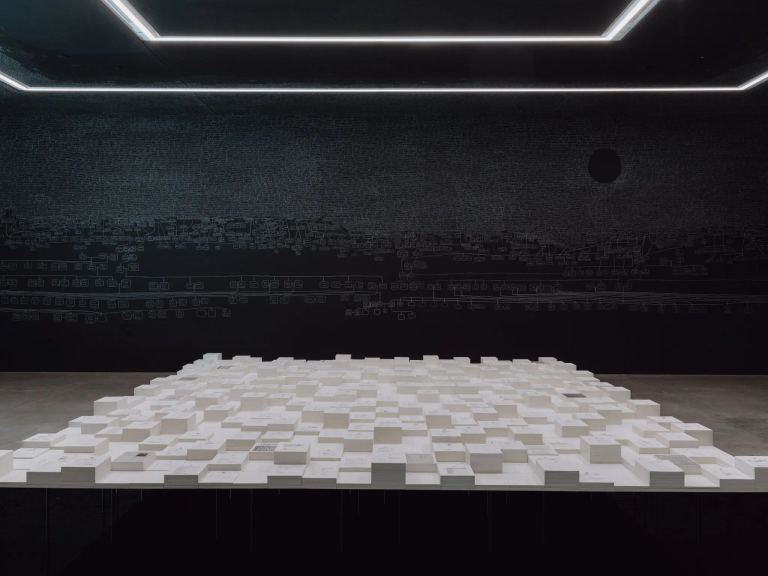
At the center of Archie Moore’s Kith and Kin, installed in the Australian pavilion at this year’s Venice Biennale, a large tabletop hovers above an inky reflecting pool. The table holds stacks of paper, each pile an official record of an Indigenous Australian’s death in custody since 1991. On the pavilion’s black walls, a chalk drawing traces a genealogical map.
The diagram starts at the bottom with the artist himself (“Me”) and soars upward and outward — to his paternal side in England and Scotland, and to his maternal side, with thousands of names representing 2,400 generations and more than 65,000 years of Aboriginal life on the Australian continent. Erasures and gaps indicate massacres, disease outbreaks and other events that interrupted not only family lines, but the oral transmission of First Nations history.
Amid the sensory overload of the Biennale, which runs through Nov. 24, Moore’s installation offers an opportunity to slow down and take in something that begins with the history of Australia’s Indigenous people but ultimately connects to the rest of humanity and even to the natural world. As the artist has described it, it’s “a memorial to everything that has ever lived.”
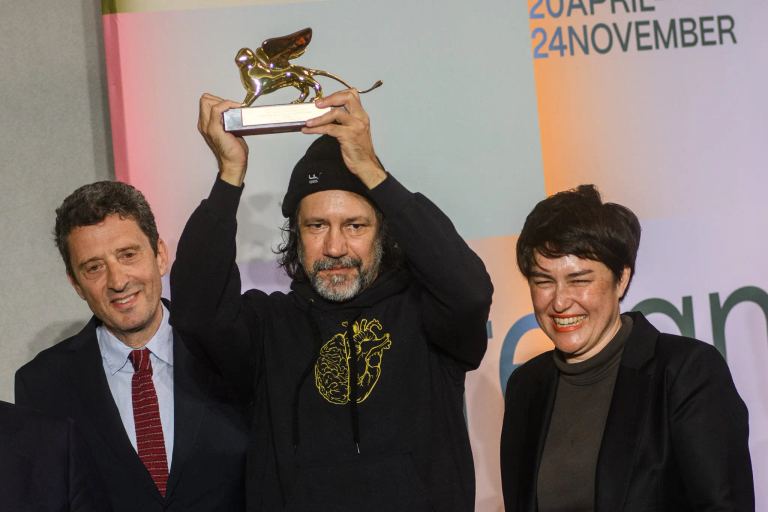
Moore made history in April by becoming the first Australian artist to win the exhibition’s coveted Golden Lion award. The achievement was all the more remarkable given that Moore is only the second First Nations artist to have a solo presentation in Australia’s national pavilion, he has had very few exhibitions outside Australia, and he doesn’t show at a blue-chip gallery. The announcement of the prize was celebrated in Australia’s Parliament in May. In August, the government announced it was purchasing the work, making it a gift to both the Queensland Art Gallery | Gallery of Modern Art in Brisbane and the Tate museum group in London.
But perhaps more significant than the official recognition has been its meaning for First Nations people, who are still waiting for a full reckoning with Australia’s colonial history. That history began with the arrival of British fleets in 1788 and has included the displacement of Indigenous peoples from their land, suppression of their languages, forced removal of children from their families, indentured labor, and, in recent decades, a disproportionate degree of incarceration.
It also represents a career-long personal reckoning for the artist. In a recent interview in
Brisbane, Moore, 53, said, “I wasn’t interested in my family history for a long time, because I was embarrassed and ashamed about being Aboriginal,” a fact he now attributes to internalized racism. “A lot of my work is me trying to figure out who my family is.”
Moore grew up in a tiny town in the Western Downs region of Queensland, an upcountry state that was sometimes known as “the Deep North,” an ironic reference to the Jim Crow-era U.S. South. Moore’s father, who was born in 1908, descended from a man who arrived on a British penal transport ship in 1820. His mother was Aboriginal. Neither parent spoke much about their origins nor had any real relationship with their families, Moore said.
After taking art classes at a trade school, Moore began a degree program in art at the Queensland University of Technology in Brisbane. He stayed in the city, post graduation, coming into contact with a large, politically active Indigenous population and a group of Indigenous artists, including members of the proppaNOW collective, who were working in nontraditional, conceptual modes.
Though he never joined the group, his early work shares its strategy of challenging racist stereotypes, often with a healthy dose of humor. After 2010 or so, he moved from sculpture and photography into installation. The shift coincided with a greater focus on his own obscure origins and their connection to Aboriginal history.
He began making reconstructions of family dwellings, including Archie Moore: 1970-2018, a work he created in 2018 at the Griffith University Art Museum in Brisbane. It was a series of chambers based on memories of his childhood house and his grandmother’s dirt-floored, corrugated-iron home, down to the smell of kerosene from the gas lamps and Dettol antiseptic soap.
Another path led to the Bigambul people and his great-great-grandmother, a woman known as Queen Susan of Welltown. And he found a 1938 interview with his great-grandmother Jane Clevin and a photograph in the papers of an anthropologist; the researcher had also taken a piece of her hair, which remained preserved in the South Australian Museum in Adelaide. (It was returned to Moore as of last week, at his request.)
Moore cross-checked snippets of oral histories against government records, often created as part of a system that he described as the “scrutiny and surveillance of the state” over Aboriginal people: applications to move from one place to another, to access money, to buy a railway pass, and so on, that white people didn’t have to complete. (Some of these documents appear on the table in Kith and Kin, supplementing records related to deaths in incarceration.)
The family tree that we see in Kith and Kin is both carefully documented and, when that documentation peters out, speculative. Moore invented some of the names, and sometimes used generic ones, based on the specious race science used by Australian authorities (“full blood woman,” “octoroon man”), on racial slurs, and on conventions of how names are formed in the languages of the Kamilaroi and Bigambul people. As is usual in Aboriginal belief systems, animals, waterways and the land also appear as ancestors.
The expansiveness of the diagram, which begins to look like some kind of star map as it reaches the ceiling, contrasts with the sharp-edged stacks of official documents at the center of the room, which are placed just far enough from the edge of the reflecting pool that they cannot be read clearly — a deliberate choice, said Kevin O’Brien, an architect and longtime collaborator of Moore’s who worked on the project.
“The experience becomes a direct mirror of what Archie, myself and other First Nations people experience,” O’Brien said. “We know that official documents exist, and sometimes we occasionally get to see them, but they’re always just out of reach.”
“A lot of our stories are very easily shot down,” he added. “People like to say ‘Well, there’s no proof’ and that discounts your experience,” he said. “What’s great about the table is that, there you go, there’s the official white records. So that’s the official history on the table, and it’s undeniable. It’s sitting there, like some sort of document cemetery.”
When the pavilion first opened, visitors determined to read the documents kept accidentally stepping into the reflecting pool’s ink-tinted water. “Some people do tend to get lost in the forensic side of things, which kind of misses the point,” said Ellie Buttrose, the Queensland Museum curator who worked with Moore on the pavilion.
“People have been moved by the sense of loss in the work,” Buttrose said. “But there’s an almost overwhelming sense of connection, too, and the strength of those connections and how they endure.”
One of the subtle details of the installation is a low window along one wall of the pavilion that looks directly onto one of Venice’s canals. “It relates how water connects the pavilion to the canal to the lagoon, and then flows to the Adriatic Sea, and then flows into other seas, and flows around the world, even around Australia,” Moore said. “It was a way to talk about how we’re all connected on Earth,” he added.
“That’s what the family trees are about as well. We only have to go back 3,000 years to discover we all have a common ancestor,” he said. “We realize we’re all one people, one global family.”