Readings
Justene Williams: A New Cathedral for Socialism
James Gatt
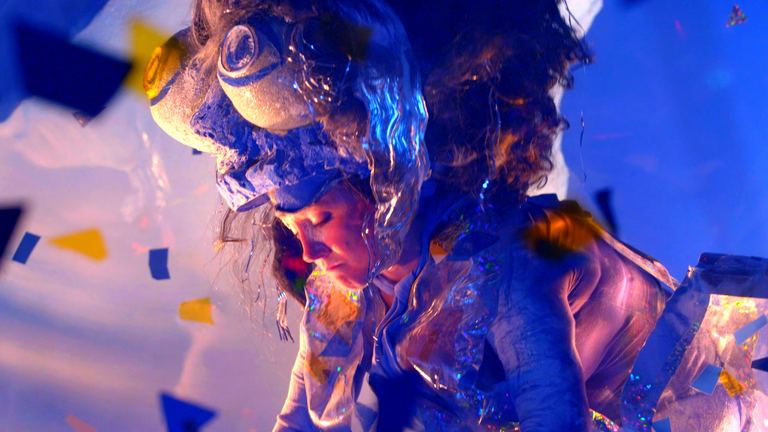
Justene Williams: Once We Were Mudskippers, Queensland Art Gallery, Meanjin/Brisbane, 3 October 2026–7 March 2027
Justene Williams: Once We Were Mudskippers, Queensland Art Gallery, Meanjin/Brisbane, 3 October 2026–7 March 2027
An art-school friend once referred to me as a
sophisticated bogan. I’ve enjoyed the term ever since. In capturing the duality
of a poor kid from Sydney’s western suburbs committed to art, fashion,
philosophy, and poetry, my friend incidentally poeticised a perceived
incompatibility between class and cultural consciousness, repositioning the
otherwise egalitarian aims of art as esoteric.
Though I first properly felt class distinction at
university—in peers who seemed to follow different social codes, wore designer
clothes, and lived in beautiful eastern-suburbs homes without needing to work—I
hadn’t grasped how profoundly it shapes empathy or relationships. While at
university I began working at Sarah Cottier Gallery, where I met Justene
Williams. We have remained friends and collaborators ever since, based on our
shared commitment to art despite—or maybe because of—our plebeian backgrounds.
We speak the same language and share reference points. We believe art’s
transformative power supersedes class. For us, art’s punchlines lie in
subversions of established orders, often at the expense of our own comforts.
We’re both sophisticated bogans.
Born in 1970 in Darug/Western Sydney, Williams
graduated from the University of Western Sydney in 1991. That year she had her
first solo exhibition, at 2701+m3, above Firstdraft in Annandale, run by artist
Mikala Dwyer. The show featured a single sculpture: a copper-clad suitcase
filled with vegetable oil. Williams now lives in Meanjin/Brisbane, where she is
a Senior Lecturer at Queensland College of Art and Design.
Williams’s early experimental photography work
quickly evolved into an energetic amalgam of performance, sculpture, and video.
She is now renowned for her elaborate costumes and immersive environments,
which repurpose found detritus and humble materials into sets for delirious
actions that invoke the spirits of historical avant-gardes while alluding to
her autobiography. Her video Milk Seeped in Bread and Rocked the Leg (2012–3),
for instance, features an ad hoc environment comprising geometric cardboard claddings
and old furniture, in which Williams stultifies domestic activities with her
mother and father as a way of processing her father’s mesothelioma.
Documentation of similar performances is screened within sprawling
installations or gesamtkunstwerke (total works of art).
Shaped equally by her time in her father’s wrecking
yard, her years in retail, and her close study of art history—particularly the
Bauhaus, dada, and constructivism; futurism and fluxus, and arte
povera—Williams’s work draws its remarkable inventiveness from lived and
learned experience: proletarian and artist, pleb and intellectual. The
‘cathedral of socialism’—imagined by Bauhaus founder Walter Gropius to describe
a future society where art, craft, and architecture would unite to serve the
common good—is made manifest in Williams’s incredible worlds, far from European
art history, in the Australian suburbs. Gropius’s spiritualisation of class
equality echoes in Williams’s redistribution of the means of cultural
production; a kind of sophisticated boganism.
Thinking about Williams’s work over the years, I’ve
become fascinated with the idea that our bodies are vehicles of evolving
information, coded by lived experience and expressed through behaviour.
Sociologist Pierre Bourdieu referred to this as habitus: the dispositions
shaped by class and unconsciously reproduced through the body. Neither destiny
nor identity, habitus is the accumulation of what we inherit and how it shapes
our perception and our place in and views of the world. Using discarded materials,
bodily memory, and historical art, Williams deals with what we inherit and its
capacity for reinvention, fusing class and cultural consciousness, capitalist
and anti-capitalist visions, failures and desires, into spectres of where we’ve
been and where we could go.
In his unfinished book Acid Communism, philosopher
Mark Fisher argues that working-class consciousness and cultural consciousness
were never meant to be separate projects. Against the neoliberal positioning of
culture as elitist or purely economic, he imagines reconnecting political
imagination with aesthetic experience. Williams has been quietly performing
something akin to this for more than three decades. Her practice makes use of
art history like it does wrecking yards and shopping centres, inhabiting it
through a body whose experiences of labour and intellectual life are
inseparable. By channelling her own labour histories through art, she tests the
working-class body as a site of continual conditioning, asking: Can this
conditioning be meaningfully rewritten? Can conditions inherited through
personal experience, work, and so on provide grounds for association and
imagination? Can we reimagine class as liberating rather than subjugating?
Williams’s roots in the so-called ‘grunge art’
scene suggest they can. Coined by art critic Jeff Gibson in his landmark 1993
essay ‘Avant-Grunge’, the term referred to a group of Gadigal/Sydney and
Naarm/Melbourne artists—including Williams, Dwyer, Hany Armanious, Dale Frank,
and Adam Cullen—who were subverting traditional gallery spaces with
intentionally messy, trash-strewn, and lo-fi installations. Gibson’s essay
title reconciles established art with a new counterculture scene characterised
by DIY aesthetics, anti-form installations, and larrikinism.
Earlier that year, Frank curated Rad Scunge at
Karyn Lovegrove Gallery, Naarm/Melbourne. Reviewer Chris McAuliffe wrote, ‘it
seems to me that the artists are playing the margins, triggering patterns of
interpretation which enable the viewer to salvage some metaphorical or art
historical credibility for the objects, only to have the pieces collapse back
into non-art status under the sheer weight of their tackiness’. Here is the
dilemma of reconciling class and culture: Can junk be art? Can grunges be artists?
McAuliffe continues: ‘The viewer’s almost desperate
need for these objects to be art—to will them into artness—is mapped by Justene
Williams’s Untitled (1993). She places a magnifying sheet over an op-shop
painting, suggesting that the object can be willed into art status by the
viewer’s persistent, fetishistic attention.’
Even in her early work, Williams demonstrated class
tensions. Referencing the detritus and disciplinary conditions of working life
and suburban leisure—factories, offices, and shopping malls—she and her fellow
grunge artists deployed sophisticated boganisms, invoking the endless
extractions of consumer capitalism to critique a system that determined their
class status. Their recycling is less an ecological gesture than a condition of
necessary improvisation. As curator Anneke Jaspers, discussing Williams’s work,
observes: ‘Improvisation is the epitome of being vulnerable’.
Throughout her career, Williams has realigned the
egalitarian aims of art. She has channelled constructivism through the
contemporary construction worker in Given That/You Put a Spell on Mine/Uterus
(2014), reimagined Boccioni’s futurist figure as female for Boccioni Babe
(2022), and recast the ancient sheela na gig as a distinctly Australian woman
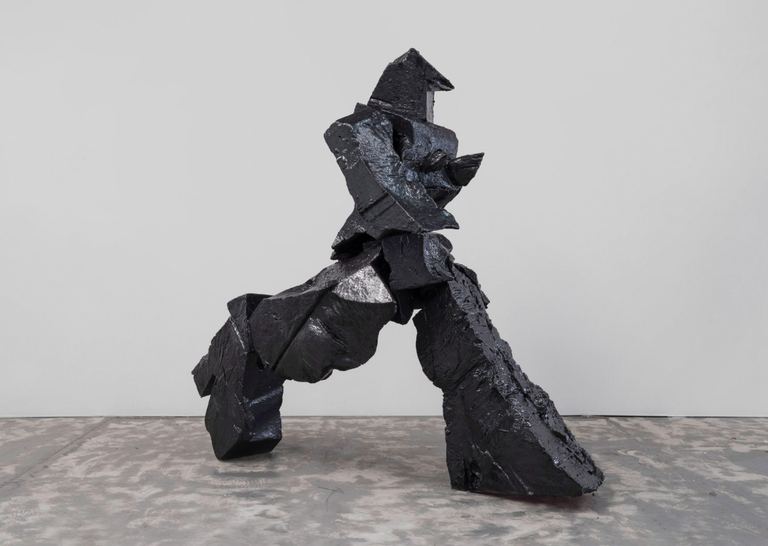
for an aptly titled monumental bronze sculpture Sheila (2024). In her hands,
art becomes a portal through which anything—from mythology to pop culture,
ballet costumes to Christmas trees, boganisms to cultural artifacts—holds
potential for new meaning and social value. Rather than treating art history as
fixed or authoritative, she salvages it, cannibalises it, and puts it back to
work. This includes her own oeuvre. Her installations don’t reconstruct the
past but re-envision it, revealing inheritance as provisional. Australian art
is often positioned provincially as blind emulation of—or deference
to—Euro-American art. But Williams shows us that derivation and adaptation are
alive with potential. For artist-alchemists like her, art can transform
inherited objects and histories, giving them a new use value.
These notions of inheritance and adaptation will
reach an ambitious culmination in Once We Were Mudskippers, Williams’s
forthcoming exhibition at Queensland Art Gallery. Her largest exhibition to
date, it brings together major installations from the past fifteen
years—including Santa Was a Psychopomp (2014), Victory Over the Sun (2016), A
Metal Cry (2017), and The Vertigoats (2021)—alongside new commissions,
surveying a practice that has remained remarkably coherent while reinventing
itself. Rather than present bodies of work discretely or as they were first
presented, it maps Williams’s oeuvre as an evolving project in which works are
readapted. Like the wrecking yards that first shaped her imagination, her
oeuvre is scoured for parts to be reconfigured into dynamic new installations.
Costumes are reworked and shown on mannequins alongside new sculptures; new
installations are forged from parts of old ones; past videos are scattered
throughout new installations. It will be an archipelago of theatrical islands,
each with its own ‘community-cum-dance-troupe’, opening channels of exchange,
producing an interconnected network.
As Stephen Zepke writes in the catalogue:
‘Williams’s work, its excessive, messy, uninhibited and wildly animated
conglomeration, shows us how to liberate matter from our pre-formatted ideas,
our sad dreams and our tired and burnt-out bodies, in order to experience
something new, something unrestrained by what we know, something dragged out of
the future.’
Once We Were Mudskippers aptly starts under the
water, with a riff on Sadko, a 1911 production by the Ballets Russes derived
from the underwater scene in Nikolai Rimsky-Korsakov’s Russian bylina-opera of
the same name. It follows Williams’s last solo institutional project, Making Do
Rhymes with Poo, commissioned by Te Uru Waitākere Contemporary Gallery, Tāmaki
Makaurau/Auckland, in 2024, then reimagined for Contemporary Art Tasmania,
Nipaluna/Hobart, in 2025. Williams saw Making Do as an evolving work, surviving
through adaptation.
Built from locally sourced materials gathered from
junkyards, each Making Do installation rematerialised industrial and consumer
histories of the places they were made. Williams’s improvised live performances
transformed her environments over the course of seven days or a ‘working week’.
Her performance personas developed daily. In Nipaluna/Hobart, they included a
swamp attendant tending to her ‘habitus’ like a caretaker.
The mudskipper emerges from Making Do’s primordial
swamp, not escaping its conditions but evolving through them. Here Once We Were
Mudskippers finds its central metaphor: an amphibious fish capable of pulling
itself from swamp to land, with evolution as muddy, improvised, yet insistent.
The exhibition title ‘places us all in the primordial swamp together’, writes
exhibition curator Ellie Buttrose, suggesting that we all emerge from a swamp
of inherited histories—of labour, class, and culture—‘looking for our own way
out with daring adaptability’.
We might not all be sophisticated in the way my art-school friend meant—genteel, orthodox, privileged—but we are all products of evolution and capable of adapting, which for Williams, as for life everywhere, is the most sophisticated thing to be.
James Gatt is a curator and writer based in Gadigal/Sydney. In 2024 he curated Justene Williams: Making Do Rhymes with Poo at Te Uru Waitākere Contemporary Gallery, Tāmaki Makaurau/Auckland, where he was curator from 2023 to 2025.