Readings
Justene Williams: Embodied Knowledge
Ellie Buttrose
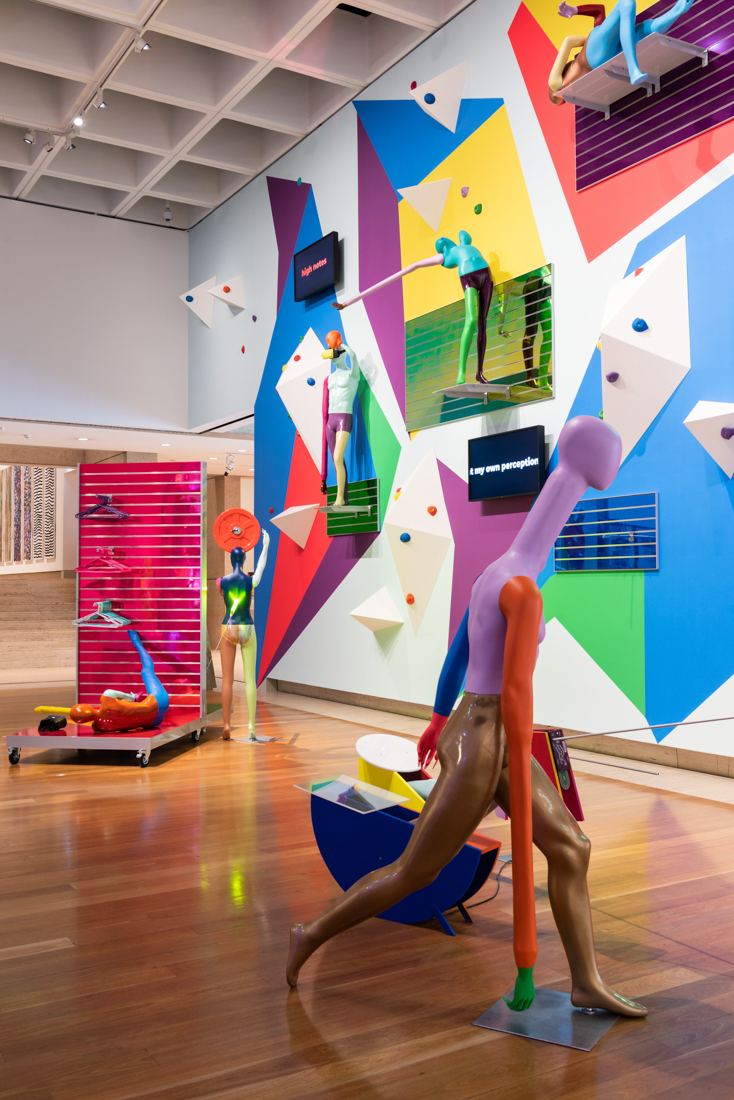
In a riot of colour, The Vertigoats 2021 humorously comments on the desire to ‘climb the ladder’ of the social and economic order. In this installation by Justene Williams, a vivid array of mannequins pose across an expansive gallery wall. Lurid, metallic department-store shelving further adds to the vision of a hyped-up retail environment. While shop mannequins once served as a material translation of the ideal body, here Williams stretches and distorts their limbs so extensively that they almost lose their relationship to the human figure. The artist is not seeking to create an absurd artwork; rather, she draws our attention to the ridiculousness of contemporary capitalism — in this instance, the images created by the fashion industry for veracious consumption.
Reinforcing the vertigo alluded to in the artwork’s title, colourful plastic climbing holds and geometric boulders are dotted across the space in reference to in-vogue climbing gyms. All across the world, inner-city light industrial spaces are currently being converted into pop-coloured, tessellated exercise terrains akin to a nightmare in which modernist geometric abstract art is transformed into theme-park attractions. The Vertigoats points to the irony of the fashion and wellness industries which, while advertising themselves as a means to realise individuality, actually engender conformity by selling only a limited range of products and services that function as status symbols. In this way, Williams’s sculptures not only mimic shop props but also robots, making the analogy that people who are mindlessly devoted to contemporary trends are akin to androids.
Reinforcing the ubiquity of screen culture, some mannequins in The Vertigoats don virtual reality headsets, while others hold mobile phones and tablets flashing with poetic phrases. A few figures appear so completely consumed in their online worlds that they are unaware of their surroundings and audience. Williams not only taps into current debates about how technology augments ideas of the self, but also leaps back a century to art and films that celebrate the fast pace of the machine age, such as Fernand Léger’s Ballet Mécanique (1923–24) and Fritz Lang’s Metropolis (1927). The latter tells a worrying tale of how technology can increase social disparity and result in disharmony, which is equally as relevant to discussions today as it was when the film was first created.
With references to fashion, wellness and screen cultures, Williams’s The Vertigoats highlights how as contemporary individuals become engrossed with sculpting and perfecting their bodily and digital selves there is little time nor inclination to shape society.