Readings
Lillian O’Neil and the shared female unconsciousness
Neha Kale
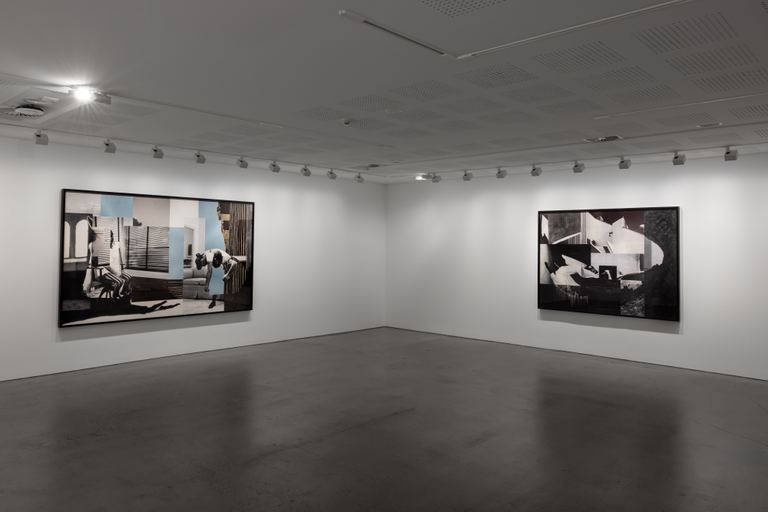
A woman extends her arms midair, as if waltzing with someone invisible. The heavy folds of a curtain conceal her face. Across from her, a double: head bowed in resignation. Although she’s surrounded by markers of domesticity – a basin, a toilet seat – the lines of her body, in silhouette, open out to a pavement scattered with autumn leaves, as if she’s made from the world outside.
Through glass (2023), a large-format collage by Lillian O’Neil, unfolds across a far wall upstairs at UNSW Galleries. It’s part of The light that spills across the ground between shadows, curated by José Da Silva, which owes its name to a quote from Les Années (The Years), a 2008 memoir by the French writer Annie Ernaux. The artist conceived this body of work when she was pregnant during lockdown in rural Victoria and to me the figures in Through glass appear fixed in their poses. They are doomed to play out the same choreography, even as they dream of a world beyond it, trapped by the static nature of the medium in space and time.
Ernaux’s writing, of course, famously blurs the public and private. In her work, the encounters women understand as personal and intimate are intertwined with collective histories. She creates stories that circumscribe our lives despite individual acts of agency. O’Neil has long collected old magazines, books and how-to guides from archives, fairs and op shops. She cuts out, enlarges and re-assembles these analog images, staging fragments of private experience at the scale of the epic.
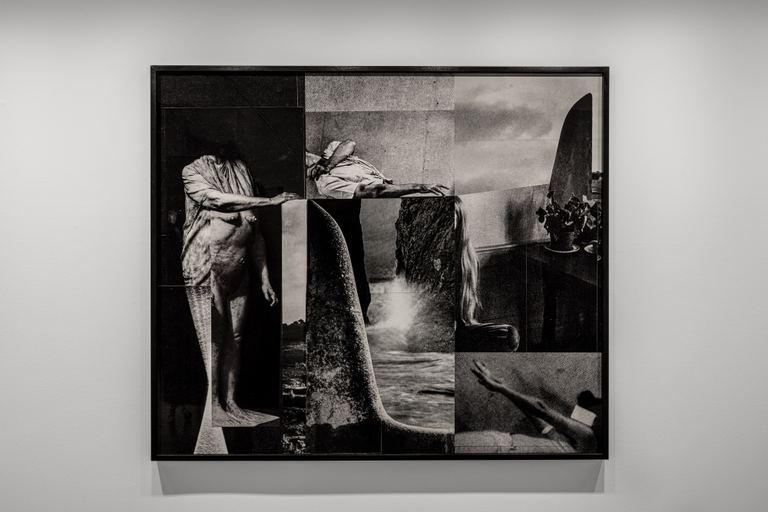
To circle these collages feels at times like confronting a shared female unconscious, strange yet familiar. It’s as if we’re seeing the weight of myth and the desire to escape it both play out at once. I pause, transfixed, in front of Half stone (2023), a work divided into a loose grid. On the left, a statue of a woman without a head reaches for a plinth that morphs into a fragment of ocean. Waveforms recur across the image: the side of a cliff, the swell of the tide, a cascade of hair. It belongs to a figure who appears alongside a coffee table laden with pot plants, the ordinary and the domestic rendered sublime by association.
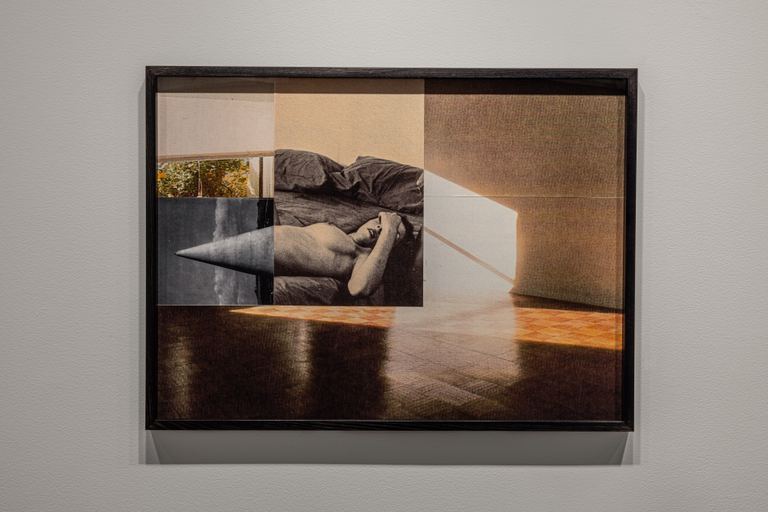
In the centre of Theirs alone (2023), across the room, a sleeping woman, face placid, hovers above a red rose. This vignette opens out into the surface of a rock, the lines of a wall. It’s tempting at first to read this literally, as a reference to the female body as a monument. Alongside it hangs one of the show’s best works, Between shadows (2023), in which a cone that widens into a sleeping woman’s torso so viscerally conjures the feeling of being inanimate I had to step back.
Collage as a medium has long addressed the puzzles of female subjectivity, of being cleaved down the middle, pulled in different directions. Think of the German artist Hannah Höch, who drew on her work as a pattern designer to invent photomontage as we know it. Or Martha Rosler, who spliced together images from men’s magazines to address the way women’s bodies are segmented, sectioned off, commodified.
To circle these collages feels at times like confronting a shared female unconscious, strange yet familiar. It’s as if we’re seeing the weight of myth and the desire to escape it both play out at once.
The place we dissolve (2023), a panoramic work that commands the back wall, combines an image of a woman’s head and shoulders folded over, like a marionette with a fragment of a couple kissing. These dissonant narratives play out against pieces of a living room: a couch, a doorway. You can see up close the edges of each image, where the artist has made her cut, and I notice a moment later a second woman sitting on a chair, a ghost self, her face and chest, an outline.
When O’Neil was making these works, she was thinking about the anthropologist Dana Raphael’s idea of matrescence: the process – physical, social and emotional – of becoming a mother. Among three new collages near the entrance of the gallery there’s an image called Lilies (2024), three silhouettes of the same woman, merging into the other, flipped on their side. They appear to be sprouting petals, stillness and motion contained within one picture-plane, a landscape in which nothing is moving but, also, everything is.
I visit The light that spills across the ground between shadows, O’Neil’s first major solo show at an institution, on a Friday afternoon, a few hours before the show’s official opening. The gallery is hushed, except for the scuffle of a ladder on the floor, a stray cough from another room. As I spend time with O’Neil’s collages, their atmosphere heightens. My sense of solitude grows more intense. Patterns and motifs start to recur. The wooden slats of a set of blinds. Stairways that lead nowhere. In Midnight (2023), the only collage in the show to feature a male figure, burly chest and shoulders, arms crossed, a full moon hovers in the sky. Gradations of light climb up the walls, time stretching, slowing down, grinding to a halt.
O’Neil’s collection of materials takes cues from the German art historian Aby Warburg’s Bilderatlas Mnemosyne (1927-29), an attempt to catalogue the visual history of the world through images. In her work, you can see the grain of magazine print, blown-up pixelated dots, the traces of an analogue past that no longer exists. Yet, instead of nostalgia – among the dominant modes of our time – these collages plunge you into the now. In front of them, I’m suddenly hyperconscious, possessed with the desire to look at the works again and each time, these compositions – made up of chevrons and triangles and diamonds – reveal details I hadn’t seen before. The serene vista of a lake in The winds hand (2023). A puff of a cloud, glimpsed through a window. My gaze is only partial, tessellated, but I can somehow perceive more clearly, with a sharpened acuity.
I’ve never experienced matrescence but I recognise this temporal register. The sense – like during grief, or sickness, or a period of sudden vulnerability – when you’re forced to retract from the world, given reprieve from its pressures. In these moments, I’ve understood the difference between the self that moves towards a certain future and one that resides only in the present. For whom time moves in circles, and the instincts, so often dulled by contemporary life, become animal and sensate.
The figures in O’Neil’s work often seem like creatures. In The place we dissolve, the woman sitting on a chair merges with a horse. It reminds me that these strange other selves don’t represent a departure from the world but a more intimate kind of return.