Readings
Mīal
Archie Moore
Paul Bilhaud’s entirely black painting Combat de Nègres dans la Nuit (Negroes Fighting At Night) featured in the 1882 exhibition Salon des Incohérents curated by Jules Lévy. The poet’s humourist friend, Alphonse Allais (1854–1905), a few years later claimed this joke work as his own - with his version entitled Combat de Nègres dans une cave, pendant la nuit (Negroes Fighting in a Cellar, at Night) - and later expanded upon Bilhaud’s idea with red, grey, green, blue and white monochromes in his Album primo-avrilesque (April Fools Album -1897)1 preceding Klein, Rauschenberg and Malevich by decades. Also included in this album is blank sheet music for a deaf man, Marche funèbre composée pour les funérailles d'un grand homme sourd (Funeral March for the Obsequies of a Deaf Man), beating John Cage’s 4’33” (1952) by fifty-five years.
Entirely black postcards of famous places “at night” were produced from the early 1900s and black pages appeared in books such as The Life and Opinions of Tristram Shandy, Histoire de Mr. Lajaunisse (Paris, 1839) Charles Amédée de Noé, known as Cham - another racist and Robert Fludd’s Utriusque cosmi maioris scilicet et minoris metaphysica in 1617 (The history of the physical and metaphysical cosmos) - a black page with ‘Et sic in infinitum’ (‘And so on to infinity’) is inscribed across each of the four sides of page.
Last year, Paul Bilhaud’s thought-to-be-lost painting was found in an attic trunk along with other works from the Incohérents exhibition. It appears to have remained a black square whereas Kiev-born Malevich’s blackness of paint in his 1915 version of Чёрный квадрат (Black Square) has faded and cracked since. In 2015, researchers at Moscow’s Tretyakov Gallery using x-ray imaging found two Cubist images underneath, peering through the layers of cracked paint. Another discovery in the white border was an inscription, some say in Malevich’s handwriting, which says “Negroes Battling In A Cave”. This reference to Allais or Bilhaud’s earlier work casts the seriousness of Malevich’s Suprematist composition in a new light and poses a question of plagiarism. Or is it a very common and obvious joke made by European people about Africans which goes back centuries? Even though the range of human skin colours is a vast spectrum from dark to light, skin itself does not quite reach the stubborn binary opposites of ‘black’ and ‘white’. The colours that were used to categorise race - black, white, red, yellow and brown - are easily debunked through impartial, examination at fifty paces.
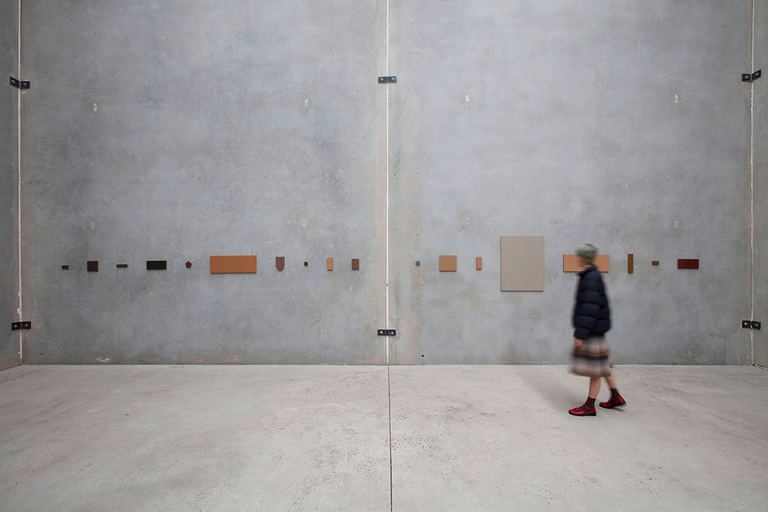
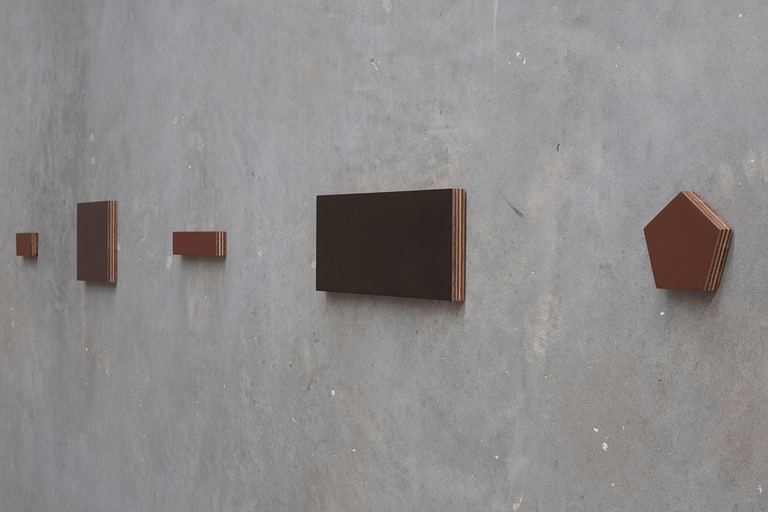
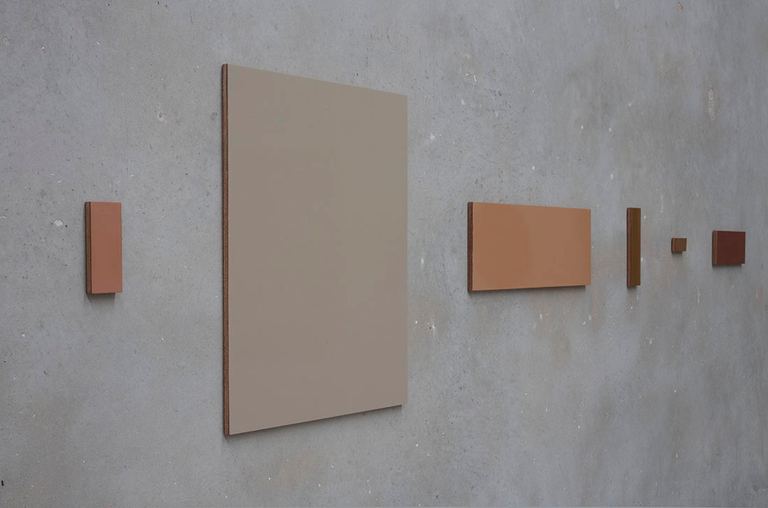
At Bunnings a colour sample of any material can be scanned, allocated RGB+LV colour values and matched with corresponding paint amounts to replicate that sample into a tin of paint. I have used the same technology to scan various areas of my own body and left it up to the small hand-held scanner and its software to suggest to me what colour I am. The results - mediated by the scanner lens, software, my phone screen, converting RGB+LV values into Pantone ones and then the paint colour itself will further shift as it ages - hang on the wall for the viewer to scan and assess.
P.S. Unbeknownst to me, recently, my autonomy and privacy was breached as I was inspected by biometric facial recognition on entry to the Bunnings store. News articles of the past few weeks on the use of this technology in liberal democracies and its ethical boundaries reminded me of an earlier story about the New York Police Department employing facial recognition software to search by skin colour. The police could search a large database for ‘ethnicity’ tags, such as ‘Asian,’ ‘Black,’ and ‘White.’3
1. The title is taken from an early Bigambul dictionary and means “Aboriginal Man”. https://indigenous.sl.nsw.gov.au/collection-items/kamilaroi-and-other-australian-languages-rev-william-ridley-2nd-ed-sydney-1875-100#&gid=1&pid=71
2. Allais’ work Première communion de jeunes filles chlorotiques par un temps de neige (First Communion of Anaemic Young Girls in the Snow - 1883) was completely white. Seeing this took me back to similar joke paintings I did during my course at Gateway TAFE in 1992 entitled Polar Bears In The Snow Series. Jules Lévy’s curatorial rationale that "All works are allowed, serious works and obscene excepted” and exhibiting drawings by people who couldn’t draw also relates to my early days of art making.
3. Last month consumer group CHOICE published findings of an investigation which prompted the Office of the Australian Information Commissioner (OAIC) to launch a formal investigation into the technology's use at retail stores. A ruling on whether these stores have breached the Privacy Act will be a landmark one.