Readings
Minimalist Melbourne Art
Jasper Jordan-Lang
An adjective and artistic movement, minimalism has had a profound impact on art history and culture globally. Its influence has waxed and waned over time, but it remains a twentieth-century archetype and symbol of modernity. Unsurprisingly, minimalism seems to be having a revival in our uncertain times. It is in one sense nostalgic, but today it is also taking on a new form.
Minimalism has always been inherently global despite its American-centric art history. Other Primary Structures, an exhibition at New York’s Jewish Museum in 1966, demonstrates the extent of its influence. The exhibition included canonical figures like Donald Judd and Walter de Maria alongside their non-Western peers such as Jirō Takamatsu and Lygia Pape. Melbourne, too, has its own flavour and specific variation of minimalism, influenced as much by itself as by internationalism. Minimalism has always been here, but even a few years ago it was scarcely a topic of the conversations that shape artistic consciousness. Now a noticeable group of young artists is joining established practitioners working in the genre to revitalise its aesthetic for a new era. I have heard people call it nihilistic, reactionary, anti-conceptual, boring, bourgeois. Maybe they’re just talking about the Melbourne art world. One thing is for certain: it’s back, but different.
Recently closed Rosanna-based gallery Guzzler has undoubtedly had an impact on this revival, exposing a younger crowd of art graduates to artists from prior generations and spaces lost to the annals of local art history, such as Pinacotheca or Store 5. Rose Nolan and Stephen Bram, both of whom have been influential in recent Melbourne art, appeared anew among young artists via their respective 2022 solo exhibitions White Trash Constructed Work (1995) and Unstable Painting (1991) in Guzzler’s backyard shed space. Bram’s show re-staged an exhibition from Store 5 itself, an important art space that Nolan and Bram were involved in together in Melbourne in the early 1990s.
In March this year, Nolan held two simultaneous exhibitions: Working Models at Anna Schwartz Gallery and Light Weight / Light Well at Hyacinth. A month later, “address on request” gallery Sydney Sydney held a self-titled solo exhibition by Bram and in June one by Nolan, Coloured Constructed Work (1993). In July, both were included in Asbestos’s Menagerie fundraiser: an exhibition featuring almost 170 works for sale and just about as many artists. A sure sign of artworld relevance is contextual mobility between artist spaces and institutions. This has always been a characteristic of minimalism, and it remains true of artists working in the genre today; its formal “uninflection” (the absence of expressive or stylistic embellishments) gives the work interpretative adaptability and agility across different exhibition contexts.
Nolan’s Working Models is more reminiscent of the 1960s British revival of constructivism than its original form, which emerged in Russia in the early twentieth century. I think mostly of the group’s pacesetter, Mary Martin, whose intricate, small-scale wooden and plaster reliefs use light to accentuate form, akin to Nolan. A key difference, however, is the material and content in Working Models. Nolan uses used packaging from iPhones, champagne, tea, Camembert, luxury goods—all tasteful. Presented on a large, double-decker shelving unit in the centre of the gallery, the objects appear as if for sale, or on display in a showroom. An unusual show, it is somehow glamorous and mundane at the same time.
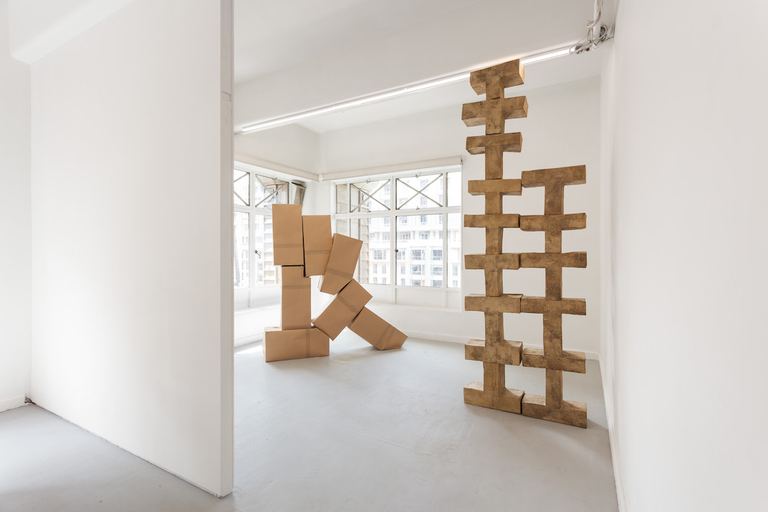
Last month, Augusta Vinall-Richardson’s [sic] exhibition TEMPLATE / SKETCH at Caves immediately brought to mind Nolan’s recent show. Both exhibitions featured cardboard as the main material. The work was constructivist, but naive and haphazard: cardboard assemblages, or bronze disguised as cardboard in cardboard brown. This gave the pieces a childlike playfulness, which seemed to counterpose or offset their austere and brutal forms. My suspicions of artistic collusion were confirmed when, upon requesting a room sheet, I was handed a publication containing an interview between Nolan and Vinall-Richardson. In their conversation, they discuss where their processes converge and diverge. Nolan’s edges are hard and neat; Vinall-Richardson’s are organic and soft. Like the forms themselves, Vinall-Richardson’s walk a tightrope between playful and severe, organic and harsh.
[...]
Previously renowned for its internationalism, transcending geographical boundaries and cultural divides, minimalism is now demonstrating its capacity for intergenerational connectivity, bridging times. The sheer density of exhibitions in recent months is noteworthy. This surge in activity highlights the genre’s ability to engage with and reinterpret local histories through intergenerational exchanges. The active engagement with local histories provides insight into how this twentieth-century movement time travels and warps, evolving and adapting rather than merely repeating itself. Fashion may be cyclical, but revivals are never replicas.