Readings
Review, Restless Legs by Mitch Cairns
Wes Hill
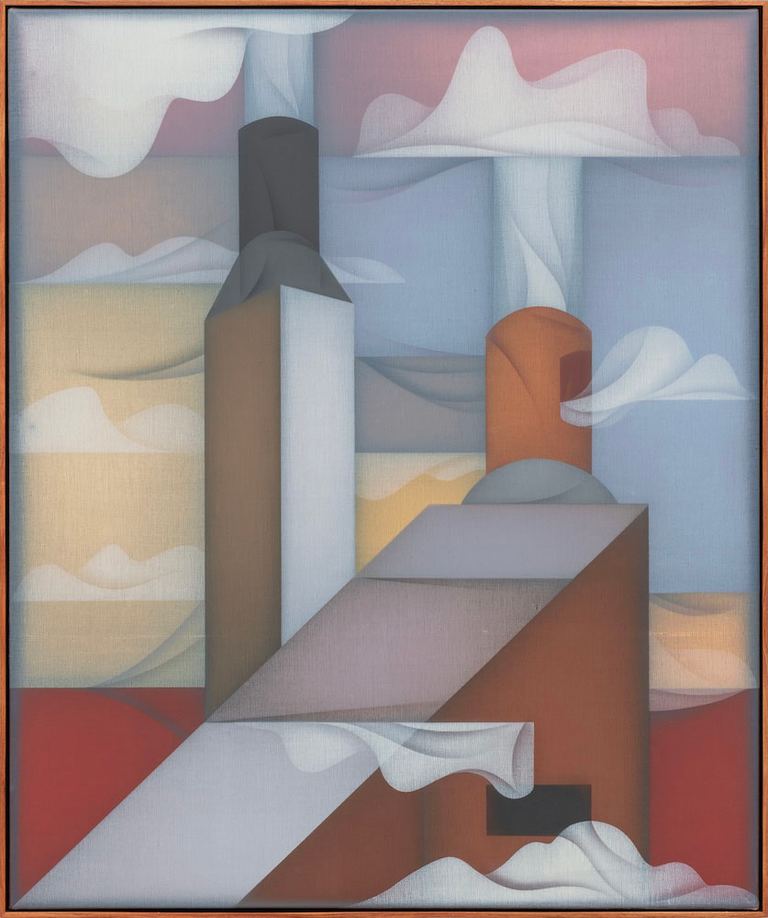
Does anyone paint a better line than Mitch Cairns? The forty-one-year-old Australian artist is known for his reliably rigorous treatment of painting’s essentials, taking color and form as subject matter. Emerging in Sydney as a laconic, mostly text-based artist in the early 2000s, Cairns has since developed an ambitious visual repertoire, somewhere between the decorous formalism of Australian neo-Cubist Dorrit Black and the steely-eyed cartoonishness of Chicago Imagists Christina Ramberg and Barbara Rossi.
Shown in the Naala Badu building of the Art Gallery of New South Wales—known colloquially as Sydney Modern—the eight paintings in Restless Legs represented another attempt by Cairns to balance beautiful detail with cerebral waywardness. The exhibition took its name from a condition Cairns experiences mainly when reading in bed. It’s a quirky metaphor for mind and body in tension, or perhaps for the battle of head and heart—between an art based in ideas and one based in visual experiences.
Through exquisitely thin applications of mostly pastel blue, fawn, terra-cotta, and dusty lilac, these poised yet often anxious-looking oil paintings showcase folds, curves, and intersecting color planes. They depict things such as smokestacks, trees, clouds, cigarettes, musical instruments, and signboards, though it’s not always clear what we’re looking at. Self-portrait as a pair of restless legs (all works 2024) is, despite its title, more like a landscape of factory chimneys feeding smoke to wobbly clouds. The painting 9-5 presents its title literally as signage, but at first we encounter what looks like four floating cigarettes in front of a starkly painted eyeball above a passing cloud.
Nine small word-based bronze reliefs, expanding on Cairns’s previous use of Letraset, were interspersed among the paintings. Face of Man Plate, for instance, looks like an e. e. cummings poem in the form of a sculpture of a day spa gift voucher. The work’s eccentrically laid-out text begins: AT LAST A / SKIN / CARE / SALON / EXCLUSIVELY FOR MEN, referring to the first male-only beauty clinic in Sydney in the 1970s, which happened to be owned by the artist’s grandmother.
Other bronze reliefs—composites of text messages translated via metal stamps onto wax sheets before being cast—flaunt their impenetrability. Rousseau Plate is composed of rectangular blocks that frame a single word, ROUSSEAU, leaving viewers guessing whether Henri or Jean-Jacques is its rightful referent. This fusion of poetic refinement and heavy-duty materiality was reiterated in the exhibition through the inclusion of a decommissioned wooden telephone pole that Cairns installed as an elegant bench for viewers to sit on.
Cairns’s paintings are like vignettes, but what impressed me was their sheer formal drama, especially in ERATO, which centers on a harp based on the internationally recognized logo for Guinness stout. Titled after the Greek muse of lyrical and erotic poetry, represented by the lyre, the painting shows a dexterous musical hand in action, making both it and the harp look disproportionate in opposite ways. Dana Schutz’s Breastfeeding, 2015, owned by the Art Gallery of New South Wales, may be its perfect companion piece—Schutz’s frenzied stillness offsetting Cairns’s strained composure. The orange nails and curved creases of the hand in ERATO echo the heart-shaped harp to which it is adapting. These forms build on a previous painting by Cairns, Drive-Thru, 2018, showing a similar hand in a fingerless glove pulling a dart out of a dart board.
Despite borrowing liberally from modernist visual culture, the formal peculiarities of Cairns’s oeuvre overshadow any historicist tendencies in the work. Utilizing Cubist and Art Deco motifs, poetic word fragments, and stark contrasts between industrial and natural tropes, the artist engages less with tradition than with the anachronism of his obsessions, chasing offbeat images for the ages in our own foreboding times.