Readings
Situated Reading
Julie Ewington
I
In 2013 Agatha Gothe-Snape described her work as fundamentally ‘context-responsive’.¹ Immediate locations aside, which cultural and historical contexts does she investigate? For responsiveness is not simply reaction: Gothe-Snape stakes out her fields of practice, constructing contexts as she enacts them. Her immediate frames might be a location, a commission or an organisation; within these, she devises processes, parameters and guidelines.²
Many processes specify reading: An Uncertain Reader, at Gertrude Contemporary in 2014, surveyed the reading patterns of artists over the course of their residencies there, charting their critical, fictional, poetic, journalistic and philosophical interests in a tome of texts that could be read by invigilators in the exhibition space.³ In Lion’s Honey, 2019, commissioned for Making Art Public, an exhibition of fifty years of the Kaldor Public Art Projects at the Art Gallery of New South Wales (AGNSW), performers read daily from books of their choice. The first, read by Gothe-Snape herself, was David Grossman’s novel 2005 Lion’s Honey: The Myth of Samson, a gift from John Kaldor.
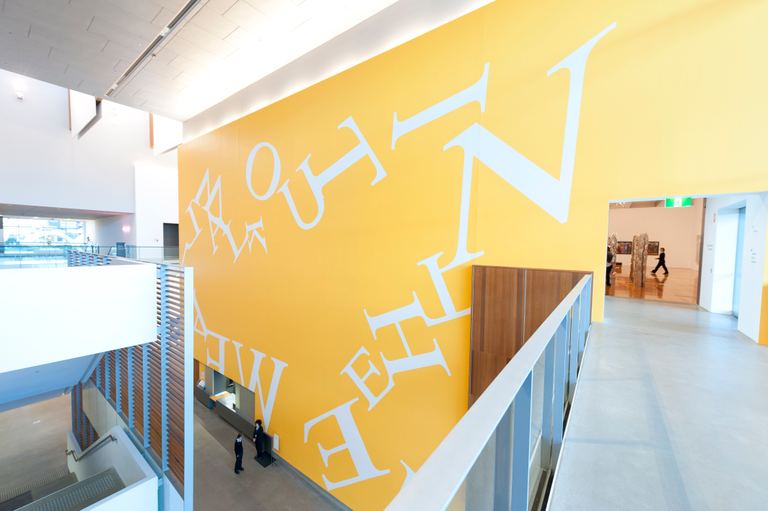
This emphasis on situated procedures invokes a delicious conundrum: how can one trace Gothe-Snape’s art historical inheritances when her imagery, media, and forms of production constantly diverge, oscillate, even double back, and when many works are ephemeral or collaborative, precisely to introduce uncertainty into the mix? Moreover, Gothe-Snape’s habitual use of text inserts a recessive medium into the art historical frame. No matter how crisp the typography or beguiling the colour, text is generally taken as read, a Trojan Horse hiding in plain sight, rather than scrutinised as imagery. For example, the gargantuan wall-text We All Walk Out in the End, positioned at the entrance (and therefore exit) of Brisbane’s Gallery of Modern Art in 2012, wryly enacted the proposition it put.
Yet, art history does matter to Gothe-Snape. As Anneke Jaspers notes it is the frame of art and, more specifically, the shadows of western art history, that provide the overarching conceptual basis for her work.⁴ While art history tends to follow continuities, or legacies, these provide Gothe-Snape with causes for contestation. Individual works, despite the insouciant slipperiness of her processes, are driven by her creative context. This is the Sydney art world, where, with the exception of several productive periods in Melbourne, Gothe-Snape has lived, studied and worked her entire life. It is also Sydney’s intellectual world, where she trained in theatre, dance, performance, philosophy, and art history (although, ironically, at the time this focus was less important to her).⁵
Like the education of early twentieth-century artists, this apprenticeship was long. The difference was its catholicity, given Gothe-Snape’s childhood engagement in theatre at PACT; her introduction to dance through Tess De Quincey’s BodyWeather training, with its origins in Japanese butoh; the influence of the immediate environment of her own family of artists across generations and their many artist friends; and later, her time at university—crucially within the broad theoretical scope of the University of Sydney’s Performance Studies department, followed by the painting department at Sydney College of the Arts.⁶ In the mid-2000s, Gothe-Snape became immersed in Sydney’s lively artist-run spaces, including Firstdraft (2007–09) and The Cosmic Battle for Your Heart (2009–11) with Mitch Cairns, Kelly Doley and Brian Fuata. This itinerary suggests an artist alive to an array of artistic practices, charting an improvised and idiosyncratic course through (often around) both the contemporary moment and conventional art histories.
II
In 1985 Ian Burn, artist and writer, asked ‘Is Art History Any Use to Artists?’ He was arguing for practice-driven accounts of art, suggesting that artists answer self-directed queries rather than following stylistic imperatives, national histories or international canons. Burn concluded that ‘Art History is too important to be left to the art historians’.⁷ Closer to home, in 1997, Gothe-Snape’s father, the sculptor Michael Snape, made a banner demanding ‘SAVE ART FROM EDUCATION’, resisting the introduction of ‘competency-based training’ at Sydney’s National Art School.⁸ Educating herself is precisely what Gothe-Snape does in her search to make sense of the historical, cultural and affective networks surrounding her. As artist Matthew Greaves remarked in 2012:
Agatha Gothe-Snape is something of an anti-hero in a line of work defined by individualism. An artist whose work has almost always been commemorative, she has long been concerned with acknowledging artists in Australia and contemplating their collective worth.⁹
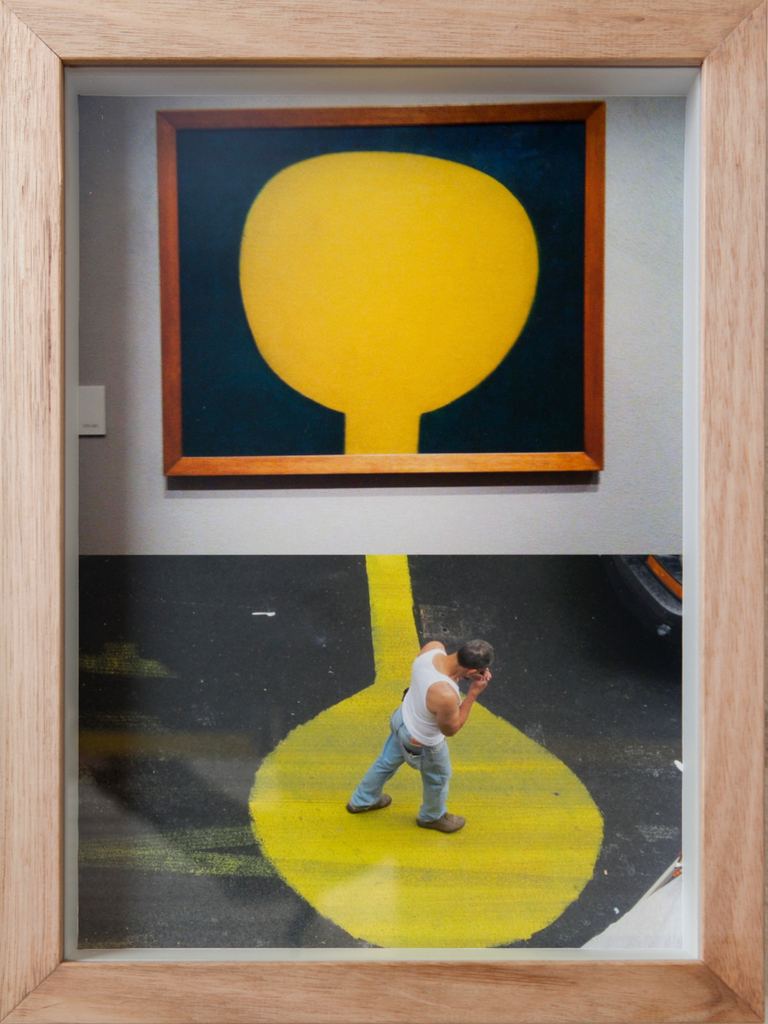
This consistent engagement with Australian artists is hard-wired, and Gothe-Snape has a personal lexicon of images. A case in point is The Surface of the Moon, a digital photograph-collage conceived in New York in 2012. Here Sidney Nolan’s celebrated painting Boy and the Moon c.1939–40 was the remembered lens through which Gothe-Snape spied a man walking on a painted SoHo pavement. Simultaneously a tribute to the enduring persuasiveness of Nolan’s painting even in modernist Manhattan and a pointed inversion for the northern hemisphere, Gothe-Snape’s ‘Nolan’ grapples with an issue threading through her practice: ‘I think all of my work is in some way about how we deal with the shadows of the canon’.¹⁰
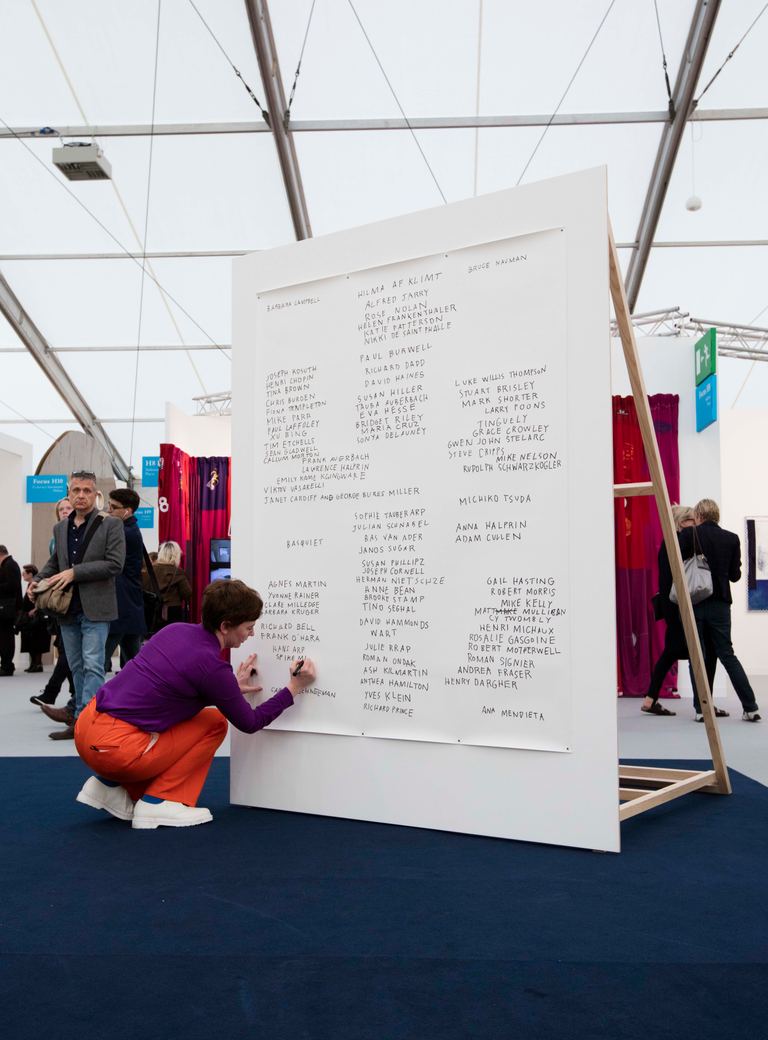
The important series of performative drawings titled Every Artist Remembered, 2009–18, exemplifies Gothe-Snape’s drive to understand how artists negotiate the cast shadows of their predecessors. Initiated in 2009 at Sydney’s Firstdraft, these drawings on large sheets of paper manifest interactions between Gothe-Snape and invited artists; the work has subsequently been undertaken at Melbourne’s Australian Centre for Contemporary Art (ACCA), 2011; Frieze Art Fair’s ‘Live’ program in London, 2017; and most recently at the fiftieth anniversary celebration of the teaching of Art History at the University of Sydney, 2018. The encounters last two hours, are not rehearsed, and are never subsequently altered; the work takes place during gallery hours, in front of visitors. The guest remains seated as Gothe-Snape, the self-appointed medium of the exchange, armed with a Posca pen, records strings of names that emerge as the two attempt to recall artists significant for their practices.¹¹
Because of the temporal frame of the transcriptions, Every Artist Remembered reveals the personal character of affiliations between artists; each carries an importantly unsystematic ‘history of art’. This in turn implies the selectiveness of the formal discipline of art history, even its baggage and biases. At Firstdraft, the participants included artists as various as Mike Parr, Anne Kay, Noel McKenna, and Elizabeth Pulie, and as Gothe-Snape notes, the shared recollection is a gloriously approximate enterprise:
Exclusions, misunderstanding, misspelling and miscommunication are as likely as an objective description. The drawings are a partial, improvised and provisional record, like all forms of documentation.¹²
III
Agatha Gothe-Snape’s conjoined family name registers multiple inheritances, artistic as well as genetic. She acknowledges in interviews, and through her work, the indelible impact of her father Michael Snape’s sculpture and painting; the crucial influence of her mother Jacqueline Gothe—an academic whose practice is particularly focused on the visual communicator’s relational role as mediator; and her paternal grandmother Margo Snape (1926–2016), a fine calligrapher and book-maker, as well as an ardent astrologist and numerologist. Margo and Jacqueline were both accomplished graphic designers, and Gothe-Snape speaks of a ‘naturalisation of visual literacy’ in the house, with calligraphy, typesetting and design highly valued.¹⁷ This childhood familiarity with text design has threaded through Gothe-Snape’s work from the beginning. Her installed works require visitors to navigate spaces, noting colours, carpets or changes in lighting, and to become aware of their own positioning in relation to the work. Crucially, these encounters are steered by large propositional or interrogative wall texts, many delegated to professional sign-makers.
Gothe-Snape’s fascination with inscription extends from calligraphy on walls, windows and objects (including a beach towel in 2015), to an extended series of PowerPoint works. Typefaces range from what Gothe-Snape calls the ‘faux neutrality’ of Helvetica and Helvetica Neue to digitally wobbled renditions of the beautiful eighteenth-century Baskerville typeface used in Volatile Medium, 2016, in a tribute to the recently deceased Margo Snape that included her grandmother’s signature marbling on paper.¹⁸ For Gothe-Snape, typefaces produce emotional affects, just like any other component of a work. Against standard understandings of texts as carriers of meaning, passive or inert, each typeface in this work was actively engaged, ‘volatile’, to borrow the exhibition’s title: the original Baskerville typeface is attenuated, leaning out of true, in a slightly melancholic disposition.
Similarly, in MATERIAL DEFECTS TO HA HA EXIT, originally presented in 2014 at Gertrude Contemporary, representational drawing meets archaic signwriting in a Dadaistic melee of typology and poetic wordplay. This encounter between two-dimensional forms of marking—text and drawing—invokes the fundamental challenge of meaning in a world that encompasses mirror reversals, scrambled texts, open and closed volumes, one appalling pun (CHEZ LOUNGE), and the exit line HA HA, ultimate derision. CASTING FIXED PEDESTAL might refer to play with sculptural volume, but the style is surely indebted to archaic signwriting.
Gothe-Snape’s hyper-sensitivity to design includes colour. Margo Snape’s gift to her of the book by Swiss psychotherapist Max Lüscher (1923–2017), about colour tests devised to indicate emotional states, was the key to Emotional Wall with Everything Else, 2012–13, an extensive wall-painting of five bands of colour, originally commissioned by Shepparton Art Museum and now in the collection of the Museum of Contemporary Art Australia. Four of its five colours were chosen from Lüscher’s samples; the fifth, a deep blue from outside his prescribed palette, and carrying the text ‘Everything else’ in cursive, was intended by the artist as a contemplative zone so visitors could ‘pause and reflect upon those bigger, existential questions’.¹⁹
Gothe-Snape’s family inheritances provide rich sources in the history of Sydney sculpture. As a result of Michael Snape’s practice, Gothe-Snape was in constant contact with generations of Sydney sculptors, but most particularly with those, like her father, who principally worked in metal, such as Ron Robertson-Swann (born 1941), Michael Buzacott (born 1950) and Paul Selwood (born 1946). Invoking this practice and these names recalls the implacable opposition of some sculptors, in the lineage of the British artist Anthony Caro, to the emergence of post-object art in Sydney in the 1970s, and to post-conceptual art in subsequent decades.²⁰ Michael Snape was intimately acquainted with the often bitter arguments surrounding sculpture in Sydney; given his work is variously non-representational, textual, and figurative, he dissented from the narrower orthodoxies. Also a painter, musician and writer, Snape’s interests are broad and his disposition playful; his blog continues to track his antic imagination.
These inheritances of sculpture and typography were explicitly juxtaposed in 2013 in the exhibition Late Sculpture, with the playful steel Living Sculpture (White) its anti-heroic centrepiece. Made from one sheet of mild steel, Living Sculpture is freestanding, elegant, and extremely simple. Ostensibly abstract, and painted in the manner typical of Formalist sculpture, it is also cheekily anthropomorphic, an ur-sculpture standing in for its maker, as the title suggests. Multiple sly digs structure the piece: the sculpture is heavy, following the Sydney art world shorthand ‘heavy metal sculpture’, but also alluding to the genre’s seriousness, satirising its pretensions.²¹
The complementary Heavy Reading is paradoxically physically light, being digital, and consisting of a screen with rolling text fleeing the scene almost as soon as it enters. Here the heavy content is the text itself, a digest of overheard arguments between Sydney sculptors in the early 1990s about the meaning of art and life, which eventually resulted in physical violence—encounters driven by passion to which Gothe-Snape has returned several times.
The most recent versions of these encounters were The Five Unknowables, at TarraWarra Museum of Art in 2018, and in Certain Situations, an exhibition by Gothe-Snape and Wrong Solo (with collaborator Brian Fuata) at Brisbane’s Institute of Modern Art (IMA) in 2019. At TarraWarra, a text recapitulating two sculptors arguing was placed on tall windows along the Museum’s Vista Walk, looking out to work by Michael Snape positioned just outside, with green slopes and the vineyards beyond. Legible from the exterior of the building, and only projected onto the floor and walls inside in bright sunlight, The Five Unknowables was as ephemeral as the original dialogue, and as opaque as only recent history can be. At the IMA, another version of The Five Unknowables presented the arguments in wall texts and soundscape, here condensed and enigmatic, exactly like fragments of conversations overheard at parties: ‘Something about it catching you unawares’, said one; another was more explicit: ‘Something about hanging your neurosis on a flimsy copper frame’. Dead centre was this pointed jab: ‘Something about how sculptors don’t wear lipstick’.
So how does an artist frame herself?
IV
Gothe-Snape recently made a beguiling account of her artistic context. Trying to Find Comfort in an Uncomfortable Chair, exhibited at Perth Institute of Contemporary Arts (PICA) in 2019, responded to an invitation to explore the country’s most significant collection of Australian women’s art. Gothe-Snape situated herself physically by inviting the participation of artists whose work is held in the Cruthers Collection of Women’s Art (CCWA), now held by the University of Western Australia. The chair of the work’s title comes from the artist’s studio. Most artists submitted an actual studio chair: battered, soft, paint-stained, suggesting their daily studio life. Others sent representations, and Narelle Jubelin (who lives in Madrid) contributed a petit-point rendition of an Arne Jacobsen Series 7 dining chair. At PICA the artists congregated in response to Gothe-Snape’s invitation through works held in the CCWA, but also actively, through their own responses.
The ‘uncomfortable’ chair in this dyad is the public collection. Curator Gemma Weston wrote that the project articulated Gothe-Snape’s sense of being displaced from her self, and her own works—‘… a complex bouquet of emotions—pride, relief, shame, empowerment, discomfort … even as she understands that they form part of public collections, other lives and histories’.²² Here I recalled Matisse’s notorious description of art as ‘a good armchair’, which provides relaxation from physical fatigue, but Gothe-Snape’s convocation addressed different priorities.²³ The ‘uncomfortable chair’ might also allude to the still awkward positioning of women as artists in Australian culture. In 2015, speaking about Rhetorical Chorus (LW), 2015, which responded to videos of hand gestures by leading American conceptual artist Lawrence Weiner, Gothe-Snape articulated her dilemma with such canonical figures: how to ‘transcend them but also allow them to be present’.²⁴ This challenge exists for every artist, but most acutely for those displaced as legitimate inheritors of past masters. In Gothe-Snape’s case, there is a pronounced feminist dimension to her revisionary project.
It is therefore not surprising that one stalking-horse who recurs in her interrogation of the canon is Australian-born Robert Hughes, whose work Gothe-Snape originally encountered on television, as Hughes morphed from art critic into mass media star with the series The Shock of the New, first screened by the BBC in 1980, the year of her birth. One sentence in Hughes’s orotund prose about the project of artmaking, ‘and then to close the gap between you and everything that is not you and in this way to pass from feeling to meaning’,²⁵ stuck with Gothe-Snape and became the core of her work for The National 2017 at AGNSW. Hughes also provides the punning title of an early proposal for The National 2021: The Fatal Sure/The National Doubt. If Hughes was ‘sure’, it is axiomatic that an intelligent (feminist) observer cannot be. His certainty, formed in Sydney and successfully exported, is fatally compromised, despite his brilliance; while Hughes’s authoritative confidence is infectious, it is also suspect. An irresistible combination for review.
V
Finally, The Field and the field. In 2016 Gothe-Snape remarked—‘Every Artist Remembered was a work that was symptomatic of my space at the time. I was trying to visualise the field’.²⁶ But which field? Michael Snape was too young, by a whisker, to exhibit in the National Gallery of Victoria’s landmark exhibition The Field in 1968, but as a sculptor of the next generation he lived in its long shadow, now obliquely illuminated by Gothe-Snape: one of her best-loved reference books is Craig McGregor’s In the Making: Australian Art and Artists, a generously illustrated compendium published just the year after The Field, and celebrating artists including colour field painters such as Sydney Ball. Since then, of course, ‘the expanded field’ of sculpture posited in 1979 by Rosalind Krauss has become a wide open expanse.²⁷
By invoking ‘the field’, Gothe-Snape is also referring to the sociologist Pierre Bourdieu, as she takes on previous art histories and maps them onto her own practice, asking loaded questions.²⁸ (That is why Robert Hughes matters.) But to avoid standing at one vantage point, Gothe-Snape moves the recurring (and accruing) elements of her practice around her arena: she characteristically takes an image, theme or method from one domain and displaces it to another. I’m thinking of how texts appear in different materials and genres: More Words, 2018, is scribbled in bronze; texts appear on glass windows at TarraWarra in a work from the same year, with yet another wall text and soundscape at the IMA in 2019. And the trailer for EVERY ACT OF READING PERFORMS THE WORK, 2018–19, presented in The National 2019, employs virtual reality and exists only online, but points to the ‘monolithic virtual reality sculpture’ that Gothe-Snape will present in The National 2021.²⁹
Dislocation deliberately courts discomfort. This is an art of transposition—perhaps even transubstantiation—and following Margo Snape, Gothe-Snape sees herself as a kind of medium, working with ‘the transposition of language and how it has different meanings in different contexts’, affecting visitor experience in gallery spaces.³⁰ Fundamentally, Gothe-Snape explores her own history—through her family, among peers such as Brian Fuata and Shane Haseman, as an Australian, as a woman—through recontextualisation. This ‘art history’ is constantly subjected to shifts (in practice and metaphorically), precisely in order to discombobulate the ponderous sense of inheritance suggested by the notion of influence.
In 2011 Agatha Gothe-Snape said that her artmaking felt like moving through rooms with fogs that comprise different areas of knowledge and experience: ‘I guess it is so much about trying to navigate the crisis of being human’.³¹ If Gothe-Snape is moving through an art history of her own devising, this traverse is not uni-directional or one-dimensional: it has a shape, it has volume, it is inhabited. And if it is not exactly home, I do not imagine she will be leaving any time soon.
- Agatha Gothe-Snape, MCA Artist’s Voice series, originally videoed 2013, https://www.youtube.com/watch?v=Nb0Ws5fBc60.
- An early work featuring four guidelines was exhibited at Breenspace, Sydney, in *Kate Blackmore | Agatha Gothe-Snape | Shane Haseman | Emma White*, 14 May – 13 June 2009.
- *An Uncertain Reader* was included in *Octopus 14: Nothing beside Remains*, curated by Tara McDowell, at Gertrude Contemporary, Melbourne, in 2014.
- Anneke Jaspers, ‘Artist Profile: Agatha Gothe-Snape’, MCA Australia, accessed 7 October 2019, https://www.mca.com.au/artists-works/artists/agatha-gothe-snape/.Agatha
- Gothe-Snape, interview with author, 24 September 2019.
- Min Tanaka’s butoh work was well known in Sydney after his appearances at the 4th Biennale of Sydney in 1982. The distinguished scholar Gay McAuley, in the University of Sydney’s infant Performance Studies department, was a key figure for Gothe-Snape, introducing her to ethnographic approaches, including those of Clifford Geertz, and, crucially, to the sociologist Pierre Bourdieu’s ideas of field and habitus. See McAuley’s *Space in Performance*, University of Michigan Press, Michigan, 1999
- Ian Burn, ‘Is Art History Any Use to Artists?’, reprinted in *Dialogue: Writings in Art History*, Allen & Unwin, Sydney, 1991 [1985], p. 200.
- Eve Sullivan in conversation with Agatha Gothe-Snape, ‘Agatha Gothe-Snape: On Art and Education’, *Artlink*, vol. 39, no. 3, September 2019, p. 51.
- Matthew Greaves, ‘Agatha Gothe-Snape’s Four Parts’, *un magazine*, vol. 6, no. 1, pp. 30, http://unprojects.org.au/magazine/issues/issue-6-1/agatha-gothe-snape-s-four-parts/.
- Rachel Fuller, ‘Agatha Gothe-Snape in Conversation’, *Ocula*, 19 October 2015, https://ocula.com/magazine/conversations/agatha-gothe-snape/.
- See https://thecommercialgallery.com/artist/agatha-gothe-snape/exhibition/3/every-artist-remembered-1 for the artist’s account of the process. See also http://everyartistremembered.blogspot.com/2009/ for images of the Firstdraft 2009 series, as well as the 2008 typescript version.
- Sullivan, p. 51.
- Agatha Gothe-Snape, email to author, 6 October 2019.
- See Clifford Geertz, ‘Thick Description: Towards an Interpretive Theory of Culture’, in *The Interpretation of Cultures*, Basic Books, New York, 1973, pp. 3–30. The distinction between ‘thick’ and ‘thin’ description was first proposed by the British philosopher Gilbert Ryle in 1949.
- In 2012 and 2016, Carriageworks commissioned Gothe-Snape to hold conversations with artists, community and industry representatives, resulting in mind maps that have informed Carriageworks’s strategy for the periods 2012–16 and 2016–21; Lisa Havilah, former Director of Carriageworks, conversation with author, October 2019. In 2018, Gothe-Snape was invited by Kaldor Public Art Projects to participate in the planning of ‘All Schools Should Be Art Schools, Symposium on Art Education’, presented with UNSW Art & Design, Sydney, during which she produced durational text-based drawings and presented demonstration lectures and workshops with invited collaborators. See *Carriageworks Six Year Strategy 2016–21*, Carriageworks, Sydney, pp. 62–67 and Sullivan, p. 51.
- Gothe-Snape, interview with author, 24 September 2019.
- Ibid.
- Agatha Gothe-Snape, SMS to author, 18 October 2019.
- See the MCA Collection at https://www.mca.com.au/artists-works/works/201627/.
- See Graeme Sturgeon, *The Development of Australian Sculpture*, Thames & Hudson, London, 1978; Linda van Nunen, ‘Patterns of Experience: Sydney Abstraction’, in Lynne Seear and Julie Ewington (eds), *Brought to Light II: Contemporary Australian Art 1966–2006*, Queensland Art Gallery, Brisbane, 2007, pp. 32–41; Geoffrey J. Wallis, *In the Square: The Sculpture That Challenged a City*, Indra Publishing, Melbourne, 2004, on the controversy about Robertson-Swann’s *Vault*; and Terence Maloon, *Michael Buzacott*, Drill Hall Gallery Publishing, ANU, Canberra, 2015, for a comprehensive account of Buzacott’s work.
- For Michael Snape’s writing, see https://www.michaelsnape.com/; in particular, see his post about making *Living Sculpture (White)* for Gothe-Snape, ‘Late Sculpture’, posted 25 April 2013, https://www.michaelsnape.com/sydney-school-of-sculpture-blog. See also Shane Haseman, essay in *Agatha Gothe-Snape: Late Sculpture*, exh. cat., The Commercial, Sydney, 2013, https://thecommercialgallery.com/uploads/Shane_Haseman_AGS_late%20sculpture_essay_3_back%20picture_helvetica.pdf.
- Gemma Weston, ‘If a Collection Could Dream’, in *Trying to Find Comfort in an Uncomfortable Chair*, exh. cat., PICA, Perth, 2019, n.p.
- Henri Matisse, *Notes d’un Peintre*, first published in *La Grande Revue*, 1908, in Jack D. Flam, *Matisse on Art*, University of California Press, Berkeley, 1995, pp. 30–42.
- Fuller, ‘Agatha Gothe-Snape in Conversation’.
- Robert Hughes, transcript of the closing address of ‘Episode Eight: The Future That Was’, *The Shock of the New* (1980). See https://the-national.com.au/artists/agatha-gothe-snape/you-and-everything-that-is-not-you/ for Gothe-Snape’s choice of this speech by Hughes.
- Kim Brockett, ‘Ten Questions for Agatha Gothe-Snape’, *Vault*, no. 13, 2016, p. 62.
- See Craig McGregor et al., *In the Making: Australian Art and Artists*, Thomas Nelson, Melbourne, 1969, and Rosalind Krauss, ‘Sculpture in the Expanded Field’, *October*, 1979, no. 4, pp. 30–44.
- Pierre Bourdieu, *The Field of Cultural Production*, Columbia University Press/Polity Press, New York, 1993.
- See https://www.the-national.com.au/artists/agatha-gothe-snape-2019/every-act-of-reading-performs-the-work/.
- Agatha Gothe-Snape, email to author, 30 October 2019.
- See Susan Gibbs, ‘Agatha Gothe-Snape / Campbell Patterson—Mother’, *Society*, August 2011, closed blogspot, quoted in Nicholas Chambers, ‘Agatha Gothe-Snape: Aesthetics in Motion’, in *Contemporary Australia: Women*, exh. cat., Queensland Art Gallery | Gallery of Modern Art, Brisbane, 2012, p. 74.