Readings
The Impoverished Aesthetic: Class, Race, and Depression In the Work of Archie Moore
Tara Heffernan
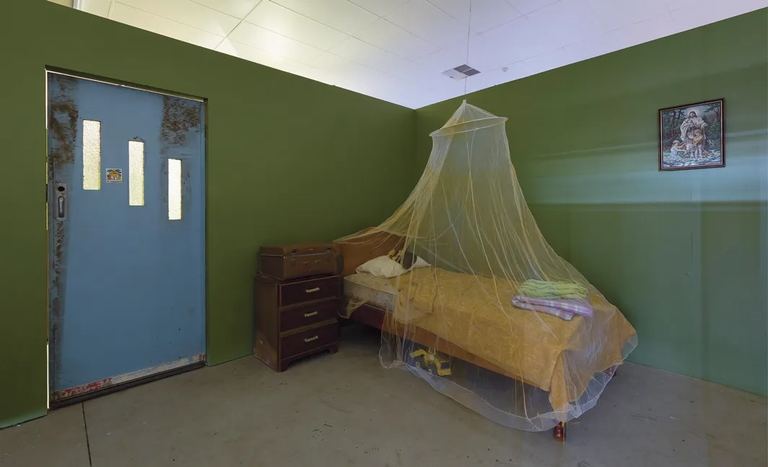
Archie Moore, Dwelling (Victorian Issue), 2022, mixed media, dimensions variable. Photo: Gertrude Preston.
“Paying your respects costs you nothing,” wryly notes a t-shirt designed by Archie Moore. In Australia, well-meaning attempts to address colonial culpability and bear witness to its legacies often paradoxically serve as cathartic rituals, assuaging the white guilt of a predominantly middle-class audience. Along with bureaucratised expressions of remorse, key among these symbolic reparations is the excessive platforming of trauma narratives. Premised on a foundational contradiction—the externalisation of inner turmoil—these politicised acts of self-disclosure are routinely encouraged, only to be mined for ideological edification.
In Moore’s immersive installations and assisted ready-mades, on the other hand, this paradigm of strategic self-disclosure is challenged. Comprising dishevelled found objects, these works frequently call upon Moore’s formative memories of the arid landscape and emotional space of his upbringing.
Moore grew up poor in the predominantly white, rural town of Tara, Queensland. Harmonising with his employment of discarded and damaged materials—marked by age, poor quality, or the scars of their misuse—and his deskilled methodology, Moore articulates a poetic poverty that encompasses the economic, emotional, and spiritual dimensions of his experience. This embodies what I term an “impoverished aesthetic.” Key to this aesthetic is Moore’s nod to the inadequacy of self-disclosure. Rather than promise untempered access to the inner self, in these artworks he traverses the bridge between the objective world and the subjective self, neither of which is static or “knowable.”
Aesthetic Impoverishment
Emblematic of Moore’s aesthetic impoverishment are Black Dog (2013), a taxidermied dog Moore presents as a self-portrait, and the expansive installations based on his childhood home (exhibited from 2012). A closer look at these artworks unravels Moore’s untidy relationship with the inner self.
The term “black dog” is both a racial slur and a common metaphor for depression. “There have been many papers that speak of a link between discrimination and mental illness,” Moore noted while discussing this assisted ready-made.¹ While taxidermy was once reserved for scientific specimens or hunting trophies, Moore’s awkward, sawdust-stuffed dog is a quiet monument to the depressive state brought on by the burden of stigmatisation. A found object reminiscent of the refuse populating Moore’s installation work, the artwork speaks to a recurrent theme in the artist’s multisensory practice: the many meanings of blackness in both discourse and iconography, and how the injuries of class irrevocably shape identity.
The dog resembles a Bull Terrier. Combining the stoicism and broad jaw of the bulldog with the energy of the terrier, these compact dogs were originally bred for dogfighting. It is poorly stuffed and preserved, but the act of preservation ironically imbues the animal with sentimental value. To make the dog blacker, the coat has been touched up with shoe polish, a product associated with the blackface makeup of American minstrel theatre. This cosmetic emphasis on blackness is ironic, offering a parodic mirror to the investment in markers of racial difference that preoccupy discourses on race and authenticity. Speaking on later work Blood Fraction (2015), Moore reflected on the absurdity of racial classifications, saying, “I’ve been identified as ‘half-caste’ and have also wondered what people meant when they called me ‘black’ because the colour of my skin isn’t anywhere near black. I’m too pale to be Aboriginal for some non-Indigenous people and also not black enough for some Aboriginal people. I don’t know where I sit, and does it matter anyway?”² Hanging from the bulky bondage of a too-big leather collar is a name tag reading ARCHIE, humorously underscoring the sculpture’s status as portraiture.
As a self-portrait, the dog is a potent symbol in modern culture. Against the dogs that populate this history, Moore’s is comparatively lowly. Historically, pet ownership was viewed as a decadent indulgence reserved for elites and aristocrats. But the Victorian era saw pets become signs of social status and moral virtue. The aspirational middle class’s obsession with pedigree echoed an interest in high-society pageantry. Far from being a mere household companion, the domesticated dog became an article of conspicuous consumption, a living representation of societal disparities and the rigid codes of modern life. Today’s luxury lapdogs, specifically bred to resemble infants, serve dual roles: a bourgeois accessory and an obedient recipient of our projections, affections, and self-affirmations.
“I am I because my little dog knows me,” Gertrude Stein wrote in “Identity a Poem” (1935). In Stein’s prose, the little dog is a proxy for the regard of others and our need to define ourselves based on their perception. The dog recognises their owner only by external traits; they have no access to the inner life. Moore’s identification with the black dog, a dog that was bred for fighting, not a babyish, pinch-nosed, puffball-bodied live teddy, resonates with Stein’s portrayal of the human–pet bond, but with bleaker implications. Remarkably, Moore’s dog is not alive at all but lingers in its preserved form: an empty shell. Its impoverished aesthetic is paramount to its impact.
The black dog knows Moore, and Moore knows the black dog. But what do we know of the black dog?
House and Home
Littered throughout Moore’s house installations are mementos of formative experiences and the interior life shaped by them. In these installations, Moore meticulously reconstructs his childhood home, a now-demolished weathered fibro build, along with other sites of personal significance like classrooms and his grandmother’s house.
The house works evoke the ambition and emotional impact of Ilya Kabakov’s Labyrinth (My Mother’s Album) (1991). In Labyrinth, Kabakov created an intimate exploration of personal history by remaking the dimly lit, deteriorating hallway of a communist housing block inside the gallery. The work epitomised Kabakov’s concept of “total installation,” an all-encompassing design transporting gallery visitors from the museum to a dream-like space with psychological resonance. Moore’s total installation is similarly claustrophobic and disquieting, divulging a personal story in the form of an immersive psychogeography, capturing the experience of the rural poor.
These memory-scapes expand and contract to suit the spaces that house them. Features are added or subtracted, and points of reference or emphasis shift. “I know it’s reconstructed,” Moore laments of memory. “Every time you remember something, something gets added to it.”³ One persistent feature in Moore’s house works can’t be conveyed in photo documentation: the scent of Dettol disinfectant soap. It lingers in the works, as a ready-made aroma drawn from the everyday. Marketed in the 1930s as a douching formula—sanitising feminine “internal” spaces—Dettol quickly became synonymous with domestic maintenance and institutional spaces of care. It’s used for cleaning wounds or big messes; it haunts doctor’s offices and other regulated institutions. It’s the smell that accompanies banal catastrophes.
In Moore’s upbringing, the smell of Dettol was tied to his mother’s paranoia about cleanliness—a paranoia induced by the fear, in the shadow of the Stolen Generations, of her children being taken away from her by the state. This manifested, Moore speculates, in an internalised anxiety about dark skin “never being clean enough.”⁴ A Proustian gesture, Dettol’s scent for Moore engenders internalised racism. But even when untethered from these specific biographical details, the incongruity between the organic grime of curated domestic clutter and the harsh chemical fragrance of Dettol still triggers apprehension.
Self-Disclosure
Another telling parallel can be drawn with the impoverished aesthetic of Moore’s immersive house works. Two years Moore’s senior, Norwegian author Karl Ove Knausgaard is best known for his six-book autobiographical series Min Kamp, or My Struggle in English (2009–2011). Across 3,600 pages, intimate accounts of the author’s childhood, adolescence, and the trials of adulthood are punctuated by insightful ruminations on art, literature, and philosophy. Echoing the interwoven timelines in Moore’s house works, Knausgaard darts between past and present, revealing the topography of memory and the jagged contours of emotional life.
In The End (2011), the sixth book of My Struggle, Knausgaard describes memory as “a ledge on the mountainside of the mind; there we are, drinking and chatting, and on the ledge below us my dad sits in his chair, dead, his face smeared with blood.” Like Moore, Knausgaard repeatedly revisits the domestic interiors of his past and their weighty events. “It didn’t feel as though my childhood surroundings were intruding on the present,” he explained in book four, Dancing in the Dark (2010), of writing a short, semi-autobiographical story, “but vice versa: I was really back in my childhood, and it was the present that was intruding.” Walking into Moore’s house installations might conjure a similar feeling, as the markers of the clinical institutional art space disappear. One of Moore’s most resonant statements on the installations echoes Knausgaard: “This is my dwelling in the past, and although it has been demolished long ago it lives on in many ways today. I am yet to leave home.”⁵
While striving for radical self-disclosure in his sprawling autofiction—for sharing what seems utterly unshareable—Knausgaard ponders what can truly be conveyed to others of one’s individual, inner life and struggle. Indeed, it is “through the contemporary eyes of society’s culture and self-understanding,” the author reflected in The End, that a “person’s inner being, her singular, individual existence, what use to be called the soul, vanishes.” Moore also fears the barriers to empathy, and to the inner self, may be impermeable. Discussing his total installation in 2018, Moore stated, “This and other works are more about the impossibility of having a shared experience with another.” However, he conceded, “I can never be certain that others haven’t had the exact same thoughts and feelings as me.”⁶
In his influential book The Culture of Narcissism (1979), Christopher Lasch spoke of the ubiquity of the “confessional mode” as a testament “to the new narcissism that runs all through American culture.” He warns against the “fine line between self-disclosure and self-indulgence.” Lasch’s analysis resonates today in a culture gripped by identity politics, where the work of the artist is rarely detached from personal attributes like gender, sexual preferences, or cultural heritage. Lasch suggests a troubling paradox. As the confessional mode becomes more prevalent, it simultaneously loses its authenticity. Instead of providing genuine insights into one’s inner life, it degenerates into a mere performance—an “anti-confession” that, while mimicking deep introspection, merely skims the surface, an “unintentional parody of inner life.” The very tools meant to express our innermost thoughts and feelings now undermine the interiority they are intended to convey.
What should we make of Moore’s and Knausgaard’s biographic self-disclosure?
Firstly, it is important to recognise that both were brought up in environments where self-censorship was encouraged: Knausgaard in Tromøy and in Kristiansand in Southern Norway, and Moore in rural Queensland. Of the provincial, anti-artistic mindset that defined his hometown, Moore has referred to the pervasiveness of tall poppy syndrome, a phrase referring to an intense disdain for anybody who is perceived to have ambitions to raise themselves above others. A memorable instance he cites is the town’s reaction to a restaurant opening. Locals scoffed, “What do they think this is? Paris?” Moore also reflects on the mixed emotions he felt on receiving an art award at the Tara show as a child, describing winning as “an anxious event as other people would tell you that you didn’t deserve it.”⁸
This small-town shaming resounds in Knausgaard’s uncle’s stinging disdain, described in The End: “Gunnar had pointed his finger at me. He said, I know you. You think you’re someone, but you’re just a little shit.” Indeed, Knausgaard’s work caused controversy in his home country precisely because it was a deviation from Norwegian seriousness and literary conventions, offering what a 2017 reviewer for The Hudson Review called a “naive, credulous, American-style enthusiasm.” And, though he has been referred to as “Norway’s Proust,” his first book sold relatively poorly in France. While Parisians and global cosmopolites have enjoyed fine dining and introspection for over a century, provincials are often strangers to such practices.
Shaped by provincial, anti-confessional cultural climates, there was something at stake for both artist and writer. The very ubiquity of the “confessional mode” in mainstream art today heightens the importance of Moore’s and Knausgaard’s projects of self-disclosure: they serve as important counters in a culture awash with the tricks of strategically cultivated self-insight. Rather than siphon personal experience for ideological purpose, or as fodder for political messaging, Knausgaard instead wallows “in the idiosyncratic,” as Ruth Franklin puts it in a 2018 article in The Atlantic, “scrupulously avoid[ing] anything that smacks of a higher cause.” Moore similarly does not strive to teach his audience, or subject them to political messaging. His disclosure is a meticulously crafted chaotic reflection of class, race, systematic abuse, and discrimination. We happen upon it through storytelling in the form of artefacts like old artworks, sensory cues, and fragments of biographic information that we are invited to paw through, literally and figuratively. Though we can discern their relationship with broader social issues, Moore does not purport to deliver clean moral lessons. He instead honours the irreconcilability of experience and the unknowability of the interior self.
Cultural Deprivation and Aesthetic Education
Moore’s reflections on his poor upbringing emphasise cultural deprivation alongside material poverty. “Apart from the lack of resources or access to anything creative from outside of town,” he reflects, “there was no gallery, no cinema, no record store, no bookshop—people would not encourage you to do anything other than drink, fight, and chase feral pigs.”⁹ Eventually, he discovered music, sourcing albums by The Cure, The Smiths, Joy Division and New Order—bands Knausgaard was similarly drawn to.¹⁰ While Knausgaard feared his music preferences were “too whiny”—as disclosed in Dancing in the Dark—Moore wondered how Robert Smith of The Cure, “this white goth guy from England,” happened to resonate “with an Aboriginal teen in a small town in Australia.”¹¹
Beyond adolescent brooding, the appeal of these musicians lies for many in their commitment to articulating emotional turmoil, loneliness, and longing—introspection antithetical not merely to conventional masculinity but to a culture of self-censorship and hostility toward art and creative ambition. Morrissey of The Smiths was himself a youth who retreated from the rough working-class streets of Manchester by reading classical poetry in cloistered bedroom solitude.
Like Morrissey, Moore was a young aesthete. He hid from the threats of his lower-class environment, its violence and racism, by living through art and imagination. When Moore tried to share his musical tastes with disinterested others, he admits to kind of liking it when they balked. It could therefore be preserved as something exclusive to him, something that made him different and special. Indeed, those threatened by circumstance sometimes elevate themselves through art, forging hierarchies and unique identities through taste and the cultivation of an emotional life. “We may be hidden by rags, but we’ve something they’ll never have,” Morrissey wails in “Hand in Glove” from The Smiths’ debut album. This verse describes, Morrissey later elaborated, “how I felt when I couldn’t afford clothes and used to dress in rags, but I didn’t really feel mentally impoverished.”¹² The line, and the faith in more from people with less, harmonises with Moore’s impoverished aesthetic.
Everyday Magic
Access to art and the importance of an aesthetic education is a liberal value that has been largely forgotten today, eclipsed by art’s complete subordination to ideology and the concurrent rise of philistinism. Smuggled under the banner of “anti-elitism,” these phenomena have, by no coincidence, accompanied the decline in class consciousness over the past decades. Littered with debris of his formative experiences, Moore’s impoverished aesthetic is testament to the importance of creativity and cultural education in nourishing the inner life. Breaking long yawns of Chekhovian bleakness and melancholy are moments of everyday magic.
A noteworthy memory recreated in the immersive installations takes the form of a camera obscura Moore witnessed as a child. One day, a hole in the front door cast an inverted projection across his living room wall. “When I got closer,” Moore explains, “I could see that it was the outside-world projected upside down. I didn’t know what a camera obscura was, nor had I ever been to a cinema, so I sat and watched this free movie for a while, fascinated by how it came to be there. Something to adore.”¹³ This projection of the outside on the inside, an image that is accurate, but changed by the conditions of its —…interior space—chaotic and inadequate as it may sometimes be—is an apt metaphor not only for Moore’s practice but also for what good art might aim to deliver today: neither a perfect reproduction of the world as it is nor an entirely subjective interpretation, but something in-between.
1. Archie Moore quoted in “Archie Moore: Black Dog,” The Commercial, accessed 27 October 2023, https://thecommercialgallery.com/artist/archie-moore/exhibition/394/black-dog.
2. Archie Moore, “Archie Moore Interview,” interview by Steve Dow in Archie Moore: 1970–2018, ed. Angela Goddard (Brisbane: Griffith University Art Museum, 2018), 33.
3. Archie Moore, “Archie Moore: Biographical Interview,” a Cross-Cultural Working Group on “Good Culture” and Precariousness, filmed 2015, published 1 March 2016, video, 10:53–10:55, https://www.youtube.com/watch?v=aqQITSpN1b0&t=466s.
4. Archie Moore, “Archie Moore Discusses Dwelling (Victorian Issue) with Paris Lettau,” interview by Paris Lettau, Gertrude Contemporary, 2022, https://gertrude.org.au/article/archie-moore-in-discussion-with-paris-lettau.
5. Archie Moore, “Welcome,” in Archie Moore: 1970–2018, ed. Angela Goddard (Brisbane: Griffith University Art Museum, 2018), 9.
6. Moore, “Archie Moore Interview,” 31.
7. Moore, “Archie Moore: Biographical Interview,” 9:37–9:56.
8. Moore, “Archie Moore Discusses Dwelling (Victorian Issue) with Paris Lettau.”
9. Moore, “Archie Moore Interview,” 31.
10. Moore, “Archie Moore Discusses Dwelling (Victorian Issue) with Paris Lettau.”
11. Moore.
12. Steven Patrick Morrissey quoted in Simon Goddard, Mozipedia: The Encyclopedia of Morrissey and The Smiths (London: Random House, 2012), 154.
13. Moore, “Archie Moore Interview,” 9.