Readings
Two Moods of Suburbia: Justene Williams and Tony Schwensen
Melissa Chiu
In his influential book The Australian Ugliness, first published in 1960, Robin Boyd describes the urban landscape as monotonous and culturally derivative. Australia is a “country of many colourful, patterned, plastic veneers,(and) brick-veneer villas…“¹
This definition of Australian suburbia is celebrated in the work of two emerging Sydney artists, Justene Williams and Tony Schwensen.
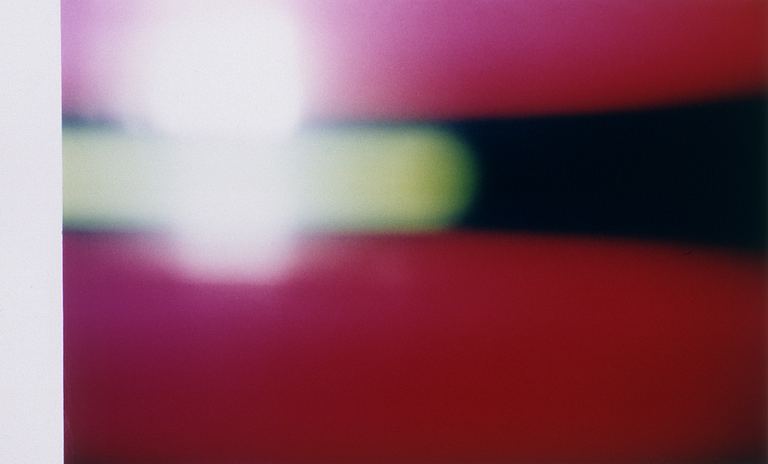
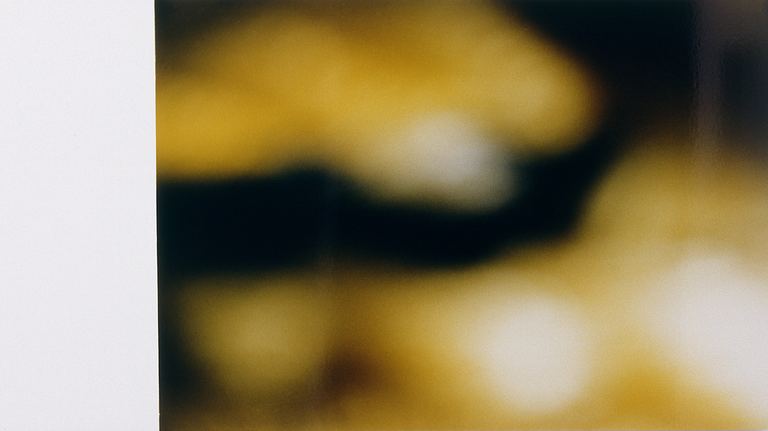
Williams’ photographs are taken spontaneously, and sometimes surreptitiously, with disposable cameras. This approach allows chance to play a role in the creation of image and composition. Williams comments illustrate this nonchalant attitude: “There is no such thing as a bad picture.“² In spite of this seemingly indifferent method of recording images, Williams’ photographs are aesthetic. Her work transforms the banal into the desirable. Can’t Live Without Plastic (1996), for instance, is fourteen photographs which resemble sticky yet desirable lollies trapped within the visual distortions of glass jars. These abstract images are arranged according to a colour spectrum ranging from reds, pinks and oranges to blues, greens and pearl iridescence. Burned white light, blurs, distortions and colour fields dominate. Individual titles such as Strawberry Hart, Pineapple Chunk! and Dreamworld serve as enticing introductions. Other titles such as Pretty in Pink and Untitled, for John Hughes recall popular teen films from the 1980s.
Williams’ strategy of aestheticisation also appears in an untitled pair of photographs shown in 1997 at 1st Floor in Melbourne. They show a repetitive circular pattern characterised by blurs and pixillated forms. White jewel-like circumferences frame deep green pools in a dazzling but bewilderingly familiar image. In an astonishing metamorphosis, Williams has illuminated a domestic scene of upturned wine bottles.
Tony Schwensen’s installations combine paintings and sculptures to embody an idea of suburbia. His strange combinations of elements from the home and garden could be described as dysfunctional - utilitarian objects rendered useless. These constructions allow Schwensen to disturb urban order by eschewing the expectations usually associated with these materials. In addition to these objects, Schwensen often includes paintings. In keeping with his sculptures made out of banal materials, Schwensen’s paintings are invariably made with tarpaulin, plastic, butcher’s paper and even dishcloths.
A good example of this combination of sculptural objects and paintings was Schwensen’s 1996 one-week exhibition at the Art Gallery of New South Wales. Australia A (This is Where We Live), for example, comprised six gestural white and silver paintings, each offering different perspectives from which to view the sculptural works. Although entirely prosaic in manner, these paintings also referred to the tradition of expressionistic painting, frequently characterised as heroic and masculine. Schwensen’s two sculptures Australia A (Shortfall) and Australia A (Regional Presence) deployed signifiers of Australian suburbia. Utilising recognisable elements from the backyard such as wading pools, treated pine logs and car axle jacks, Schwensen’s work engaged with the myth that the suburbs are an idyllic setting. The titles of these works also related to this location, taken from the name of the Australian cricket team.
Schwensen’s arrangement of these very Australian materials does not conform to expectations. The castors in Australia A (Regional Presence), for instance, make the wading pool unsteady, not at all suitable for bathing. At one end of the pool Schwensen has also fixed curved handrails to assist getting in and out. While these would suggest that the pool is deep, they are puzzling when placed on a shallow pool. In addition, the treated pine logs - usually used in the garden to demarcate areas or form a barrier - are elevated by car axle jacks so that they resemble parallel bars in gymnastics.
- Boyd, Robin, The Australian Ugliness, Middlesex, England: Penguin Books, 1960, p.9.
- Artist’s statement made by Justene Williams. See Michael, Linda (ed.) Photography is Dead! Long Live Photography! exhibition catalogue, Museum of Contemporary Art, Sydney, 1996, p.36.