Readings
Yasmin Smith: Forest
Kathryn Weir
Glossopteris,
a giant tree that flourished in Gondwanaland’s swampy forests in the Permian
period, makes up much of Australia’s black coal. Unlike the other plants that
ended up as coal – horsetails, ferns, cycads and others – it has no living
relative and disappeared 250 million years ago at a time when around
90% of earth’s species became extinct following catastrophic volcanic
eruptions that released enough carbon dioxide to trigger a greenhouse crisis and
drastic global warming. The coal deposits that contain Glossopteris’ ancient
forest remains, across what is now Africa,
Australia, India and South America, are today at the centre of another climate
and toxicity crisis.
In her artistic methodology developed since 2014, Yasmin
Smith works with plant ash to make visible what a plant has absorbed in its
lifetime through applying ash glazes to ceramic sculptures. She first
considered working with coal ash when she encountered ash from the coal-powered
steam cranes on Cockatoo Island at the time of the 2018 Sydney Biennial. Ash is
a by-product of burning coal for energy, and through further research Smith
learned of the huge ‘ash dams’ that have been created next to coal power
stations all over Australia, which in turn are built near coal deposits and
mines. Australia
has around a quarter of the world’s coal reserves, and, according to a recent
report on water pollution in NSW, coal ash accounts for a fifth of all of Australia’s
domestic waste. 1
Smith
decided to make visible the composition of the ash from as many coal ash dams
as she could access. Systematically researching dimensions of environmental
science and chemistry, as well as, in the case of this project, of plant palaeontology,
her practice also relies on developing networks of collaborators, who may range
from scientists to activists to industrial workers. It was only though such relationships
that she was finally able to access the ash from 11 power stations from along
the Eastern Australian seaboard and in inland areas of New South Wales,
Victoria and Queensland. These divide into ashes of black and brown
coal, which are coals laid down in different geological periods, from around 300-250
million years ago (black coal), to ‘just’ 66-23 million years ago (brown coal),
all constituting concentrated chemical traces of plant and other organic
materials formed over time into coal-rich rock through sedimentation, compression
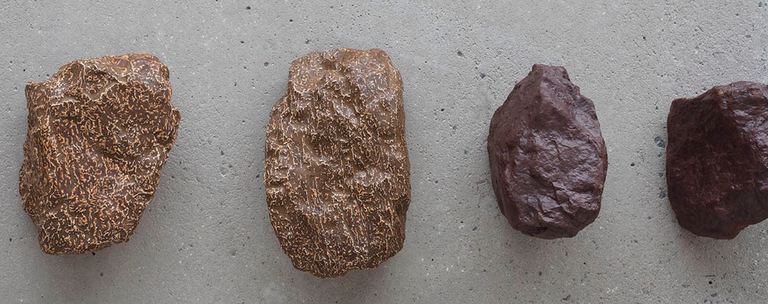
and heat. Brown coal, being more recently formed, retains more organic
materials and the glazes made from brown coal ash are more highly coloured and
textured, showing more plant-like elemental characteristics. Black coal ash
glazes on the other hand are almost white, their light colouring reflecting the
absence of many soluble minerals deriving from organic materials that have
leached away over the longer time frame since the coal was formed.
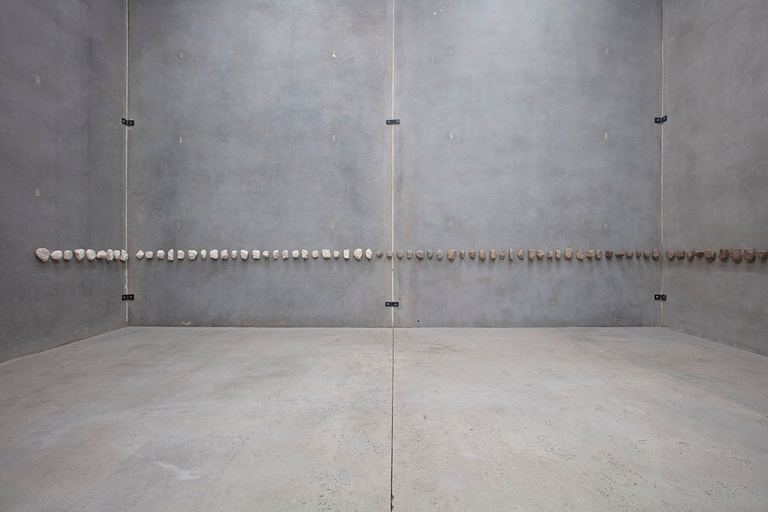
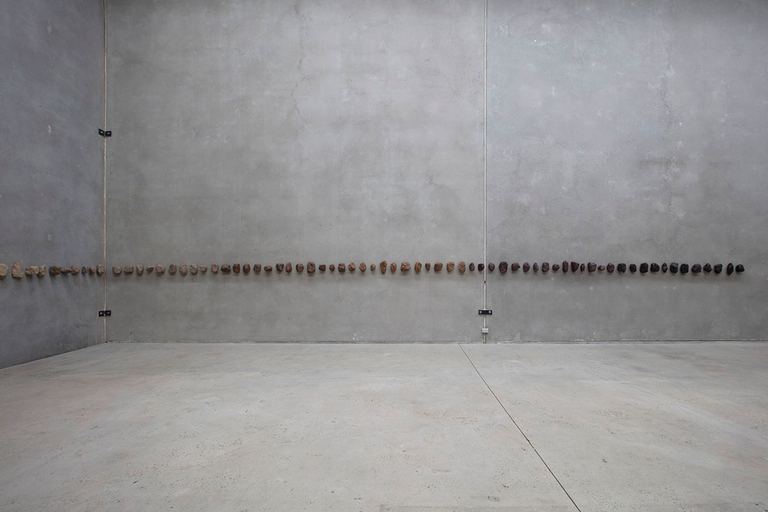
In
the installation, the sculptural elements are arranged in a chronological
horizon line that proceeds from the earliest formed ash materials to the most
recent. The sculptural forms were moulded by Smith from coal lumps that she
selected from a mine south of Sydney, coal in its unprocessed state as it is
extracted from its stratum within the geological layers of the earth. The line of the installation evokes the
stratum of the underground forest transformed into coal, but also the stratum
of ash that began to be visible in the geological record from the 1950s with
the exponential increase in coal burning across all geographies in the wake of
the coal-fired industrial revolution. It also figures as a horizon line beyond
which we cannot see, like the event horizon of a black hole. Temperatures rise
as carbon continues to be emitted from coal-burning industries; coal ash dams
in the marshy areas around coal deposits continue to leak into ground water. Smith
has returned across many bodies of work to industrial and agricultural effluents
that flow into water systems, toxic presences to which her plant ashes testify.
Her most recent major body of work produced in 2021 near Naples in southern
Italy explored the disaster of illegal industrial waste disposal buried in
agricultural fields dubbed the ‘Terra dei Fuochi’. While coal in the ground is not toxic, the
concentration of certain heavy metals in the ash produced by burning coal makes
this coal burning by-product highly toxic. There is potential for greater re-use
of the ash in asphalt, bricks and cement, but if more is not done to remove and
repurpose this material, many tonnes of heavy metals will continue to leach
into the waterways from unlined coal ash dams in coming years.
Smith
speaks of her motivation in creating this work:
‘I’m attempting to
represent a cycle of growth> death> coalification> extraction>
reduction> return. From the Industrial Revolution onward, sections of
humanity have dug vast amounts of coal from the earth leaving voids where
forests once stood. A seam of geological time is removed. We then burn the
ancient forest and resow its ashes back into geological time, returning the ashes
to the earth’s surface and creating a new stratum. The accelerating industrialisation
globally since the 1950s is a likely candidate to mark the entry of humanity
into the geological time-scale, defining the so-called Anthropocene. When
considering the massive, industrialised extraction and use of coal undertaken
by humans since the mid-19th century, as a contributing factor to changes in
earths systems and climate, I think about the morphological changes that this
activity leaves behind; the physical void 300 million years down, where coal
was removed from geological time and the drastic changes to contemporary
terrain to reach those depths. But to officially enter the Anthropocene into
the geological record, evidence of humanity must be defined in geochemical
strata as it is laid down on the earth and contributes to a new geological age.
If you ask what humans contribute to the geological fabric of the earth, the
answer is fly ash from coal combustion. The spectrum of coal ash glazes in Forest present a visual understanding of this geochemical contribution’.
1. Out of the Ashes II: NSW water pollution and our aging coal-fired power stations, Hunter Community Environment Centre, 2020.